
The risks of outsourcing development aren't evenly distributed. Some engineering teams run faster, ship more, and stay leaner by bringing in external talent. Others end up with missed deadlines, brittle codebases, security incidents, and vendors who overpromised from the first call.
What separates those two outcomes usually isn't the decision to outsource — it's often the vendor model they chose and whether it was designed for what they actually needed.
Why Outsourcing Development Feels Risky (and Often Is)
The skepticism around outsourcing is earned. Most experienced engineering leaders have lived through a bad engagement or watched it happen to a peer.
The typical failure pattern looks something like this:
- A company selects a vendor based primarily on rate.
- They sign a project-based contract.
- They gradually lose visibility into what's happening.
- Requirements drift, or communication slows across time zones.
- The team on the other end rotates.
- By the time something is delivered, it's not quite what was scoped, it's late, and it's expensive to maintain.
None of that is inevitable, so why do so many outsourcing engagements fail? Because of structural reasons.
Traditional outsourcing companies are optimized for delivery: Shipping a defined output on time and within budget. They're not optimized for ownership, continuity, or deep integration with your product direction. When those things matter (and they almost always do), a delivery-first model creates friction.
Understanding why these risks emerge is the starting point for avoiding them.
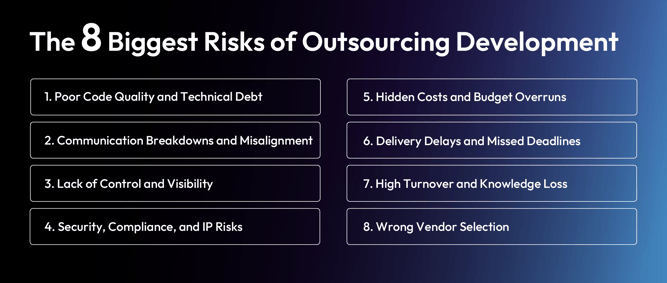
8 Biggest Risks of Outsourcing Development for Companies
The risks of outsourcing development follow predictable patterns, and most of them trace back to the same structural misalignments. Here's what to watch for.
Poor Code Quality and Technical Debt
Code-quality issues are consistently the top complaint from companies that have bad experiences with outsourced software development. According to the Consortium for Information & Software Quality, poor software quality costs US companies at least $2.41 trillion annually, with accumulated technical debt reaching at least $1.52 trillion.
The root cause is usually upstream: weak vetting, overallocated teams, and developers who are optimized to meet sprint milestones rather than build something maintainable.
At most outsourcing agencies, the economics dictate these outcomes. Margins depend on utilization, so engineers are spread thin across multiple clients. Context is shallow, with light quality checks. When something ships with problems, the cost resurfaces in rework cycles, slower velocity, and architectural decisions that are painful to undo.
How do you avoid this? Select an outsourcing partner with rigorous vetting standards and senior-weighted talent, where the engineers working on your product actually have the depth to care about what they're building. Embedded models, where developers work as part of your team over the long term, tend to produce significantly better quality outcomes because the incentives are differently aligned.
Communication Breakdowns and Misalignment
Quality problems often get the headlines. But many outsourcing failures are communication issues that compound quietly until they become too expensive to ignore.
Time zone gaps don't just slow down the work; they also change its very nature. When your feedback loop is asynchronous by default, small misunderstandings compound across sprints. A product decision that would take five minutes to clarify in real time turns into a back-and-forth that spans days. By the time alignment is reached, you've built the wrong thing.
Language barriers add another software outsourcing challenge. Differing communication norms and styles mean that what reads to a U.S.-based product manager as a clear requirement can be viewed very differently on the other side of the world, and vice versa. Neither side is wrong. They just have different defaults.
Time-zone-aligned teams change this dynamic. Real-time overlap means faster decisions, fewer misinterpretations, and a natural feedback rhythm that maps to your existing delivery cadence rather than fighting against it. Embedded models account for this, with developers who overlap with your core hours and integrate into your workflows.
Lack of Control and Visibility
Even when communication is functional, many outsourced engagements suffer from a related problem: loss of control over what's being built until it's too late to course-correct.
"Black box" development — where you hand off a spec and wait for a result — is one of the most frustrating dynamics in any outsourced team arrangement. Progress is unclear, problems surface late, and issues become expensive to fix.
When an external team operates in their own environment with their own processes, they have to deliberately build in visibility — and most vendors don't. The project management layer exists to give status reports, not provide genuine insight into what's happening.
The alternative is engineers who work inside your repos, ticketing tools, and Slack channels. With team members embedded into your infrastructure, control and visibility come naturally. You can see what's being built as it's being built. Surprises become rare because you're not waiting for a handoff to find out where things stand.
Security, Compliance, and IP Risks
Visibility into the development process isn't just about project management. It also has direct implications for data security, your IP, and financial exposure. According to IBM's 2025 Cost of a Data Breach Report, the global average cost of a data breach was $4.44 million in 2025, a decline from 2024 but still a considerable financial hit to endure.
Every third-party relationship expands your attack surface. When you bring in an external development team, you're granting access to your codebase and infrastructure, and oftentimes to sensitive information. If that outsourced team operates in a loosely governed environment, the risk exposure grows quickly.
IP ownership is a related concern that often gets underweighted at the contract stage. Ambiguous agreements about who owns the code, where it can be used, or whether the vendor is subletting work to parties you're unaware of create real legal and operational risk, especially for companies building proprietary technology.
Compliance-aware engineers reduce this exposure significantly. Clear contracts, defined IP clauses, and a partner who doesn't shadow-outsource your work aren't nice-to-haves; they're baseline requirements for any serious engagement.
Hidden Costs and Budget Overruns
Outsourcing frequently ends up being more expensive than expected. This is often less about one big incident and more about the slow accumulation of little problems.
Outsourcing's biggest appeal is often about reducing costs. It works until it doesn't. The headline rate might look attractive, but the total cost of engagement can be higher than expected once you account for scope changes, rework cycles, management overhead, and the ongoing cost of misalignment.
Low-rate vendors accelerate this pattern. Cheap hourly rates suddenly look less affordable when work requires multiple rounds of revision, when your project manager spends 20% of their time clarifying requirements, or when you're onboarding a new rotation of developers every few months because of turnover.
Transparent pricing and long-term efficiency are related. The teams that deliver genuine cost value over time operate with low churn, high alignment, and a deep working relationship that minimizes communication overhead. That's a function of the model, not just the rate.
Delivery Delays and Missed Deadlines
Cost overruns and delivery delays tend to go together, and for the same underlying reasons.
Outsourcing failures are often described as quality failures, but many are actually scheduling failures. Timelines slip, milestones are missed, and the root cause is the same structural issues: asynchronous communication that slows decisions, scope drift that accumulates unnoticed, and a handoff model that creates lag at every transition point.
When developers are disconnected from your delivery cadence, every point of integration is a potential delay. The farther apart the outsourced team is from how you actually work, the faster coordination overhead accrues.
By contrast, engineers who integrate into your delivery cadence eliminate the handoff delay that causes most of the scheduling slippage. There's no transition layer to manage because there isn't a separate process to translate.
High Turnover and Knowledge Loss
Delays are painful in the short term. Turnover creates a different kind of damage that compounds over the life of an engagement.
Agency and project-based vendor models have an inherent turnover problem. Developers get allocated to engagements and get rotated when the project winds down — or sometimes simply because the agency needs them elsewhere. From your perspective, continuity is a priority. From the vendor's perspective, it's a constraint.
The practical cost is significant. Every time a developer rotates off your project, they take institutional knowledge with them, along with their understanding of your architecture, edge cases, and context about why decisions were made. Onboarding the next team members takes weeks, which reduces velocity and increases error rates.
High retention is a product-quality benefit, not just a cultural one. Teams with long-term continuity build better software because they understand what they're building. That's especially true for complex systems where context accumulates over time and is genuinely hard to document.
Wrong Vendor Selection
Most of the aforementioned risks emerge during an engagement. This one happens before it starts, after companies decide on staff augmentation or project outsourcing.
The vendor selection process accounts for a significant share of outsourcing failures — long before any code gets written. Companies overindex on rate, take portfolio claims at face value, and skip the vetting that would surface whether a vendor's team can actually handle the work.
Common selection mistakes include: Choosing based on price alone, skipping technical interviews with developers who will work on your project, ignoring cultural and communication compatibility, and failing to define a trial phase that would surface misalignment before it's expensive to address.
Effective risk management at the vendor selection stage prevents many of the biggest challenges. Here are five questions worth asking before you sign anything:
- Are you vetting individual engineers, not just the agency's reputation?
- Do the developers' skills map to your specific stack and domain?
- Is there real overlap between your working hours and theirs?
- Does the contract define IP ownership, security responsibilities, and what happens if the team changes?
- Is there a defined governance structure (milestones, escalation paths, quality benchmarks)?
Partners built for long-term, embedded work tend to welcome this scrutiny. Vendors that resist are telling you something else.
The Real Problem: Traditional Outsourcing Models
These challenges are interconnected symptoms of the same underlying structural issue: Project-based outsourcing with a vendor that's optimized for delivery over ownership.
That model made more sense when software development projects were more discrete, with stable requirements and a primary goal of shipping on time.
Modern software development doesn't look like that. Products are continuous. Teams need to simultaneously move fast and maintain quality. The best software development outsourcing companies understand your product deeply, rather than simply executing against a spec.
Vendors that operate on a delivery-first, project-based model are structurally misaligned with what high-performing engineering teams actually need. The resulting risks are features, not bugs.
Because the risks are structural, so are the fixes. If you're evaluating an outsourcing partner or revisiting a relationship that isn't working, here's where to focus:
- Choose an embedded model over a project-based one.
- Vet individual engineers, not just vendor portfolios.
- Prioritize retention; ask directly about average developer tenure on client engagements.
- Align time zones to enable real-time collaboration.
- Require transparency: bring developers inside your systems, not alongside them.
- Define governance upfront by determining milestones, escalation paths, IP ownership, and security requirements.
These steps aren't complicated. But most vendors in the market rely on a model that doesn't support them. The benefits of outsourcing are real, but they only materialize with the right model.
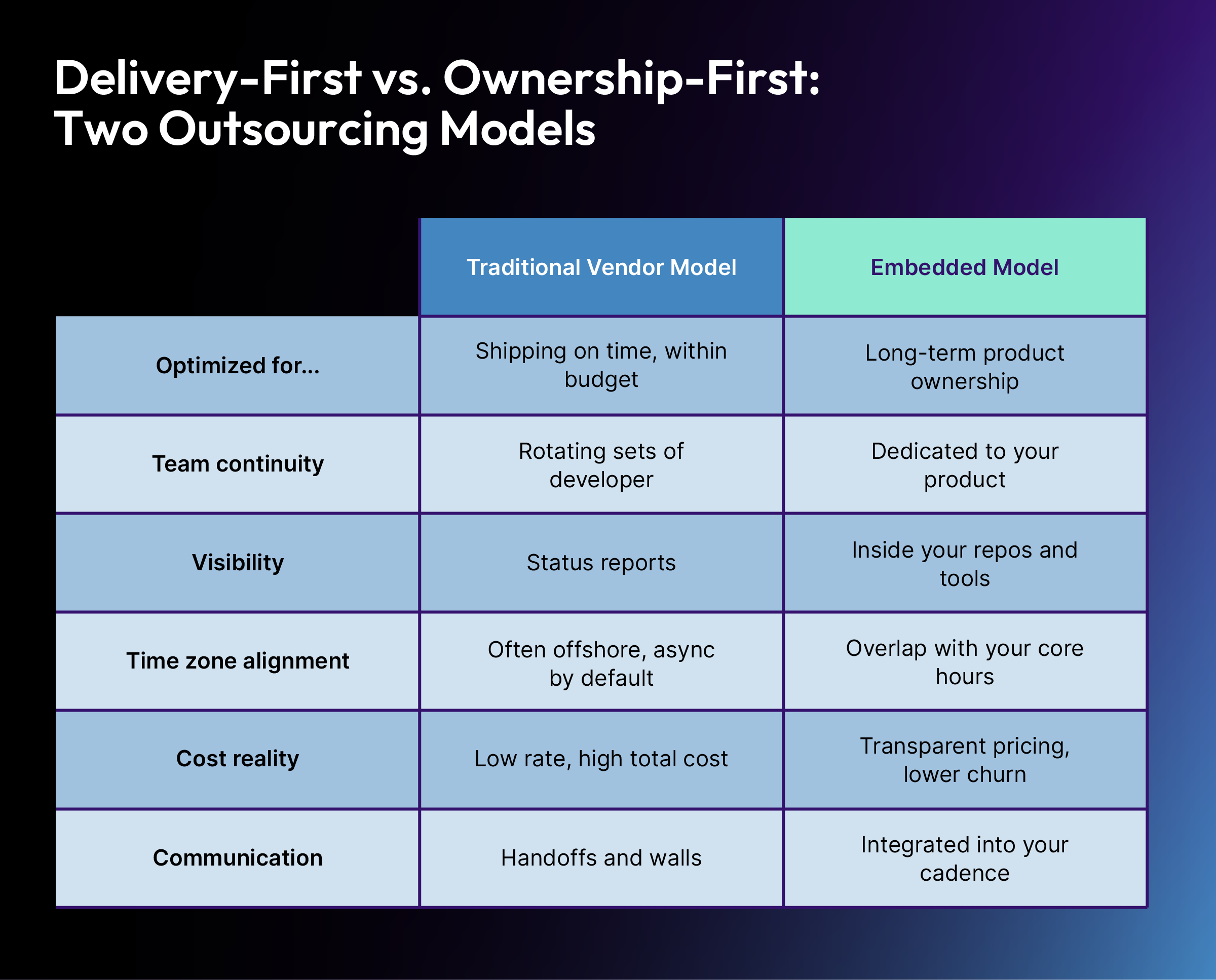
How X-Team Removes the Risks of Outsourcing Development for Companies
X-Team places elite engineers who are assessed not just on technical depth, but also on communication and the kind of long-term ownership mindset that makes embedded work successful. You get developers who focus on your product, rather than rotating among five other clients.
For companies that have had bad outsourcing experiences, the difference usually isn't immediately obvious on paper. It shows up in the first few weeks — how quickly the team integrates, the quality of the first few PRs, and whether you feel like you have a real team versus a contractor relationship.
The outsourcing development risks for companies are real, but they're less about outsourcing and more about using the wrong model. The right partner builds differently.
Connect with X-Team to explore what an embedded model looks like for your engineering team.
SHARE: