
Most conversations about outsourcing custom software development start in the wrong place. Leaders open with cost — how much can we save, how quickly can we staff up — and end up with exactly the teams they deserve: transactional, disengaged, and gone the moment a better contract comes along.
Outsourcing custom software development is a capability decision before it is a cost decision. The companies that get it right use it to access engineering depth their local market can't supply, compress timelines that would otherwise slip a product launch by a quarter, and free their internal engineers to stay focused on the work only institutional knowledge can solve. Done well, it doesn't feel like outsourcing at all. It functions like a natural extension of your development team.
Getting there requires a very different approach than calling a vendor and asking for headcount. The model matters. The risks are specific and preventable. The difference between a development partner and a staffing body shop is legible — if you know what to look for.
6 Benefits of Outsourcing Custom Software Development
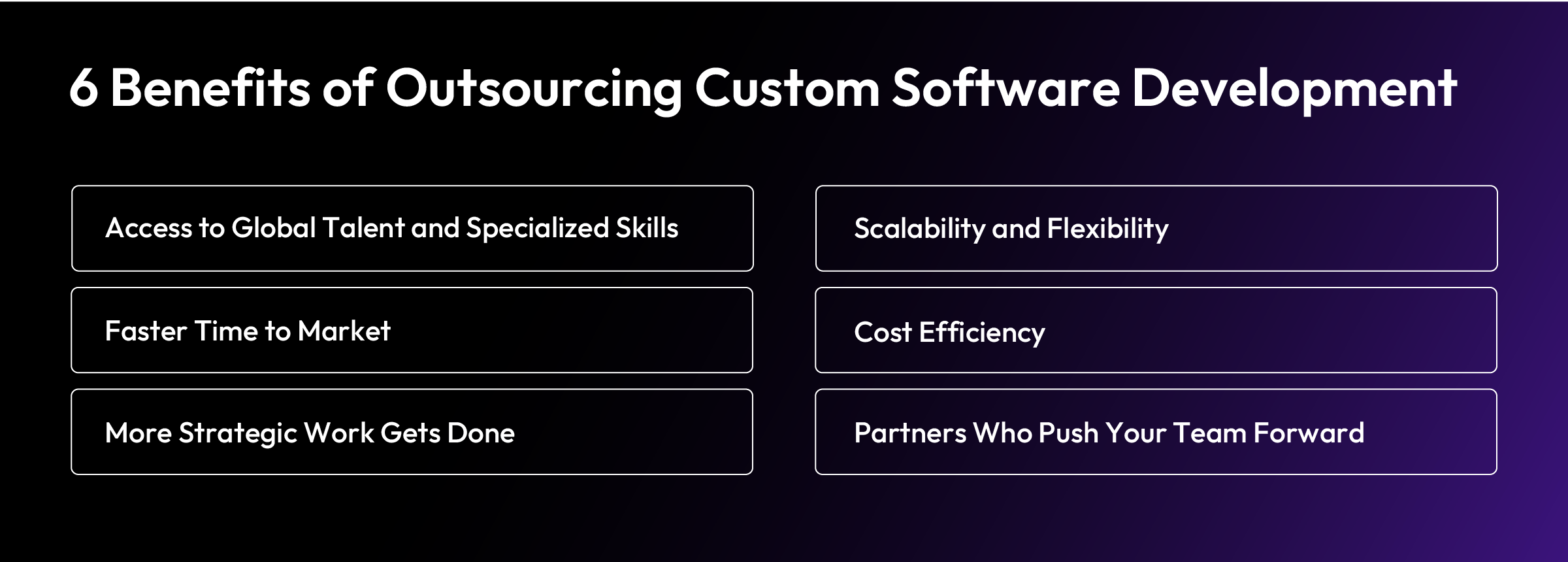
The case for outsourcing custom software development isn't primarily about cost. It's about what becomes possible when engineering capacity stops being a bottleneck. Custom software development is the fastest-growing segment of the outsourcing market, expanding at 22.6% annually according to Grand View Research (more than double the rate of the broader IT services market). That growth reflects what leaders are actually experiencing when outsourcing works.
Access to Global Talent and Specialized Skills
For the first time, access to specialized talent has overtaken cost reduction as the top driver of outsourcing decisions. Deloitte's 2024 Global Outsourcing Survey found that 42% of executives cite talent access as their primary reason for outsourcing, ahead of the cost savings that dominated the conversation a decade ago. Stack specializations, compliance domain expertise, AI/ML fluency — these are the roles that take months to fill through traditional hiring when they can be filled at all. Outsourcing gives you access to a global talent pool that breaks that constraint. The skills exist; the question is whether you have the infrastructure to access and integrate them.
Faster Time to Market
Speed is one of the most frequently cited benefits of software development outsourcing services. It's also one of the most frequently misunderstood. External teams don't make disorganized software projects faster. They make structured ones faster. The gains come from alignment on project requirements, tooling, and communication cadence from day one, not from adding headcount to a vague brief. A larger outsourcing team working from unclear requirements ships slower, not faster.
More Strategic Work Gets Done
The right outsourcing relationship doesn't free your team from important work. It multiplies how much of it you can take on. When you embed elite engineers who ramp quickly and operate at a senior level, you're not offloading overflow. You're expanding your team's capacity to run more meaningful initiatives in parallel. Penske Media Corporation — publisher of Rolling Stone, Variety, and Billboard — used this model to accelerate key product initiatives while keeping internal engineers focused on platform strategy. The result wasn't that less important work got done. More did. The mechanics of building that kind of capacity whilescaling your development team are worth thinking through early.
Scalability and Flexibility
Demand for engineering capacity rarely arrives on schedule. Outsourcing allows you to scale up for a major launch and contract after it ships without the lag of a full hiring cycle or the severance exposure of a layoff. The ability to match capacity to demand without the friction of traditional headcount decisions is one of the structural advantages that makes a hybrid model worth building: a strong in-house team at the core, with external capacity when the roadmap demands it.
Cost Efficiency
Cost savings are real, but they're not the right starting point. A 2024 ISG Market Lens BPO Study, which surveyed nearly 400 business leaders globally, found that outsourcing programs deliver an average of 15% savings over in-house operations. But the companies that get the best outcomes treat it as a quality investment, not a discount. Wipfli's 2024 Outsourcing Trends Report, based on a survey of 360 C-suite leaders, found that 93% of organizations that outsourced reported a positive experience, citing time savings, cost savings, and improved focus on strategic work. The ones that didn't are usually the ones that optimized for the lowest hourly rate.
Partners Who Push Your Team Forward
Deloitte's 2024 Global Outsourcing Survey found that 83% of executives now use AI as part of their outsourced services. The best outsourcing partners aren't just completing tickets faster; they bring approaches and fluencies your in-house development team may not have developed yet. A well-matched outsourcing relationship runs as a two-way knowledge transfer, not a one-directional execution pipeline.
Models of Custom Software Development Outsourcing
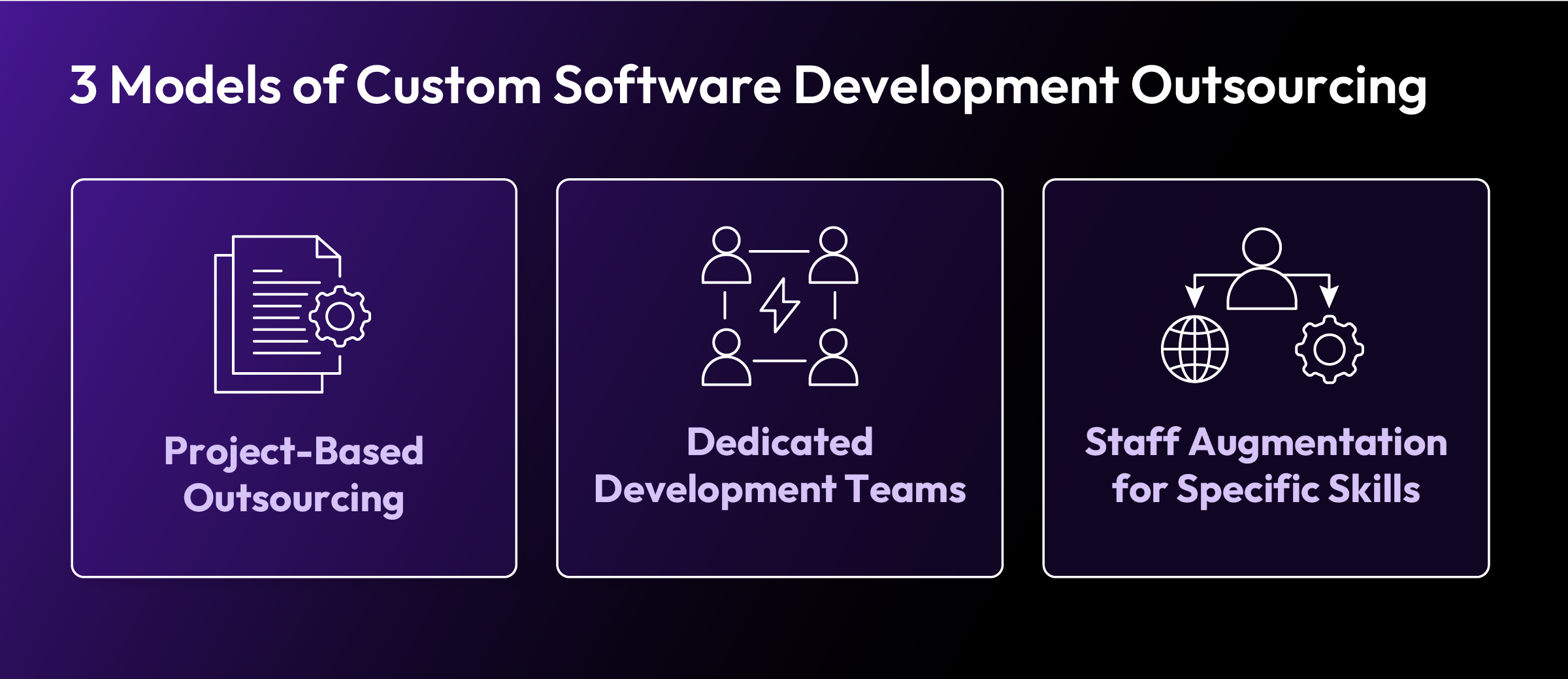
Not every engagement model fits every situation. Picking the wrong one is the most common structural mistake teams make. Three variables determine what you actually need: how stable your project requirements are, how strong your internal technical leadership is, and how long you need the relationship to last. Get those right before you talk to a vendor.
Project-Based Outsourcing
The vendor takes full ownership from discovery through deployment. You define the outcome; they own the path. When requirements are fixed, timelines are defined, and the deliverable matters more than the ongoing relationship, this model works well. When scope shifts — and it usually does — change orders get expensive fast. Incentive structures between you and the vendor diverge the moment requirements move. If your definition of done is likely to evolve, this model will punish you for it.
Dedicated Development Teams
A team allocated exclusively to your software development projects, operating as an extension of your engineering org. Engineers build product knowledge, align to your processes, and compound in value over time. The vendor typically handles project management overhead. For complex, long-term application development where institutional knowledge is a competitive asset, this is the highest-performing model available. Minimum viable commitment: six months. It pays off most clearly at twelve or more.
The performance gap is measurable. X-Team's AI Talent Readiness study — a survey of 324 U.S. technology and business leaders — found that organizations using embedded, longer-term partner teams show 85% strong value capture and 77% tracking outcomes, compared to 42% and 47% for internal-only approaches. How you structure engineering capacity predicts what you get from it. The tradeoffs between all three models are worth mapping before you commit — staff augmentation vs project outsourcing goes deeper on the decision criteria.
Staff Augmentation for Specific Skills
Individual contributors or small teams slot into your existing structure to fill bounded skill gaps in software engineering. You retain full directional control; augmented engineers execute against your standards. This model only works when you have strong internal technical leadership — someone who can onboard, direct, and integrate external contributors without that becoming a second job. If that person doesn't exist or doesn't have the bandwidth, staff augmentation creates drag rather than removing it.
Common Risks and How to Mitigate Them
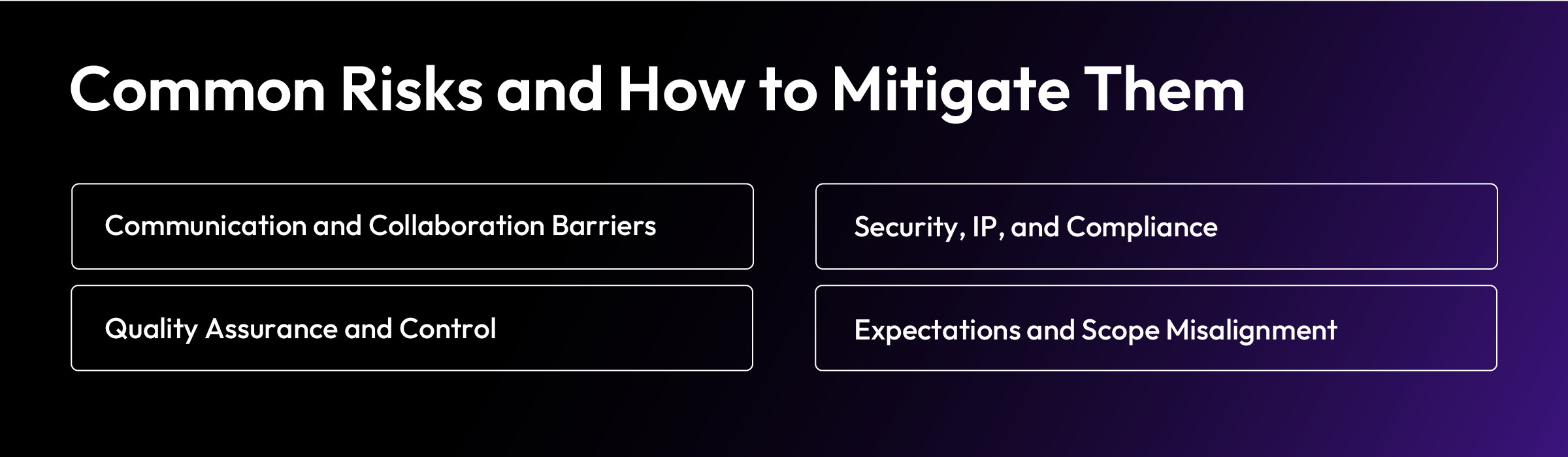
Outsourcing engagements fail in predictable ways. The software outsourcing challenges that sink projects aren't random. They show up at the same pressure points, for the same structural reasons, every time.
Communication and Collaboration Barriers
Vague requirements and missing context cause rework before a software project gets off the ground. When communication defaults to ad hoc Slack threads instead of structured rituals, critical decisions get buried. Your outsourcing team starts guessing instead of asking, and by the time the misalignment surfaces, sprints have been wasted.
The fix isn't adding another meeting. It's building deliberate cadence from day one: shared tooling across internal and external teams, external contributors included in planning sessions not just sprint ceremonies, and time zone overlap planned deliberately rather than worked around. The signal that something is already off: your external team is waiting on one person internally to unblock everything, and work stalls when that person isn't available.
Quality Assurance and Control
Quality problems in outsourced builds rarely start at the code level. They start at the process level — no iterative feedback loops, code review standards that apply to your engineers but not theirs, testing that happens at final delivery instead of throughout. Features ship on time and miss the point.
Adopt Agile or Kanban with real feedback rhythm: sprint demos where output is actually evaluated, continuous testing throughout development, and code review standards identical for outsourced and internal contributors. If you wouldn't accept a pull request from your own engineer without review, don't accept one from an outsourced development team without it.
Security, IP, and Compliance
IP protection is the most underengineered part of most outsourcing agreements. The minimum for any engagement involving proprietary code or sensitive data: ISO 27001 or SOC 2 Type II certification from vendors, a Secure SDLC with automated SAST scanning in the CI/CD pipeline, MFA and IP allowlisting for repository access, and IP ownership defined explicitly in the contract — not in a handshake or a terms document neither party will read again.
One risk that gets missed consistently: audit whether your vendor subcontracts work. If they do, confirm that security obligations flow to subcontractors with the same specificity as they appear in your primary agreement.
Expectations and Scope Misalignment
Scope creep and weak change control turn fixed-price software projects into relationship disasters. "Small tweaks" accumulate until the original estimate is meaningless. Your outsourcing partner resents unpaid work. You resent paying for what you assumed was included. And by the time either side says something, the trust is already gone.
Lock shared understanding in writing before development starts: what's in scope, what's deferred, what triggers a change request. Then build scope checkpoints into the engagement structure throughout, not just at final delivery. The cost of a conversation at sprint three is a fraction of what it costs at launch.
How to Outsource Custom Software Development
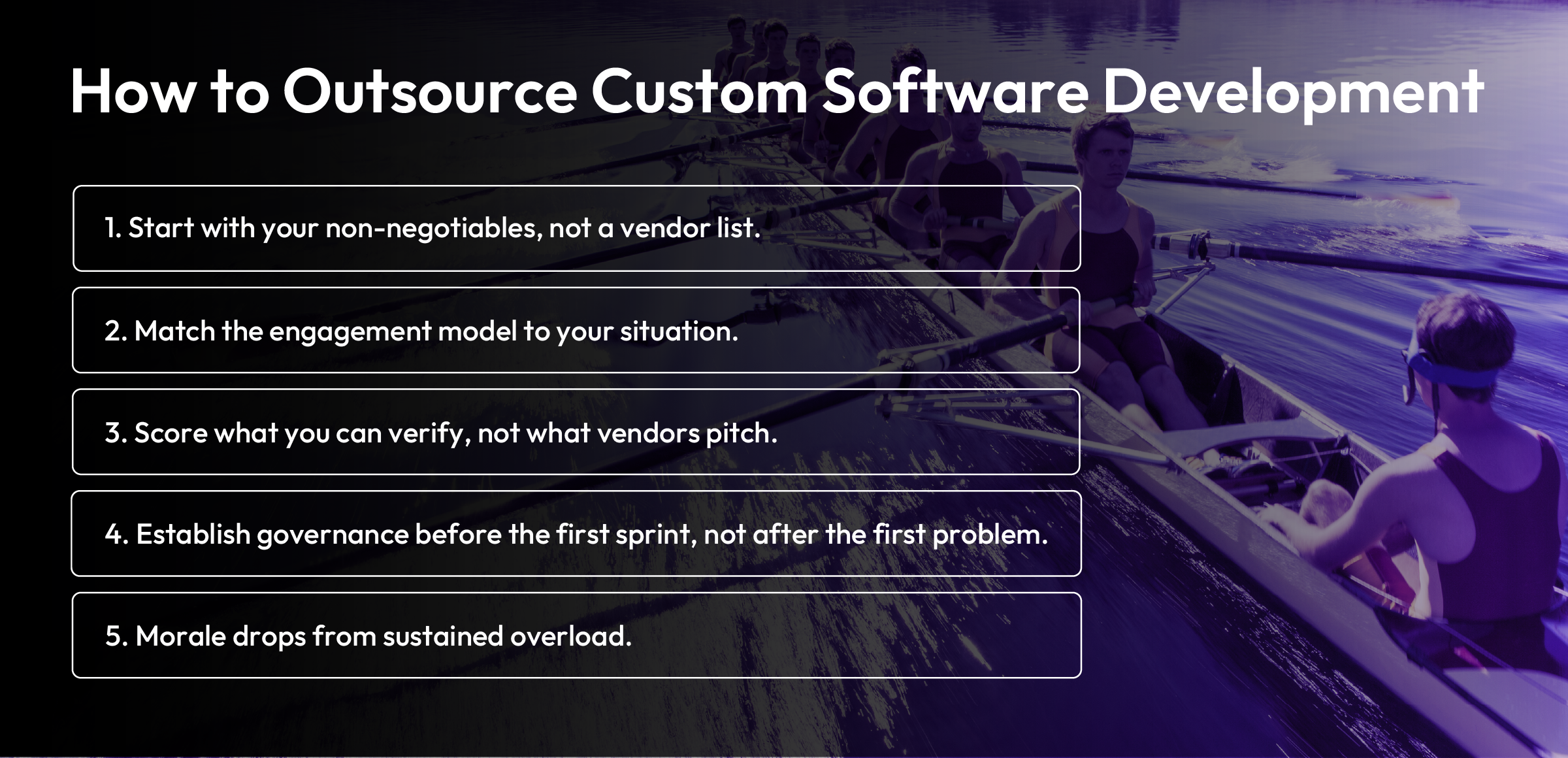
Most outsourcing guidance stops at the decision to outsource. The engagement structure, the vendor selection process, the first two weeks of execution — these are where projects succeed or fail. Here's how the teams that get it right approach each stage.
Start with your non-negotiables, not a vendor list. Write down internally what success requires before you talk to anyone: onboarding speed, security standards, communication cadence, retention history. Without that internal alignment, every ambiguity in the evaluation process gets resolved by whoever is most persuasive in the room.
Match the engagement model to your situation. Revisit the three-variable framework: requirements stability, internal technical leadership strength, and relationship duration. The wrong model will underperform regardless of the vendor's quality. The most common mistake is defaulting to staff augmentation because it feels lower-commitment, then being surprised when a long-term software development project produces inconsistent results because no one owned continuity.
Score what you can verify, not what vendors pitch. Onboarding documentation, communication norms, compliance certifications, client retention history — these are observable. Shortlist to two or three finalists, not ten. Run a structured pilot of one to three months to test the vendor's operating model, not just the individual developers they place on your project. Decide on data, not gut feel. Red flags worth naming: technical depth in your specific stack matters more than breadth across everything; ask about prior work with fintech developers, game development teams, and high-growth SaaS companies, and push for specifics. Pay attention to how vendors behave during the sales process — development partners who surface risks during scoping are showing you how they'll behave during delivery. Ask for retention data. If a vendor doesn't track it, that's an answer.
Establish governance before the first sprint, not after the first problem. Define meeting cadence, escalation paths, and async norms on day one. Teams that skip this spend months retrofitting process into engagements that have already accumulated technical and organizational debt.
Invest in onboarding and monitor quality continuously. The first two weeks set the trajectory for the next six months. Engineers who understand your product vision and architectural reasoning make better independent decisions throughout. Engineers who only understand their tickets make locally correct decisions that are globally incoherent. Once the engagement is running, surface problems early: automated test coverage, code review in CI, sprint demos catch defects when they're cheap to fix. Final-stage review catches them when they're not.
For a complete vendor evaluation framework — including a scoring rubric and the questions that surface operational reality rather than sales positioning — download the X-Team Buyer's Guide.

How X-Team Supports Outsourcing Custom Software Development
For 20 years, X-Team has provided on-demand elite tech talent to world-leading brands across gaming, media and broadcasting, fintech, and high-growth SaaS. The model isn't placement-and-walk-away. It's embedded software engineering built around the factors that actually predict outcomes: rigorous vetting for technical and cultural fit, retention rates the industry benchmarks against, and integration into your team's workflows and standards.
Learn more about X-Team's custom software development solutions.
SHARE: