
Figuring out how to hire offshore software developers is, for many engineering leaders, less of a talent search and more of a post-mortem waiting to happen. The engagement gets stood up fast, the hourly rates look great, and six months later the codebase is a mess and nobody can explain why.
The failure gets attributed to offshore hiring, but the actual cause was often everything that happened before the first developer logged in — the model choice, the project brief, the onboarding that never happened, the internal owner who was too stretched to actually own anything.
Top Delivery Models for Hiring Offshore Developers in 2026
"Offshore" gets used loosely, and the imprecision causes real problems. Geography matters less than the engagement structure — and the structure defines who owns quality, who manages performance, and what happens when things go wrong.
There are four primary models:
- Freelancers. Individuals sourced through marketplaces like Upwork or Toptal. Fast to engage, high quality variance, limited continuity. The right tool for isolated tasks or burst capacity — not for engineers who need to be embedded in your codebase past a sprint or two.
- Agencies and development shops. You define an outcome, a third party delivers it. Works for well-scoped, stable deliverables. Breaks when requirements evolve, because the agency's incentives and your engineering team's incentives stop aligning once scope shifts.
- Staff augmentation and embedded teams. Engineers who join your team directly — your tools, your standups, your sprint cadence, no employment overhead. For companies that need a dedicated development team without the overhead of standing one up internally, this is the model that delivers. It's grown most over the last decade because it delivers flexibility without sacrificing integration — and at its best, it functions like an offshore software development team that's genuinely yours.
- Offshore development centers and build-operate-transfer. Long-horizon structures where you establish a dedicated team in another country with the intent to eventually internalize it. High setup cost, significant governance overhead, suited for multi-year offshore commitments.
Setting up the right model is the first decision you make. It shapes every decision that follows.
4 Common Offshore Engagement Models
When You Should (and Shouldn't) Hire Offshore Developers
The case for offshore is clearest in three situations.
- You need to scale faster than local hiring allows. Senior engineering roles routinely sit open for three to six months at mid-market and enterprise companies. According to X-Team's 2026 AI Talent Readiness Report, half of leaders who say they're confident in their ability to source AI talent can't actually staff an AI squad within 90 days. The bottleneck usually isn't the talent market — it's the internal operating model. A good offshore partner compresses that timeline to weeks.
- You need skills your local market can't supply. Strong Rust engineers, ML infrastructure specialists, embedded systems developers with specific hardware experience — these roles are hard to fill anywhere. Global talent pools are materially deeper.
- Local hiring is prohibitively expensive. Senior software engineers in San Francisco run $200,000 to $280,000 in total compensation. The same seniority in Eastern Europe or Latin America typically costs $60,000 to $100,000, without meaningful quality trade-offs, depending on the role and the vetting process behind it.
There are also situations where offshore is the wrong tool.
- When requirements aren't defined. Offshore arrangements amplify ambiguity into cost overruns. Adding offshore engineers before your in-house team knows what it's building creates more confusion, not more capacity.
- When no one internally owns the relationship. Offshore teams don't self-manage. They need a counterpart on your side with context, authority, and time. Without that person, the engagement underperforms regardless of talent quality.
- When you expect set-and-forget. The offshore teams that work are treated like real team members — context, feedback loops, genuine integration into planning. Treating them as a cost center you review from a distance is a reliable path to mediocre output.
What AI-Capable Actually Means for an Offshore Hire in 2026
The hiring bar for offshore engineers has shifted. In 2023, "senior backend developer" was a legible description. In 2026, the question underneath it is: can this engineer operate above AI-assisted output?
AI tools have raised the productive floor. Copilot, Cursor, and Claude write boilerplate, generate unit tests, and produce working first drafts of most standard features. A developer whose ceiling is "AI-assisted CRUD" is now commodity capacity. What you're actually hiring for is the judgment layer on top of the tools.
The capability profile that matters in 2026:
-
Eval and test design. Can they build evaluation harnesses for non-deterministic systems — not just unit tests for deterministic code? This is the #1 skill gap in AI-era engineering and almost no vendor vetting process tests for it.
-
AI code review. AI tools generate plausible-looking code that contains real bugs — hallucinated methods, incorrect assumptions, subtle logic errors that pass linting. Reviewing that output with genuine skepticism is now a core senior-engineer skill.
-
Agent orchestration. Comfort with multi-step agentic workflows, tool use, failure modes, and retry logic. Engineers who understand how and when agents break are disproportionately valuable right now.
-
Context engineering. Knowing when and how to use RAG, embeddings, and retrieval — and critically, when not to. The engineers who default to vector stores for every problem create systems as fragile as the ones that avoid them entirely.
-
Cost and latency awareness. The unit economics of an LLM call at scale aren't intuitive. Engineers who have never shipped a production AI feature will make architecture decisions that look fine in staging and become budget problems in production.
How to Hire Offshore Software Developers: Step-by-Step
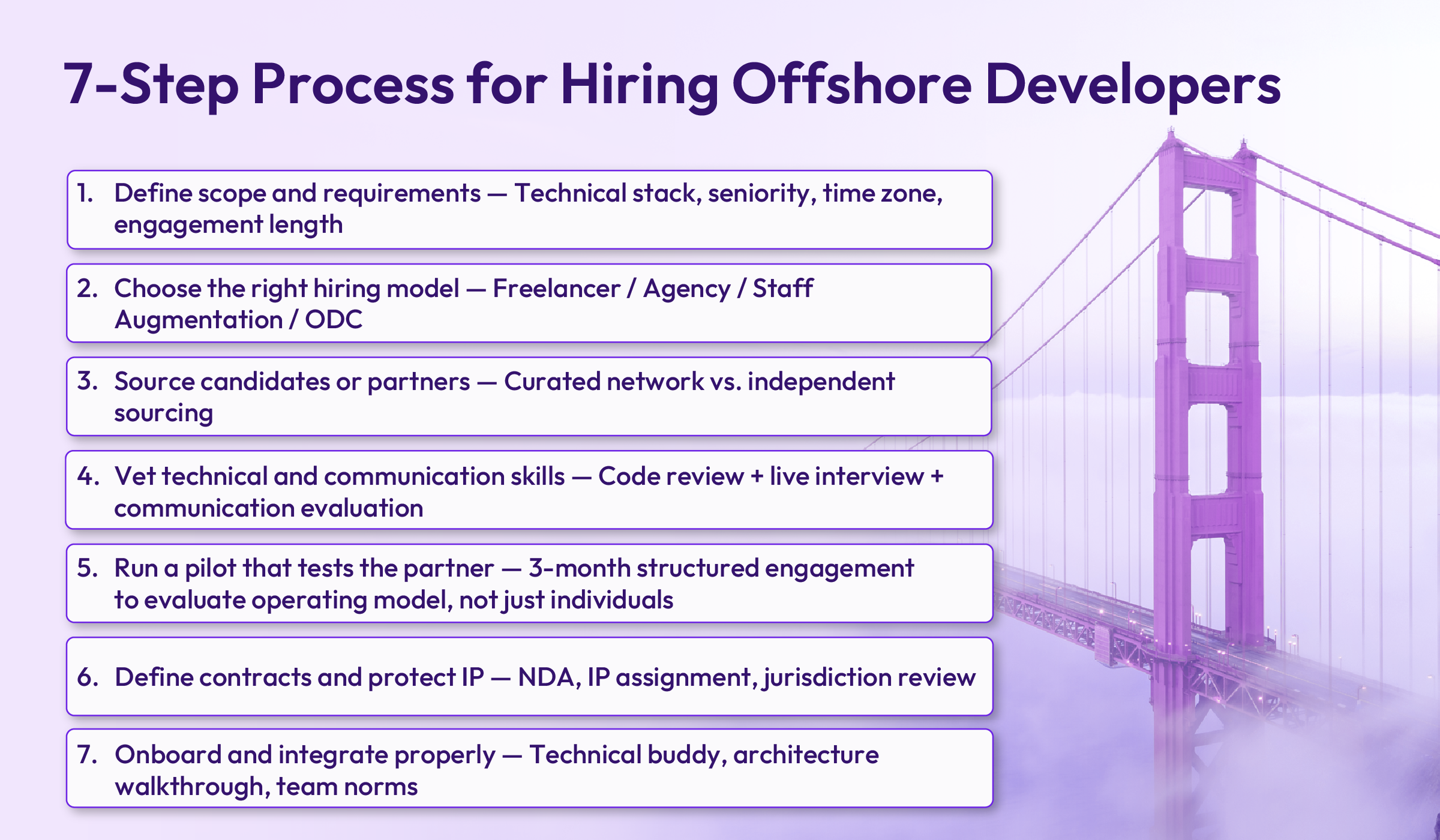
Finding the best fit offshore software developers for your needs requires a methodical process.
Step 1: Define Your Scope and Requirements
The specificity of your brief determines the quality of your candidate pool. "We need backend engineers" is unusable. "Two senior engineers with Python and AWS experience to own our data pipeline migration over the next six months, working CET hours, integrated into our existing team" gives a vendor something to work with.
Define the technical stack, including your primary programming language and frameworks, seniority level, functional ownership, time zone requirements, project management tooling, engagement length, and whether you're augmenting an existing team or standing something up from scratch. Precision here saves weeks of filtering the wrong candidates later.
Step 2: Choose the Right Hiring Model
Match the model to the engagement. Long-term embedded engineers: IT staff augmentation services. Discrete project with stable, defined requirements: an agency model may fit. Multi-year offshore investment: consider an ODC structure.
Choosing the wrong model creates structural problems no amount of good management can fix. The offshore staff augmentation model carries a very different risk profile than a fixed-scope agency arrangement — conflating the two is where a lot of engagements unravel. If you're weighing the agency route, understand the full range of offshore software development structures before committing to one.
Step 3: Source Candidates or Partners
Independent sourcing works but is time-intensive. You'll post, filter high volumes of applications, and run your own technical screens — which requires someone on your team with the bandwidth and skill to do it well. Curated networks and staff augmentation firms handle most of that overhead and often have access to talent not actively on job boards.
The trade-off: your candidate pool is pre-filtered by someone else's criteria. The quality of their process directly determines your outcomes. The best firms give you access to top talent with years of experience who aren't actively posting on job boards — but only if their vetting process is actually rigorous. When evaluating offshore outsourcing software development companies, vet the vetting process, not just the portfolio.
Step 4: Vet Technical and Communication Skills
Technical ability is table stakes. What separates good offshore hires from poor ones is almost always communication: clarity under ambiguity, proactive problem flagging, the ability to push back on a requirement when something doesn't add up.
Design your evaluation to surface both. Ask at least one question requiring the candidate to explain a technical decision they'd make under constraint, or describe a time they pushed back on a requirement. You're looking for independent judgment, not execution compliance.
Take-homes that can be one-shotted by Claude are a worthless signal. The evaluation protocol that works is a live exercise where the candidate uses AI tools openly and you evaluate the quality of their direction — how they frame the problem, what they ask the model, whether they catch the errors the model introduces. A strong candidate challenges the output. A weak one accepts it.
Step 5: Run a Pilot That Tests the Partner, Not Just the Developers
The goal in running your pilot isn't to evaluate specific developers — it's to test how well the vendor's operating model works with your team. A three-month structured pilot gives you enough runway to evaluate communication structure, onboarding quality, and what happens when something goes wrong.
Watch out for "free trial" arrangements that place specific developers on your projects. Those tell you about the individuals. They tell you almost nothing about the partner's ability to support, sustain, and staff an engagement over time — which is what you're actually buying.
Step 6: Define Contracts and Protect IP
NDA, IP assignment clause (all work product transfers to your company), clear termination provisions. If you're working with engineers across multiple jurisdictions, get counsel to review — what holds in Germany may not hold in Ukraine.
When evaluating the best countries to outsource software development, legal infrastructure and IP enforcement belong on the checklist alongside cost and time zone.
Step 7: Onboard and Integrate Properly
Onboarding is the highest-leverage investment you'll make in an offshore engagement — and the most consistently underestimated. Engineers who understand your codebase, your architecture decisions, your deployment pipeline, and your team norms produce meaningfully better work, faster.
Assign a technical buddy. Walk them through the architecture. Give them context on decisions that weren't obvious.
6 Common Mistakes When Hiring Offshore Developers
Most offshore engagements that fail do so predictably. The same patterns show up across industries and company sizes.
- Hiring on rate, not fit. The lowest-cost option consistently costs more in rework, delay, and management overhead than a marginally higher rate for the right match. Cost is one input. It's not the decision.
- Interviewing vendors before you have internal alignment. Scheduling vendor conversations before your own stakeholders have agreed on priorities creates a messy selection process and a weak brief. Get consensus first.
- Evaluating developers instead of the partner behind them. A pilot that tests specific developer performance tells you almost nothing useful. What you're actually evaluating is the vendor's operating model — their communication structure, onboarding process, and what happens when something breaks down. None of that surfaces in a two-week developer demo.
- No internal owner. Every offshore engagement needs a counterpart on your side with authority, context, and time. Without that person, the engagement drifts — and nobody can explain exactly why.
- Treating onboarding as overhead. Remote developers who don't understand your architecture or communication norms will default to their own. That's not a developer failure. It's a process failure.
- Ignoring retention risk. If the partner's engineers rotate frequently, you're spending more time re-onboarding than shipping. Ask for annual retention rates on client engagements before you sign. Strong partners have the number ready. In AI-augmented teams, this matters more than it ever has: when an engineer leaves, they take not just codebase familiarity but the prompt calibration, eval tuning, and domain-specific model context they've built over months — none of which transfers cleanly through documentation.
8 Qualities to Look for in an Offshore Development Partner
Choosing a partner is a different evaluation than choosing individual engineers. You're assessing a system: how they source, how they vet, how they support engagements, and what happens when things go wrong.
Before you talk to a single vendor, define your non-negotiables — the criteria that are must-haves versus trade-offs. Onboarding speed, security posture, communication structure, time zone overlap. Agree on them internally. Then hold every vendor to the same standard, on the same criteria, rather than letting each pitch reset the comparison.
Keep your shortlist to two or three finalists. A longer list feels thorough but prevents you from evaluating any of them with the depth the decision deserves.
The criteria that actually predict performance:
- Vetting quality. Don't accept "rigorous process" as an answer. Ask what the technical screen includes, who conducts it, and what the acceptance rate is. A partner with real vetting gives concrete answers. One without it gives vague ones.
- Seniority definition. Most partners sell senior talent and deliver mid-level. Ask what percentage of active engineers on client engagements are senior versus mid or junior — and how seniority is defined and measured.
- Retention rates. This is the number most vendors don't volunteer. High turnover means your "dedicated" engagement isn't stable — it's a rotating cast with a consistent name. Ask for annual figures on client engagements.
- Time-zone overlap. Define your minimum upfront. If your process depends on synchronous collaboration, two to four hours of daily overlap is a floor, not a preference.
- Security and compliance posture. SOC 2 certification, access control policies, incident response procedures. For fintech, healthtech, and media companies handling sensitive data, these are prerequisites.
- Communication structure. How do you talk directly with the engineers? Who's the escalation path when something goes wrong? Is there a dedicated client partner on the vendor side, or are you emailing a shared inbox?
- Ability to scale. If you need three more engineers in 60 days, can they do it, and where does the talent come from? A shallow bench leads to quality compromises under pressure.
- Industry experience. A team that has shipped fintech products understands compliance constraints a generalist team doesn't. Domain familiarity shortens the ramp and prevents decisions that look right technically but create problems downstream. Ask for case studies from engagements in your space — not just the headline logos.
A few questions worth asking every vendor: How do you maintain coverage during vacations and turnover? What's the escalation path when there's a problem with a placed engineer? Walk us through a recent client onboarding — what did that look like in practice?
You're not just selecting where your next developers come from. You're selecting the organization that will represent your delivery standards, every day.
How X-Team Helps You Hire Elite Offshore Developers
X-Team engineers embed directly into your team — your tools, your standups, your sprint cadence. Not contractors you manage from arm's length. Engineers built to work with your team long term, accumulating the institutional knowledge that makes an engagement compound over time rather than reset every time someone leaves.
Every engineer goes through multi-stage technical and communication evaluation before placement. Retention is high because engineers are invested in long-term client relationships, not rotating across accounts. And the onboarding structure is built to get new engineers productive faster than you'd manage independently.
If you're ready to hire an offshore development team that integrates like it's yours, explore X-Team's software development solutions.
SHARE: