
Outsourcing is often brought in to create breathing room during hiring freezes and major launches, but extra capacity only helps when it reduces total work. Common software outsourcing challenges get in the way of that goal.
The solution isn’t necessarily “find a better vendor.” It’s to design a structure that makes external engineers operate like an extension of your team.
When that structure isn’t in place, these same 10 IT staff augmentation challenges tend to crop up. Here’s how to spot them and suggestions on how to address them quickly when they do.
Poor CommunicationVague requirements and missing context cause rework before a project can even get started. When communication defaults to ad-hoc Slack threads instead of structured rituals, critical decisions get buried. Teams start guessing instead of asking, and by the time the misalignment surfaces, sprints have been wasted. Communication issues compound quickly in remote teams, where distance quickly makes ambiguity expensive.
The fix is deliberate cadence rather than just adding a new meeting. Effective communication requires structure:
-
Weekly ceremonies as non-negotiable: Standups, backlog grooming, demo/review — each with clear agendas and decision logs
- Explicit SLAs: Response times and code review turnaround documented and tracked
- Single source of truth: Whether it's project management tools like Jira or Linear, or a requirements doc, everyone knows where to find the latest context
When decisions happen in chat, summarize them in the shared system within 24 hours.
Cultural Gaps
English proficiency doesn't guarantee clarity. Cultural differences show up in how teams give bad news, escalate risks, or push back on unrealistic scope.
Indirect communication can hide disagreement or confusion, leading to silent failure. Different attitudes toward deadlines, hierarchy, and initiative mean your "urgent" doesn't always translate. These communication barriers compound over time, turning small misunderstandings into project-level misalignment.
Vet for cultural fluency during hiring, not just language skills. Understanding how to hire tech talent means stress-testing how candidates handle conflict, estimates, and feedback. Ask how they've navigated disagreement with clients in the past. Look for teams that ask clarifying questions instead of nodding along.
Run a pilot project before committing to a long-term contract. Joint workshops and smaller engagements expose alignment issues early, when they're still cheap to fix.
Time Zone Gaps
Every extra hour of time zone separation cuts synchronous communication frequency. Decisions that should take minutes stretch into multi-day email chains. Agile methodologies fall apart when daily standups are impossible and pairing sessions require someone to work at midnight.
Target at least 3–4 hours of working hours overlap when outsourcing software development. This gives you enough window for daily standups, incident handling, and unblocking decisions in real time.
If full overlap isn't possible, combine synchronous windows with structured asynchronous updates:
- End-of-day summaries that answer: What shipped? What's blocked? What's next?
- Decision logs that capture context, not just outcomes.
- Recorded demos so teams can review work without scheduling conflicts.
Nearshore partners often have better overlap than offshore, but the principle holds regardless of geography. If your teams can't talk in real time when it matters, you're adding days to every software development project.
No Product Ownership
When vendors are treated as ticket-takers, it creates a transactional relationship that drives misalignment. Features ship on time but miss the point. Nobody owns the roadmap, so strategic decisions stall. The result is software that works in isolation but doesn't serve the broader product vision.
Assign a product owner on your side and a counterpart on the vendor side, each accountable for outcomes, not just task completion. Empower developers to challenge requirements and suggest alternatives. If they're only allowed to code what's in the ticket, you've hired expensive typists.
Track outcome metrics like activation, retention, and cycle time instead of just velocity or tickets closed. When both sides own the result, collaboration shifts from transactional to strategic.
Scope Creep
Incomplete discovery and weak change control turn fixed-price projects into relationship disasters. "Small tweaks" pile up until the original estimate is meaningless. Teams resent unpaid work; clients resent paying for what they assumed was included.
Run a structured discovery phase before development begins. Workshops, domain walkthroughs, and technical spikes clarify constraints and assumptions up front. Lock shared understanding in writing — what's in scope, what's deferred, and what triggers a change request.
Then implement written change control. Define how new scope is estimated, prioritized, and approved. Transparent rules prevent misunderstandings from souring the relationship six months in. A clear outsourcing strategy makes change management predictable instead of political, especially when project timelines shift.
Inconsistent Code
Outsourced work often fails on maintainability even when features ship on time. Different subteams use inconsistent patterns, libraries, and coding standards. Weak or absent quality assurance gates let bugs leak into production. Six months later, your in-house team inherits a codebase that's expensive to extend.
Standardize quality gates and code review protocols across all teams. Clear development processes prevent entropy:
- Mandatory peer review with clear acceptance criteria.
- CI/CD with automated tests as entry criteria for merging.
- Shared linters, templates, and architecture guidelines maintained in a central repo that all vendors must follow.
Quality control isn't negotiable. If a vendor pushes back on code standards or testing requirements, they're telling you maintenance will be your problem, not theirs.
Lack of Visibility
When you can't see who's working on what or how close work is to done, trust erodes fast. Missed milestones blindside you because there were no early warning signs. Without clear KPIs, performance becomes subjective and arguments replace accountability.
Require shared project boards with status, blockers, and owners visible to both sides. Collaboration tools like Jira, Linear, or GitHub Projects work as long as everyone uses them consistently.
Set up reporting cadences before the first sprint. Weekly demos, sprint reviews, and retrospectives shouldn't be optional. Track KPIs like lead time, deployment frequency, defect escape rate, and code coverage in regular reviews. When both sides can see the same data, conversations shift from blame to problem-solving.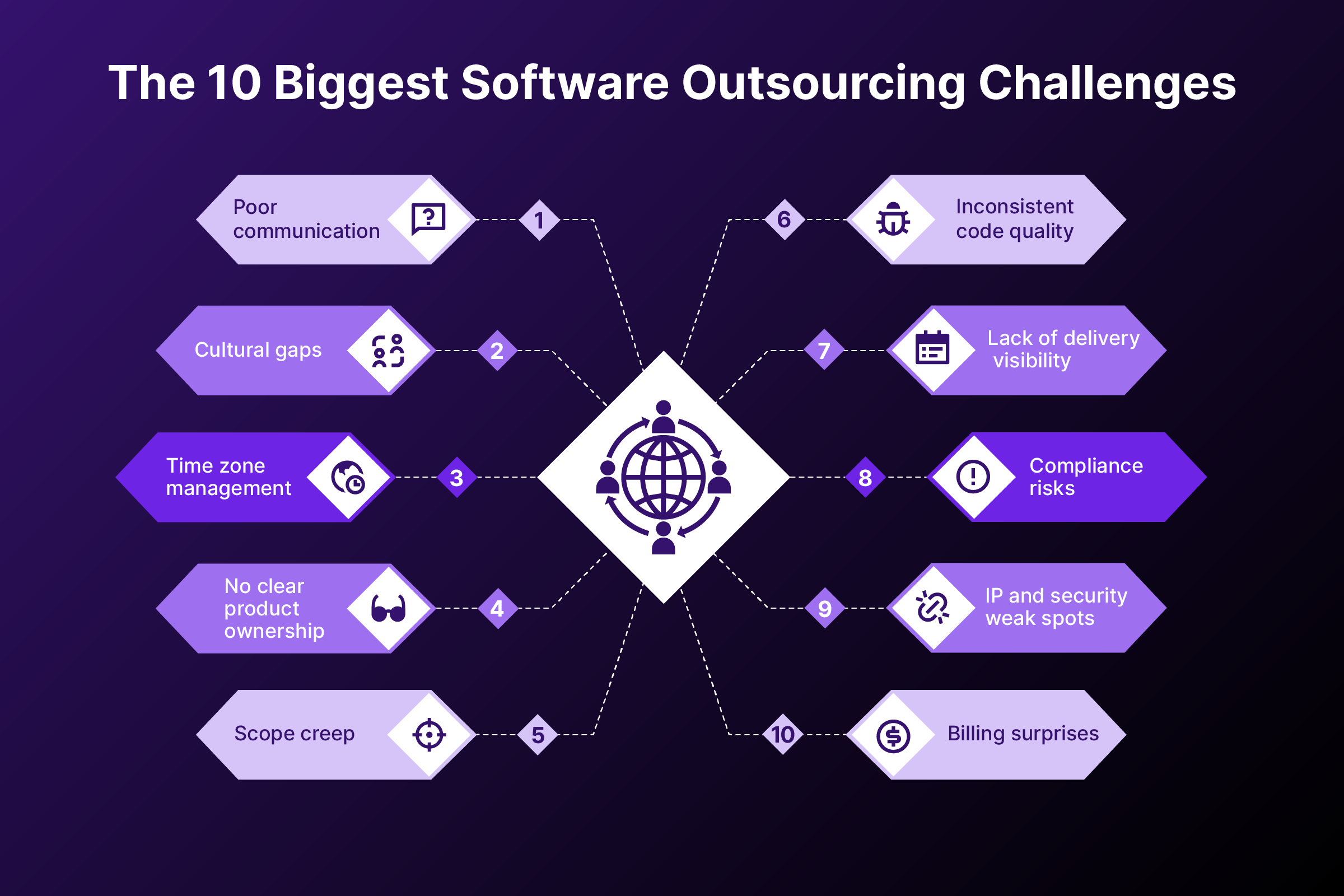
Compliance Risks
Vendors lacking required certifications expose you to legal and reputational risk. Weak oversight of third-party subcontractors complicates compliance monitoring. For fintech, medtech, or any regulated industry, this isn't abstract — it's the kind of mistake that triggers audits and fines.
Ask for documentation up front:
- Proof of certifications (ISO 27001, SOC 2, GDPR alignment).
- Audit reports and data handling policies.
- Incident response procedures.
- How they manage third-party subcontractors.
Map your regulatory obligations to specific vendor controls and contract clauses. If they can't produce documentation, assume the controls don't exist. Build audit rights and regular reviews into the contract so you can verify controls remain in place.
IP and Security Weak Spots
Ambiguous IP ownership in contracts creates expensive legal fights later. Reuse of your code in other projects means your competitive advantage leaks. Inadequate security practices or subcontracting without clear controls lead to data breaches that make headlines.
Contracts should explicitly state that all deliverables and derivatives belong to you upon payment. Require NDAs for everyone with access. If vendors resist clear IP assignment, they're planning to reuse your work.
Require concrete security measures: secure SDLC, access controls, encryption, and vendor security audits. Generic "we take security seriously" language in a proposal means nothing. Ask for the specific protocols they follow and how they're enforced.
Billing Surprises
Headline hourly rates hide the real cost. Change requests, ramp-up time, management overhead, and handover effort add up fast. Opaque contracts without clear rate cards or rules for out-of-scope work turn every scope discussion into a negotiation.
Demand transparent contracts outlining:
- Deliverables and rates for each role.
- How change requests are priced.
- Who pays for tooling, environments and extra QA.
- What constitutes "out of scope."
Evaluate vendors on total cost of ownership — including projected rework, coordination time, and transition costs — not just initial rate comparisons. The cheapest vendor is rarely the cheapest option. Factor in the hidden costs of poor quality, slow communication, and turnover before signing.
When Do Software Outsourcing Challenges Emerge?
Software outsourcing challenges surface at predictable moments, usually when the engagement moves from planning to production pressure. Knowing when those moments happen makes it easier to spot risk early and fix the operating model before small issues compound into missed milestones.
Vendor Selection and Contracting
This is where teams lock in assumptions that become expensive later: unclear ownership, fuzzy definitions of “done,” and generic security language.
Early warning sign: You see confident promises about the talent pool in the pitch, but very few specifics about day-to-day execution, such as how decisions get made, how scope changes get approved, and how quality is enforced.
Onboarding and the First Sprint
The first sprint shows whether you’re getting capacity or drag. If the team needs constant translation of domain context, your internal leads become human routers.
Early warning sign: progress depends on one person being available to answer questions, and work stalls when they aren’t.
The First Real Integration
Shipping isolated tickets is easy. Integrating into your repo, environments, release process, and architecture is the real test.
Early warning sign: PRs bounce repeatedly for avoidable reasons (missing tests, inconsistent patterns, unclear requirements) and integration becomes a negotiation instead of routine.
The First Change Request
Scope changes are normal. Confusion isn’t. This is where “we’ll be flexible” can turn into timeline drift and billing friction.
Early warning sign: New work arrives through chat and calls, not a documented workflow, and nobody can state the cost/schedule impact with confidence.
The First Production Incident
Incidents reveal whether the team owns outcomes or just output.
Early warning sign: unclear escalation paths, slow triage, and postmortems that stop at “we’ll be more careful” instead of improving the system.
The First Security or Access Review
This checkpoint exposes whether controls are real.
Early warning sign: the vendor can’t quickly explain access boundaries, environments, data handling practices, or produce the documentation your org needs.
Scale-Up, Rotation or Renewal
Change stresses continuity. This is where knowledge retention (or loss) becomes measurable in cycle time and defect rates.
Early warning sign: velocity resets whenever someone changes, and handoffs are informal instead of operationalized.
These milestones are also where Saas product scaling challenges solutions either hold up or fall apart.
Why High-Performing Teams Choose X-Team to Avoid Outsourcing Pitfalls
The teams that avoid these traps work differently. X-Team engineers integrate like full-time team members, not contractors checking boxes. High retention and cultural fit mean knowledge stays in the team instead of walking out the door every six months.
X-Team specializes in software development solutions for SaaS scaling, cloud migration, and compliance-heavy domains where mistakes are expensive. Teams at Riot Games, Fox, and other global brands rely on X-Team because the vetting process prioritizes long-term alignment over short-term availability.
When outsourcing works, it's because the organizational structure was built before the code was. The best partnerships don't feel like outsourcing at all.

SHARE: