
When the backlog is outrunning your team and hiring won't close the gap fast enough, outsourcing software development to a dedicated team is often the best move to unstick things. You get embedded engineering capacity without the four-to-six month drag of a full recruitment cycle, and at a lower total cost than building the same function in-house. That math is real.
What's also real: "Dedicated team" means different things depending on who's selling it. Some vendors use it to describe a named pool of contractors who rotate between clients. Others use it interchangeably with standard staff augmentation.
What Is an Outsourced Dedicated Software Development Team?
A dedicated outsourced software development team is a group of external engineers, each of whom works exclusively on your product. Single-client focus is the defining feature. They attend your standups, work in your tools, follow your sprint cadence and development processes, and build institutional knowledge about your codebase over time.
Composition is driven by your technical requirements and can include frontend and backend engineers, full-stack developers, quality assurance specialists, DevOps engineers, cloud architects, mobile developers technical leads. You're staffing a function, not buying a packaged service.
What distinguishes this model from traditional outsourcing is ownership and continuity. The engineers on a dedicated team are accountable to your roadmap and your business goals — not to a handoff date or a scope boundary. They're embedded in your product long enough that their success depends on yours.
Why Companies Choose Dedicated Teams
Companies land on the dedicated team model for different reasons, but they tend to cluster around the same five problems.
Faster Access to Talent
Open senior engineering roles at mid-market and enterprise companies routinely sit unfilled for three to six months, a pattern consistent with broader IT staffing trends. Recruiting infrastructure, interview loops, compensation negotiation, notice periods: each step compounds the delay. A dedicated team partner with a deep talent bench can place qualified engineers in weeks.
Reputable partners run their own rigorous vetting, including technical screens, live assessments, communication evaluation, culture fit, before a candidate reaches you. You get access to a pre-screened pool rather than starting from scratch, which is one of the more practical reasons to hire external developers when speed and quality both matter.
Stable Long-Term Capacity
When engineers stay on your product for 12, 18, 24 months, they accumulate valuable domain knowledge that can be strategically deployed: architectural decisions, edge cases, why certain tradeoffs were made. That depth is what makes velocity compound rather than reset every time someone leaves. Staff augmentation gives you capacity. A dedicated team builds momentum.
High churn is one of the most underestimated costs in outsourcing. Every departure is a knowledge loss, a ramp period and a delivery disruption. The dedicated team model built on retention rather than rotation protects that investment.
For AI initiatives specifically, retention becomes especially critical because it protects the prompt calibration, eval tuning and domain context your team has spent months building.
More Control Than Traditional Outsourcing
In a fixed-price arrangement, you hand over requirements and receive a deliverable. The vendor controls execution. That works for bounded, well-scoped projects. It breaks when scope evolves, priorities shift, or you need to course-correct mid-sprint, which describes most real product development.
With a dedicated team, you retain full control. You set priorities, manage the backlog, decide what ships when. The partner handles sourcing, HR, compliance, and infrastructure: operational overhead without directional authority.
Easier Scaling
Scaling a dedicated team is operationally simpler than scaling internal headcount: add engineers when delivery demands it, reduce when a phase completes. No severance risk, no approval cycles, no budget negotiations that take longer than the work itself.
This matters most at inflection points, such as a major product launch, a platform migration or a new market entry. You can surge capacity for the sprint and normalize afterward. The cost efficiency of that flexibility is real; it makes the dedicated model more cost effective than permanently expanding your internal team.
Better Product Continuity
When a project outsourcing vendor wraps an engagement, they take the context with them. Your team inherits a codebase they didn't build, with decisions they didn't make. Knowledge transfer documents capture a fraction of what actually gets lost.
Dedicated development teams don't have exit dates. The engineers who built your authentication layer are still there when you're refactoring it two years later. That continuity reduces technical debt, accelerates future development, and keeps institutional knowledge where it belongs — inside your product.
7 Times It Makes Sense to Hire Dedicated Software Development Teams
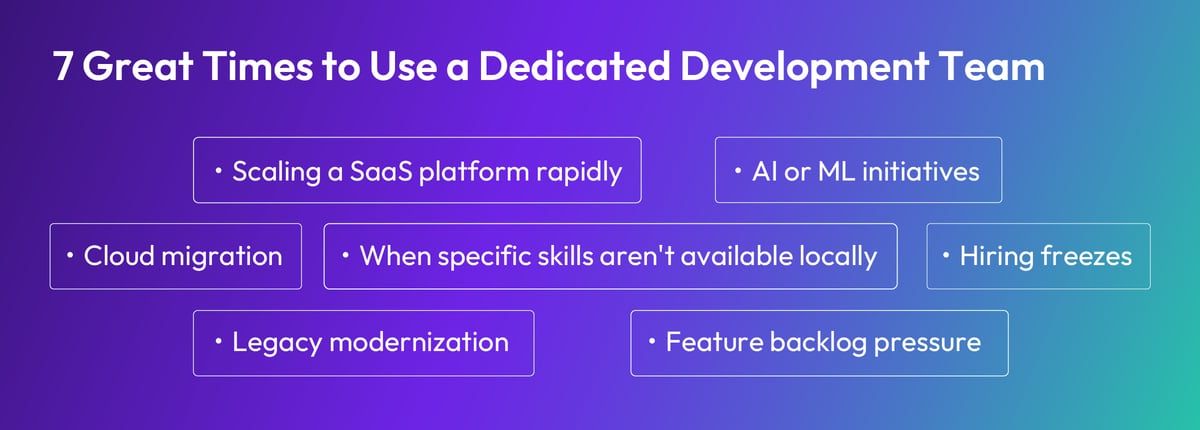
The model earns its keep in situations where continuity, depth, and sustained velocity matter more than a defined deliverable:
-
Scaling a SaaS platform rapidly. You're adding features faster than your internal team can absorb, and each new capability has downstream implications. You need engineers who understand the system, not contractors learning it on your time.
-
Legacy modernization. Migrating off a legacy system or refactoring a monolith is multi-quarter work. Engineers who stay engaged through the full arc make better decisions than a team picking up mid-stream.
-
AI or ML initiatives. Specialized expertise in a fast-moving domain, with a talent pool that's simultaneously thin and competitive. A dedicated team gives you stable access to engineers with real depth rather than a revolving door of contractors who are interviewing elsewhere at the same time.
-
Cloud migration. Architecture decisions made early have long-term consequences. Engineers with full context of the migration make better tradeoffs than a fresh team inheriting it mid-stream.
-
Feature backlog pressure. Your core team is stretched across support, infrastructure, and new development simultaneously. You need capacity that absorbs backlog work without pulling focus from your highest-priority output.
-
Hiring freezes. Headcount is locked, but delivery expectations aren't. A dedicated team adds capacity without touching internal headcount, a critical distinction during budget constraints or post-acquisition integration.
-
When specific skills aren't available locally. The engineer you need exists. Just not in your metro, and not at the pace your posting would attract them. The right partner's sourcing infrastructure finds them faster.
What these scenarios share: The work is ongoing, the stakes are high, the cost of context loss is real. Offshore team members need to function like permanent ones to deliver at that level.
Dedicated Team vs. Other Outsourcing Models
Most of the confusion — and most of the disappointment — in outsourcing comes from applying the wrong model to the wrong problem. Here's how the most common engagement models compare on the dimensions that matter most.
Dedicated team vs. staff augmentation. Staff augmentation places individual engineers into your existing structure — useful when you need specific skills and have the bandwidth to direct that person's work. A dedicated team operates more autonomously as a unit, sitting closer to staff augmentation compared to project outsourcing on the control spectrum but with deeper continuity than either. The choice comes down to whether you need a self-sustaining function or supplemental individuals.
Dedicated team vs. fixed-price outsourcing. Fixed-price vendors optimize for scope delivery. They're incentivized to define requirements tightly, resist changes, and close the engagement. That works for a greenfield app with a defined spec. It fails for a product that's evolving because every change to project scope becomes a renegotiation. Dedicated teams work against a living backlog, so your roadmap can shift without a contract amendment.
Dedicated team vs. in-house hiring. In-house ownership builds the deepest institutional alignment and keeps IP fully internal. It's also the slowest and most expensive path to capacity. For sustained product work that isn't core to your competitive differentiation, the dedicated team model is more cost-effective and delivers comparable continuity at a fraction of the time to start.
The embedded model's advantage extends further than most teams expect. X-Team's 2026 AI Talent Readiness Report found that organizations using embedded long-term partners showed 85% strong value capture on AI initiatives, compared to 42% for teams operating purely in-house, and a 34-point governance maturity advantage over those relying on short-term contractors. The gap isn't about execution speed. It's about what accumulates when the same engineers stay with a problem long enough to build real institutional depth.
Many engineering organizations run a hybrid: core team handles architecture, strategy, and the highest-stakes decisions. Dedicated development teams handle product delivery, feature development, and platform work. The division is about efficiency, not trust.
| Model | Best For | Control | Continuity | Speed to Start |
|---|---|---|---|---|
| Dedicated team | Long-term roadmap execution, sustained velocity, complex products | High | High | Weeks |
| Staff augmentation | Filling specific skill gaps, short-to-medium term capacity | High | Medium | Days to weeks |
| Fixed-price project | Bounded scope, clear deliverables, low change tolerance | Low | Low | Weeks (after scoping) |
| Freelancers/marketplaces | Small tasks, prototypes, burst capacity | Medium | Very low | Days |
| In-house hiring | Core team, long-term institutional ownership | Very high | Very high | 3–6 months |
How to Choose the Right Dedicated Software Development Team
Most companies hiring a dedicated team focus on the CVs and miss the operating model behind them. Managing a remote team well requires structural support from the vendor side (communication cadence, escalation paths, onboarding infrastructure) that never shows up in a pitch deck. The outsourcing market — including the best software development outsourcing companies — makes identical promises on talent quality, pricing models and delivery speed. What actually predicts success operates underneath the surface.
Before you talk to a single vendor, define your non-negotiables. Which criteria are must-haves versus trade-offs? For most teams, that means onboarding speed, security requirements, time-zone overlap, and communication structure. Agree on them internally. Then hold every vendor to the same standard rather than letting each pitch reset the comparison.
Keep your shortlist to two or three finalists. A longer list feels thorough but prevents you from assessing any of them with the depth the decision deserves.
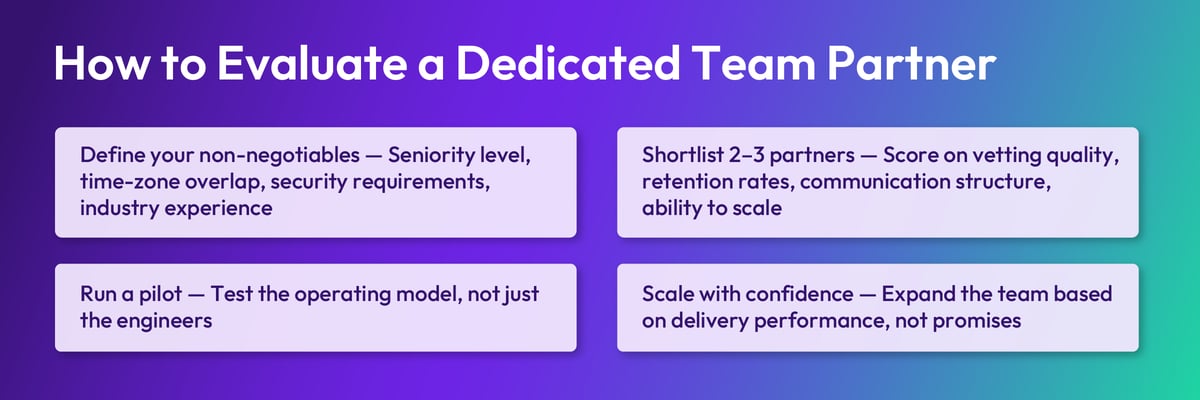
Focus on the criteria that actually predict performance:
-
Vetting quality. Don't accept "rigorous process" as an answer. Ask what the technical screen includes, who conducts it, and what the pass rate is. A partner with real vetting gives concrete answers. One without it gives vague ones.
-
Seniority level. Most partners sell senior talent and deliver mid-level. Ask what percentage of active engineers on client engagements are senior versus mid or junior, and how seniority is defined and assessed. A dedicated team needs engineers who can operate with genuine autonomy and that requires real seniority, not a fancy title.
-
Retention rates. This is the number most vendors don't volunteer. High churn means your "dedicated" team isn't stable — it's a rotating cast with a consistent name. Ask for annual retention rates on client engagements. Strong partners have the number ready.
-
Time-zone overlap. Define your minimum before the conversation, not during it. If your process depends on synchronous collaboration, two to four hours of daily overlap is a floor. Be clear about whether you're buying nearshore alignment or offshore cost savings, and whether that trade-off works for how your team actually operates.
-
Security and compliance. Data handling procedures, access control policies, incident response protocols. For fintech, healthtech, and media companies handling sensitive user data, these are prerequisites.
-
Communication structure. How do you communicate with the engineers directly? What's the escalation path when something goes wrong? Is there a dedicated client partner on the vendor side, or are you emailing a shared inbox?
-
Ability to scale. If you need to add three engineers in 60 days, can the partner do it, and where does the talent come from? A shallow bench means quality compromises under pressure.
-
Relevant industry experience. Ask for case studies from engagements in your space. A team that has shipped fintech products understands compliance constraints a generalist team doesn't. Domain experience shortens the ramp and reduces the risk of decisions that look right technically but create problems downstream.
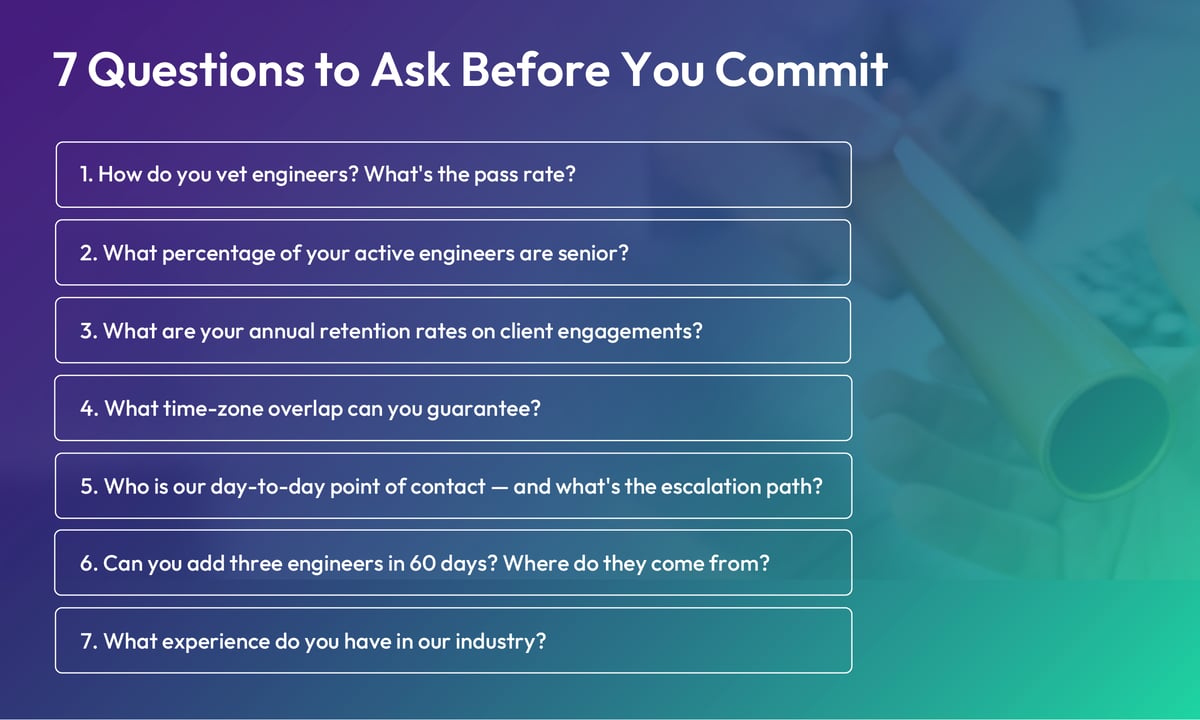
A few questions worth asking every vendor: How do you maintain coverage during vacations and turnover? Walk us through a recent client onboarding. What's the escalation path when there's a problem with a placed engineer?
You're not just selecting where your next developers come from. You're selecting the organization that will represent your delivery standards, every day.
Before you start vendor conversations, X-Team's Outsourcing Buyer's Guide gives you a ready-made evaluation rubric, including a scoring framework, vendor interview questions and red flags to watch for at each stage.
Why X-Team Is Built for Dedicated Engineering Teams
X-Team's model was built for long-term embedded delivery, and the differences show up in how engagements actually run, not just how they're pitched.
- Embedded engineers, not outsourced resources. X-Team engineers integrate directly into your workflow: your tools, your rituals, your communication channels. They join your standups, participate in planning, and build the context that makes them genuinely useful over time — not just technically capable on day one.
- Elite vetted talent. X-Team's vetting process is selective by design. Technical depth, communication fluency, and cultural fit are all evaluated before placement, with the goal of matching engineers who can operate with the autonomy a dedicated team requires.
- High retention. X-Team invests in its engineering community through ongoing professional development, a culture program that keeps engineers engaged, and compensation structures designed to retain talent across long engagements. That investment shows up in your team's stability, which is the whole point.
- Flexible scaling. Whether you need one engineer or a full squad, X-Team can structure the engagement around your actual delivery needs. Ramp up for a major initiative, normalize after launch, add a specialist for a specific phase — without the internal headcount implications.
- Deep industry experience. X-Team's track record runs through fintech, gaming, SaaS, media and publishing, and medtech. These are all verticals where compliance, performance and domain expertise aren't optional.
If your engineering capacity needs are ongoing, your roadmap is real, and you've been burned by the revolving door of traditional outsourcing, talk to X-Team about building dedicated software development solutions that hold.
SHARE: