
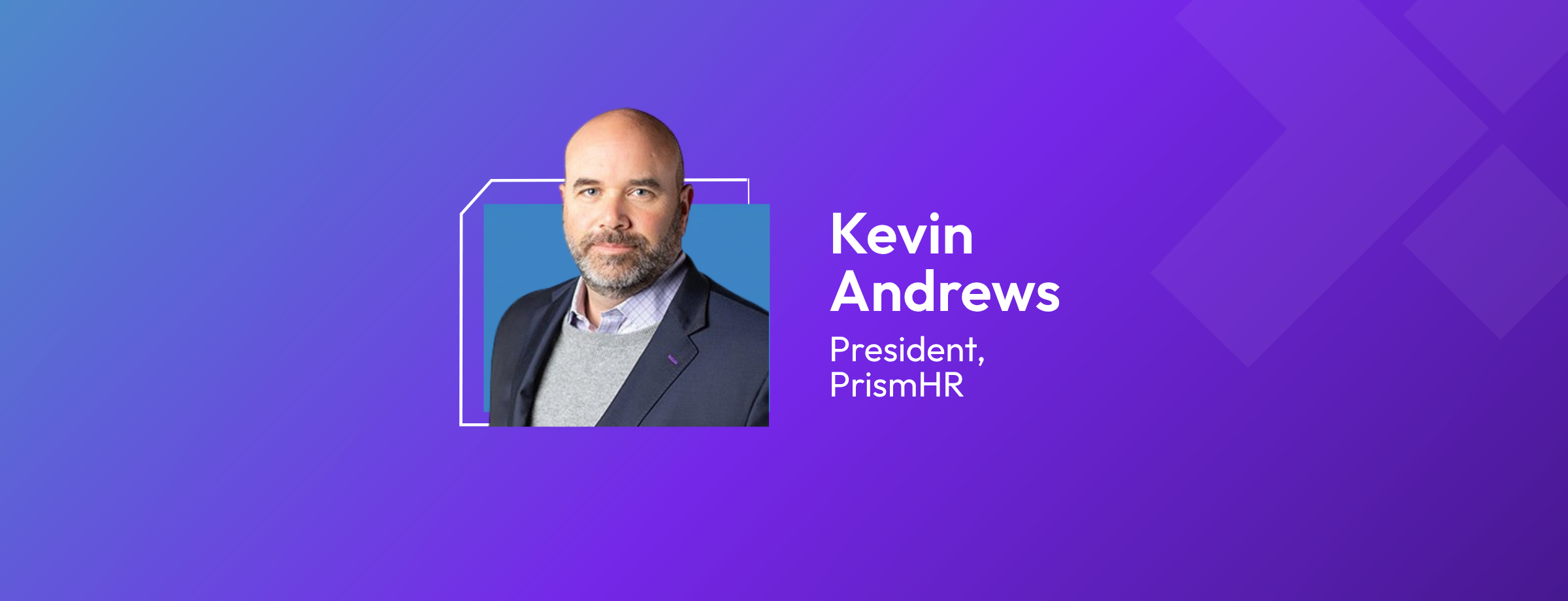
For most tech leaders, a bad call means a missed milestone. For Kevin Andrews, it might mean a lot of people won’t get paid.
Kevin is president of PrismHR and CTO of Vensure Employer Solutions — two companies at the center of an HR and payroll network serving more than 160,000 small businesses and processing nearly $160 billion in payroll annually. Vensure has completed more than 100 acquisitions since 2018, and Kevin has been at the helm of integrating all of it. He co-founded his first company straight out of college, scaled it through a private equity roll-up, and eventually sold to Alight Solutions — a Blackstone-backed company — before helping take Alight public. He's been building and operating mission-critical platforms ever since.
In this episode of Keep Moving Forward, I met with Kevin to examine what responsible innovation looks like when the stakes are this concrete — where "move fast and break things" simply isn't a philosophy available to you. We covered AI governance, the limits of vibe coding at scale, the upskilling imperative, and the leadership principle he returns to again and again: give your people the tools, and then trust them.
Governance First, Experimentation Second
Kevin doesn't resist AI adoption. His team has more than 400 developers using Copilot, Claude, and other tools daily. But when I asked how he approaches tooling decisions, his first answer wasn't about capability. It was about guardrails.
"The important thing is just the infrastructure and the governance and compliance," he said. At a company handling payroll for 160,000 small businesses, that's not a philosophical position — it's operational reality. "You can't run so fast that you ignore your compliance and your regulatory and all the things you want to make sure you protect — not just your code and IP, but personal data that may be hit from these data models or any of the pipelines that you built."
The contractual terms around how different AI vendors handle sensitive data vary significantly, and Kevin insists leaders know exactly what enterprise agreements are in place before any model touches their pipelines.
What he refuses to do is let experimentation outrun accountability. He described a deliberate structure: identify eager engineers, spin up small POC teams, give them specific directives, create shared channels for feedback, and let them sprint. Governance, in his framing, isn't a brake on speed. It's the foundation that makes durable adoption possible.
Nobody Has 20 Years of AI Experience
One of the most grounding moments in our conversation came when we turned to upskilling. Kevin has little patience for the idea that organizations can hire their way out of the AI transition.
"It's not like you can go get somebody who's got 20 years of experience with AI," he said. "It didn't exist."
That reframe is worth sitting with. The talent every organization is racing to attract simply doesn't exist in the form they're imagining. What Kevin looks for instead is curiosity and a genuine commitment to learning something new. For engineers who've spent careers building moats around their coding expertise, that requirement can feel threatening. AI models are now very good at writing code. As Kevin points out, they don't yet know how to deploy it architecturally — and that's where the good ones are focusing their energy.
He's walking this path himself. Kevin is currently pursuing a doctorate in engineering focused on AI and machine learning — not for career advancement, but because he believes you can't lead through a technological transition you don't fully understand. "To be a leader, you've gotta really understand how these models work to make sure — what are you investing in for the future? How do you make the right investments? What's hype, to your question, and what's not?"
The Part Vibe Coding Gets Wrong
On vibe coding, Kevin's take will be familiar to most enterprise tech leaders — but it's worth hearing from someone operating at his scale.
"You've got a lot of people that are what we call vibe coders that can go and prompt and get some very unique outputs and develop product," he said. "But the really tough part is how you do it at scale."
Prompting to prototype is accessible. Deploying at enterprise scale isn't. The old development pipeline — front-end, middleware, database, QA — has been replaced by something considerably more complex. Engineering teams now have to reason through tokenization costs, security and compliance requirements specific to LLM pipelines, and how to test and secure generative outputs. The architects who get this thrive. Those still treating prompting as the whole job are already behind.
His prescription: create a sandbox, invest in experimentation time, and don't mistake individual productivity gains for organizational readiness. Scale requires infrastructure, and infrastructure requires people who understand why it matters.
The Leadership Mistake People Keep Making
Near the end of our conversation, I asked Kevin for the one mistake he'd urge senior engineering leaders to avoid as they head into integration work. His answer didn't touch technology at all.
"A lot of times I see leaders forget to empower their employees and their teammates to go find solutions, and to give them the tools and the time to go do that," he said.
At the scale Kevin operates — roughly a thousand engineers distributed globally — no single leader can hold all the relevant knowledge. His job, as he describes it, is to build conditions where that knowledge can get out, then make sure it gets recognized when it does, publicly and privately.
He's equally direct about the opposite failure mode: chasing a single large customer's custom request at the expense of the 80 to 85 percent of the roadmap that serves everyone else. Kevin has watched that trap derail enterprise products repeatedly. Saying no to a specific revenue opportunity because it would fragment your architecture is, in his view, one of the highest-leverage calls a technology leader can make.
Kevin has lived through the dot-com collapse, the financial crisis, and COVID. He thinks AI could be bigger than all three combined in terms of organizational impact — and he means that as both a warning and an opportunity. The leaders who come through it well won't be the fastest. They'll be the ones who know exactly what can't break, and build everything else around protecting it.
For the 160,000 small businesses on what he calls Main Street, that protection is the product.
Transcript
Kevin Andrews:
You know, it's not always about replacing humans. There'll be some of that, right? And there'll be upskilling that needs to be done. But there'll be new roles that come about, whether they are prompt engineers or they're AI data specialists that understand how to leverage these tools. But, you know, one thing I can say is anybody who's not digging in and learning, you know, will quickly get left behind given the pace of what this is happening at.
Gemma Versace:
Hey everyone, and welcome to Keep Moving Forward, the podcast from X-Team for tech professionals who are passionate about growth, leadership, and innovation.
I'm your host, Gemma Versace, Chief Client Officer at X-Team. In every episode, we sit down with leaders who are redefining how technology teams work, grow, and lead. People who understand that performance begins with connection.
There is a category of software where the stakes are different. Not different in a "this matters to us" way. Different in a "if this breaks, someone doesn't get paid on Friday" way. Payroll, benefits, compliance. These are not features. They are promises. And the engineering organizations behind them don't get the luxury of moving fast and breaking things.
Today's guest lives in that pressure zone every day. Kevin Andrews is President of PrismHR and CTO of Vensure Employer Solutions. PrismHR powers hundreds of professional employer organizations and serves over tens of thousands of small businesses. Vensure has completed more than 100 acquisitions since 2019, and Kevin has been at the center of integrating all of it into a cohesive, enterprise-grade ecosystem.
He started his first company straight out of college, scaled it for 15 years through a private equity roll-up, and eventually sold to Blackstone. He has been building and operating mission-critical platforms ever since.
In this conversation, we get into what it actually takes to innovate when the cost of failure is this high. How Kevin's team absorbs acquisitions at pace without disrupting a single payroll run. Where AI is making a real difference inside HR tech, and where it still needs improvement. And what it looks like to lead a thousand-person global engineering organization with the clarity and discipline that kind of work demands.
Let's get started.
Welcome, Kevin. Thanks so much for joining us here today.
Kevin Andrews:
Thanks for having me. Looking forward to the conversation.
Gemma Versace:
Likewise. Absolutely. So we start all of our podcasts by having our guests tell us a little bit about themselves. If you could tell us about your role leading PrismHR, as well as serving as CTO at Vensure Employer Solutions, and what does your world look like on a day-to-day basis?
Kevin Andrews:
Yeah, so, you know, I started this business right straight out of college. I ended up starting a company. I was fortunate enough to do that and was able to sell to private equity. Grew it for about 15 years, did a roll-up. Then we sold it to Blackstone and helped that group — they merged it into going public.
So I've been in this HR payroll benefit space for most of my career, straight out of college. When I joined PrismHR, the goal was to try to help them do some similar activities, you know, grow and merge this technology, do acquisition roll-ups. And so I serve as President of PrismHR.
So I run all the technology, you know, sales and service, to help drive our core products, which are around payroll and benefits. It primarily started in the PEO business. We expanded that over into HCM, but day to day I also serve as CTO over the holding company. So we brought two companies together over about two and a half years ago.
It was an asset that was owned by Stone Point Capital, and they had both of these in their portfolio, and we merged them together and really tried to create a very unique organization, just because a lot of the entities that sit inside of the PEO are either service-based and don't own technology.
And so it gave us a chance to accelerate and do a bit of an acquisition roll-up in the space, not only on the PEO service side but also on technology, kind of build out an ecosystem. So I lead that day to day. We try to bridge, you know, the gap between innovation and kind of real-world problems that our customers have — SMBs as well as our service bureaus, who are our end customers a lot of times.
In that indirect market. So we focus on making sure we help them deliver payroll to their employees, day-to-day HR services, and give them kind of that security they need to run their business.
Gemma Versace:
Fantastic. So a very integral partner for your clients, making sure that you're getting their people paid and keeping them happy. To extend on that, you know, you are operating, as you mentioned, an HR platform across your client portfolio that literally keeps people paid and covered. How do you think about innovation when the cost of failure is so high?
Kevin Andrews:
No, that's a great question. I mean, when you think about what we do, obviously people need to get their paycheck. So from an innovation standpoint, you obviously can't impact the dependability and reliability of an enterprise-type application. So one of the things that we have to do is when we look at our roadmaps, when we look at the things that we need to deliver our customers and compliance, we have very stringent operational standards that we go through in how we release.
It's a very agile-based platform and obviously a 30-year platform. So we've got a lot of credibility in the space of making sure we deliver payroll. We have over 160,000 small businesses that depend on us to process that payroll, and I think we process almost 160 billion worth of payroll.
So innovation is around making sure we reduce friction for employers, but it also has to have a very stable and trusted foundation. So anytime we release new features, we use a lot of the standard techniques of, you know, feature flag type releases, as well as making sure that we've got very mature processes and that we don't impact anything.
Our QA and quality assurance is a big part of how we operate. So we're not a fly-by-night kind of startup. We have to operate in a manner which we have at scale. So any businesses that run at enterprise scale — anytime you do any type of innovation or rollout or improvements — you have to do it in a way that's kind of seamless to customers.
Making sure you're not impacting their core business. So we've got a great team and a lot of very skilled individuals that are domain experts in this space. And so we focus on leveraging that expertise, and we work with our customers on phased rollout of when we do releases on a monthly basis.
But, you know, AI is changing that quite a bit. So we leverage AI to help us look at the amount of unit test and coverage that we have and regression testing that takes place. But it is top of mind making sure our innovation aligns with a high quality of deliverable product that's up 24/7.
Gemma Versace:
Yeah, absolutely. Thanks so much for the detail on that. And as you mentioned, you need incredibly robust systems and procedures when doing and rolling out the releases — no doubt with a lot of enhancements and optimizations happening across the board every single day.
Let's talk a little bit more about what you touched on — trying to continue to improve and make sure that the releases are done on time and not disrupting clients. When you inherit a mix of legacy HR systems and modern SaaS, how do you decide what to modernize first?
And I guess this is also probably a two-pronged question, because this speaks to just the sheer number of acquisitions that Vensure has completed — obviously that you've been involved in — and with more than a hundred acquisitions in just a few years, this is a significant amount of work for you and your team to be doing from an engineering and platform perspective.
What have you learned about integrating new products and teams at pace, whilst also, again, with that theme of making sure that there is no disruption to customers along the way?
Kevin Andrews:
Yeah, I mean, there's always a balance there, right? We are very acquisitive. We've done, as you mentioned, over a hundred acquisitions. A lot of those have been in the tech space as we build out the ecosystem. And part of that building is you've gotta have repeatable processes, right? You're integrating current systems with either legacy or potentially a lot of tech debt that comes through acquisition. Everybody has it.
And, you know, to create a strong foundation and platform, you've gotta be able to look at — okay, what IP can you get out of the new acquisitions? Why did you buy them? How are you gonna integrate those in and still deliver a consistent experience for your customers?
So we go through and look at what's important to customers and why we actually made the acquisition. Are we filling a gap? Are we trying to expand a particular TAM or area? And so we focus on delivering kind of that unified experience. We've got a platform that we build off of. So when we do acquisitions, we look at it and say, okay, we gotta make sure that it's integrated and it feels as part of our family and not just a disparate type system.
And so when you do those, we look at the UX — how do you make sure that the experience of those end users is consistent? We look at the data. What does the data model look like? Can we put it into our data warehouse so we can start leveraging that from AI and other innovative components? We look at the IP and we look at the people, because the people are important, right?
They've got a lot of knowledge and domain expertise around that. So anytime we bring in a company from an engineering perspective, we look at it and make sure it's something that's gonna fit in, that's scalable, meets our security as well. So we overlay our security expertise, because a lot of times we're buying companies that may be smaller and don't have that domain knowledge or have the tooling to be able to get that type of enterprise-grade system out there.
So we focus on delivery, unifying the experience — not a patchwork of tools out there. And we try to make sure that we're aligning our teams around whatever those shared goals are based off of when we purchase them.
Making it easier for HR and SMBs is the end goal. So we wanna make sure if we buy something that it kind of meets those objectives we started on the front end, then we work our way through the back end, then we modernize any of the code we have to and secure it inside our infrastructure.
Gemma Versace:
Yeah. Incredible. It's such a large task with probably a lot of people, not only within your team from an engineering perspective, but a lot of project management and a lot of precise implementation — particularly with the bringing together of so many different businesses and, as you've mentioned, legacy systems as well.
This kind of dovetails nicely into the next question around when you do inherit a mix of legacy HR systems as well as modern SaaS, how do you decide what to modernize first and, you know, what to stabilize, what to retire — without, again, that all-important task of not having any disruption to your customers.
Kevin Andrews:
Sure, yeah. We always start with what matters most to customers and go back to the thesis of, you know, why we did the acquisition. So anything that impacts payroll accuracy, compliance, ease of use gets prioritized first. It's important, right, that we make sure we gain credibility with the current customers that we're acquiring and that we're taking care of them.
Because that's an important piece, right? You've got a block of business and they've got certain things they're used to. So we'll standardize systems that are tied to kind of that core business functionality for them. We'll modernize where it either improves speed, gives us scalability, or usability — those are important things.
And then, you know, when you look at how you sequence the changes when you're dealing with tech debt — you just need minimal disruption. You've gotta go and say, okay, how do we pull this apart and how do we do releases that are similar to their cadence, yet we can still make the innovations and the things that we need? And we'll retire anything that adds any kind of unnecessary complexity or risk for those customers.
So again, we try to add value to the customers of the block of business that we're buying through those acquisitions, just because we have more scale and we can take risk out of their business. We can give them access to tools that they may not have had before, integrations they may not have had before.
And then visibility to roadmaps and teams at scale between product management, QA, security, and dev expertise. So a lot of times it's a positive and a relief when we buy some of these organizations — you know, maybe they love the people, they love the product, but it hasn't been updated in a few years. They feel like it's not keeping up with the latest demand and they don't wanna look at making a shift, or there may be something unique that they're missing competitively that they just haven't been able to put on the roadmap that our teams are able to accelerate or add to.
So we always try to make it customer-first and obviously minimize any disruption for those customers. So those priority areas around accuracy and compliance.
Gemma Versace:
Fantastic. So I think, you know, one of the things I'd love to deep dive into a little bit more there is — you mentioned obviously there are a lot of ways in which your team can have a really positive impact on the end customer. How do you get to the voice of the customer?
Is it a case of relying on other teams across your business to come and give all this wonderful intel as to what customers are thinking, feeling, wanting? Or are you and your team able to sit at the table with customers and really develop things that are specific to what their needs and wants are?
How do you ensure that you get that level of constant feedback and communication and engagement with your end customers?
Kevin Andrews:
Yeah, no, it's an important piece. I mean, any product is really driven off of customers, and we get that through a lot of different channels. It could be through the solution engineers that are out there demoing in the environment, knowing what customers are competitively asking for. It also has to do with interactions taking place from the product team — making sure we understand what customers are looking for and having that relationship with a CSM. And then obviously looking at cases that come in: what kind of questions are coming in, what needs they have, or deficiencies that may be part of that process.
And then we also have advisory boards that we set up for each of our customer platforms. So we have advisory boards — it's a sampling of those that rotate every couple of years. In addition, we do webinars and constant feedback. So there are a lot of different channels. There's not any one because we get them from a lot of different areas. But we also include things within the platform where they can submit ideas and interact with our teams as well.
And those teams actually go through that list of ideas and requests that come in and help us prioritize things that we're seeing, and we rank them and stack rank them if we're seeing them across multiple customers, whether it's the indirect or direct market. So we're pretty aggressive about making sure we have the voice of the end customer in top focus when we talk about our roadmaps and what we're gonna deliver, because that's where the value comes from.
We've gotta make sure we can retain and also expand that business — both what the environment's doing and what those needs are, and then each of our individual customers as well.
Gemma Versace:
It definitely sounds like you've got it covered from all ends as to how to make sure that you're really listening to customers. And no doubt, as you said, that shines through in a lot of the engagement and customer satisfaction as well — with so many different touch points to ensure that you're consuming exactly what the clients and customers are telling you they want and need.
We can't have a podcast without mentioning anything about AI. And, you know, there's a lot of noise about AI in HR. There's a lot of noise about AI just in general in our day-to-day lives now. Where are you actually seeing AI and automation make a meaningful difference for PEOs, for service providers, and the SMBs that they support? And where do you potentially see it's mostly hype?
Kevin Andrews:
I've seen over the last six months the change between what I would say is hype versus what's reality. These models have gotten so advanced in terms of things that you can do on the business side. So the business unit economics for every company, whether you're tech or service, is changing. It's changing rapidly. And so that's the cool thing about them.
You look at any of the stats — you look at mobile phones, it took 10 years to get to a billion users. You look at the internet, it took almost 20. And you see these charts where you've got LLM usage for chat and others getting to a billion in 18 months. So the rapid pace has driven some of that hype. But as a technologist, I can see the reality of what these tools are able to do, especially in the last six months with some of the advancements in a few of these models and more that we're seeing come out.
So it's exciting, but it's also scary for people. Like, what do you embrace and what do you do? We started a couple years ago down that journey, making sure our teams were developed. We've got over 400 developers that are using copilot and Claude and other tools on a daily basis to help us push out more code.
One of the biggest challenges you deal with a lot of times is just the release of how much those customers can consume. So that'll be the balance that we're looking at going forward. We're trying to make sure that we can help our customers — business owners — save time, reduce errors, and get better decisions about how to run their business.
And, you know, it's not always about replacing humans. There'll be some of that, right? And there'll be upskilling that needs to be done. But there'll be new roles that come about, whether they are prompt engineers or AI data specialists that understand how to leverage these tools. But, you know, one thing I can say is anybody who's not digging in and learning will quickly get left behind given the pace at which this is happening.
So, you know, we try to make sure that we're providing value with AI. You still need some human oversight, and you should always have that built into your processes. You can't just turn it loose, right? It's not deterministic. It could be generative, which means hey, it's gonna be making decisions, and you've gotta make sure that it's being guided and you're giving it the right questions and answers.
It's like any human, right? You need oversight and management of that as you build out these tools. But it has a couple of impacts to a technology company. It has an impact on how you can drive efficiencies inside of how you release code. And today, you know, agile was a new thing that came out after Waterfall — where it was like, hey, we're gonna do two-week sprints, we're gonna release basically on a monthly basis or every two-week basis depending on the size of your organization and the code maturity.
What I think you're gonna see is that agile is changing where you can't take two weeks. You're gonna see daily standups taking place where people are moving code. And back to that issue of how do you help customers consume that much if you're doing a release every week, because you're pushing that much roadmap — how much can they really understand and consume and get to their customers and take advantage of?
So there is a balance there. And I think, you know, one of the promising areas is just helping quality — quality of what we do from a code perspective. It's a force multiplier when you look at what you can get done on the back end as an engineer, and everybody in that sector should take advantage of that.
And then also it's very meaningful on the operational side — where can you save time, reduce errors, make better decisions? I mentioned helping with some of the reporting. It's something that I'm very passionate about. I'm actually going back and getting my doctorate myself right now. So even though I'm not doing it from a career standpoint, it's fun. I'm going back and looking at doctorate engineering, AI, and ML, because these models I think are very impactful.
And to be a leader, you've gotta really understand how these models work to make sure — what are you investing in for the future? How do you make the right investments? What's hype, to your question, and what's not? And then how do you lead companies through this really transitional period?
You know, I've lived through — I'm a little older and I've been in this business for a long time — but I've lived through the financial crisis, the dot-com, COVID. You know, this could be bigger than all three combined if you really look at the impact it could have on organizations positively. But we've gotta be prepared and understand how to navigate it.
Gemma Versace:
When you think about the different AI tooling that has been embedded across your business, has it been a case of allowing your teams to experiment and then be able to identify which ones are getting the best results? Or your team coming and being the ones advocating for certain tools? Or has it been more of a mandated top-down policy around embedding AI across your business?
Kevin Andrews:
Yeah, no. I mean, you've got certain engineers that are very eager, right? And they want to try all the new shiny tools. It's a tough balance, right? When you're running a business, you've gotta give them a playground to go and experiment. You've gotta take time out of their normal daily tasks.
You know, tap some of your engineers and run some of these POCs across smaller teams so they can experiment and see what's working, especially in these early stages where the tools are all different. The important thing is just the infrastructure and the governance and compliance, right? When you're a large organization like ourselves where you've got a lot at stake, right — what we do every day and the type of information that we house — you've gotta put those guardrails in place. You've gotta move so that you can't run so fast that you ignore your compliance and your regulatory and all the things you wanna make sure you protect: not just your code and IP, but personal data that may be hit from these data models or any of the pipelines that you built.
So it's important to have the right people that understand how these models work and what type of agreement from an enterprise perspective you have with the various vendors, because they all differ a little bit, right? And protecting your data that's not used for training is important.
A lot of what I'm seeing out there honestly around automation is more than just generative AI, which is great. But to your point about those teams — you do need to experiment with the different tools. And we do that internally. We started with one and then we've spun up these smaller teams and let them sprint, and we give them very specific directives: what are you trying to accomplish? Feedback has gotta happen. We set up team channels for that collaboration.
But it's all about upskilling. You've gotta make sure you're upskilling your talent, because these are new tools. It's not like you can go get somebody who's got 20 years of experience with AI. It didn't exist, right? And so you've got people, and I always encourage — you've gotta be creative. Those are the people you're looking for. You gotta be curious. You gotta be able to ask those questions and really dive in. And you gotta be committed to learning something new, because you've got a lot of these developers whose moat was the code.
Well, what these LLMs do really well is the code. But what they don't always know is architecturally how do you deploy it? And that's the difference. So you've got a lot of people that are what we call vibe coders that can go and prompt and get some very unique outputs and develop product. But the really tough part is how you do it at scale. Do you understand the architecture? The infrastructure? It's not like the old days where you have a front-end developer, you've got middleware, you've got somebody working on the database backend, you've got QA, and you've got your normal pipeline.
When you're dealing with LLMs, you're dealing with a lot more complexity. How are you gonna deal with the tokenization of these different platforms? The cost associated with it? What the security and compliance are around those? And then what the results look like and how do you test and secure it?
So you're seeing your top architects and engineers really taking advantage of that. The good ones getting curious, getting creative. And I'm seeing some pretty neat things coming out of that. But you've gotta experiment. You gotta have a sandbox. You gotta have leaders that are willing to invest in the product so that these teams can really decide what's best operationally going forward.
Gemma Versace:
Yeah, fantastic. And I heard somebody say the other day that what they're seeing is that the best developers are now moving from being part of an orchestra to actually being the orchestra conductor, because they're able to utilize all different AI tooling, which obviously enhances what they're able to do.
And as you talked about too, it's really becoming a force multiplier across engineering teams when used correctly and when you've got that right appetite and motivation for engineering teams to kind of develop their skills as well.
Pivot to a little bit more of the people piece. So there are a lot of people that listen to the podcast that lead large distributed and remote teams, which is something that you do. You lead a large distributed engineering team across multiple locations as well as multiple products. What are a few non-negotiables that you would share with leaders listening — practices that you rely on to keep quality, security, and trust really consistent across your team at all times?
Kevin Andrews:
No, I think it's important as a leader. I mean, we've got about a thousand developers on a global basis, and it's one of the things that we try to do. When you look at product, you look at dev, you look at QA —
Gemma Versace:
Mm-hmm.
Kevin Andrews:
— you look at all the different channels of what actually helps you get a product to market. You know, the biggest mistake I see a lot of times at the enterprise level is just overcomplicating things. They're already complicated enough. And so keeping things very simple, approaching things where you have specific directives.
And then I would say, you know, one of the things you've always gotta focus on is how do you eliminate tech debt? You gotta apply a certain amount of your time and skill and energy to that, and don't overestimate or underestimate the value of that. And so you've just gotta have that fraction of continuing to move forward.
So the best thing you can do is build simple, repeatable, approachable, scalable processes and avoid creating all these custom solutions. Because when you're doing an enterprise-level application, you're really creating for the masses — the 80, 85%. That 15% is what derails a lot of companies at scale. They'll go focus on a customer asking for something and chase a specific revenue, but they've just deferred their overall roadmap that's gonna impact 80, 85% of the rest of the population.
So I see that mistake happen often. They'll run after a big client or one particular thing versus having a developer, an architect, or a product person sit down with a customer. And instead of just a request coming in, it's about understanding why do you need this? Why are you different? Is there a better way to approach it? Is this something that maybe is valuable to customers we're not seeing?
So again, it's relationship and trust with those customers so you can avoid creating these custom solutions that don't scale. There are a lot of boutique systems out there that do fit those niche markets, but you try to avoid that at scale. And then prioritize consistency and clarity from day to day — operationally, from a team perspective — giving them a clear objective of what we're trying to do. And if they're doing and working on things that don't actually lend to meeting that clear objective, then they need to question it. They should be asking, what are we doing? How are we doing this? This doesn't align with what I thought we were trying to do.
So getting everybody rowing in the right direction is key. And keeping those teams aligned around the impact that it has to our users.
Gemma Versace:
For senior engineering leaders that are listening that might be about to start their own integration journey — which is a significant journey to go on — what's one mistake that you'd urge them to avoid, and one habit that you'd encourage them to really implement and build on from day one?
Kevin Andrews:
You know, I would say one mistake is — always listen to your people. At the end of the day, they've got great insights, and giving them the ability to share some of those. I think sometimes you have leaders that come in with a perspective on how they want to drive things, and I think just giving people an opportunity to share their knowledge and giving them the encouragement to do so — that's an important piece.
Especially when you deal with complex, scalable entities where you've got a lot of people that have been around for a long time and see things that you're not necessarily gonna see, especially if you're new coming into a project.
So, you know, one of the big mistakes is — as I mentioned earlier — don't let them overcomplicate things, and make sure you're leveraging the talent that you have to find solutions and empowering those people to come up with solutions. A lot of times I see leaders forget to empower their employees and their teammates to go find solutions, and to give them the tools and the time to go do that.
And so that's always fun, right? When they come up with something. And then also reward them. So that's one of the things I think is important too — reward those people, not only publicly but privately, and making sure that they're getting recognition and acknowledgement. A lot of times people make mistakes around that. It's just making sure the right people are getting credit and making sure that you're drawing attention so that others can see that, hey, we do empower people and we do look for creative, innovative ways to solve these problems. And it takes people to do that at the end of the day.
Gemma Versace:
Yeah, fantastic. That's some really sage advice for those listening. You probably saw me smile a little bit earlier when you were answering one of your questions, because I think you've got the ethos of our podcast — Keep Moving Forward — already ingrained. I heard you already mention it as a key aspect of the team.
But one final question that we do ask all of our guests: what is it that keeps you moving forward every day?
Kevin Andrews:
You know, for me it's just encouragement. I love mentoring and taking this next generation — whether it's a developer, product person, or manager — and helping them improve and move down their career path. So I think if you do that, the rest of it becomes very easy. So whether you're improving a platform, it's really about improving the people first and those teams and the businesses that we serve.
So focus on the customer, focus on your people, and the rest of this stuff follows. Moving forward, you know, you progress based off of the real value that you add to customers and the real value you bring to your team. And from a technology standpoint, you've gotta make sure that you're keeping up with what the latest is.
And this is one of the best times ever to really be in the technology space, if you think about it, just because of AI and what's going on and how much you can impact customers and some of their needs. And that's evolving. Keeping that long-term goal in mind and making businesses run better and easier.
We're in the SMB world, so I say we don't serve Wall Street. We serve Main Street with these 160,000 small businesses. And it's important, right, to make sure we make their job easy — they can focus on their core competency and you can do the things that your technology is designed to do, which is help them run their business back office, pay their employees, and make sure they're compliant from an HR perspective.
Gemma Versace:
Yeah, fantastic. And I think one of the main themes that I've really heard throughout every single one of your answers is that even though you're a technology leader across the business, it's clear that within and across your whole entire business, the customer genuinely does come first. And you can hear it in most of the answers — that common theme of obviously not wanting to disrupt the customer, but also more importantly, how do we continue to find ways to add value for the customer?
So the folks on Main Street must be very happy and they're in safe hands to continue to be served and have amazing products developed for them. So thank you so much for the chat today, Kevin. It's been great.
Kevin Andrews:
Great. Thank you. Appreciate your time.
Gemma Versace:
Kevin builds things that cannot break. That principle sits behind every decision he described today: how his team stages an acquisition integration, how they govern AI adoption, how they sequence a release. When so many small businesses are depending on you to get payroll right, reliability stops being a constraint and becomes the product itself.
What I found most interesting is how that same logic extends to his people philosophy. He is not empowering his engineers because it sounds good. He is doing it because at the scale he operates, no single leader can hold all the knowledge. The people closest to the system see things you will never see from the top. The job of leadership is to create conditions where that knowledge surfaces, and then reward it when it does.
On AI, Kevin sits in an interesting position. He is pursuing it as aggressively as anyone, including going back for a doctorate to understand the models more deeply. He insists on governance, on guardrails, on human oversight because he knows exactly what is at stake when it gets something wrong. At the scale he operates, getting it wrong is not an option.
The leaders who navigate this period well are not the ones who move fastest. They are the ones who know exactly what cannot break, and build everything else around protecting it.
Join us next time for more conversations with technology leaders who inspire us to grow, lead, and innovate. You can find us on Apple Podcasts, Spotify, or YouTube Music. If you enjoyed this episode, please share it with your network. We'll see you next time.