
There's a project plan sitting in your enterprise planning system right now that looks clean. Gantt chart intact. Dates assigned. Resources named. The problem is, nobody's touched it since kickoff. The real plan — the one with every schedule slip, every scope change, every week of firefighting — lives in an Excel file on a project manager's laptop.
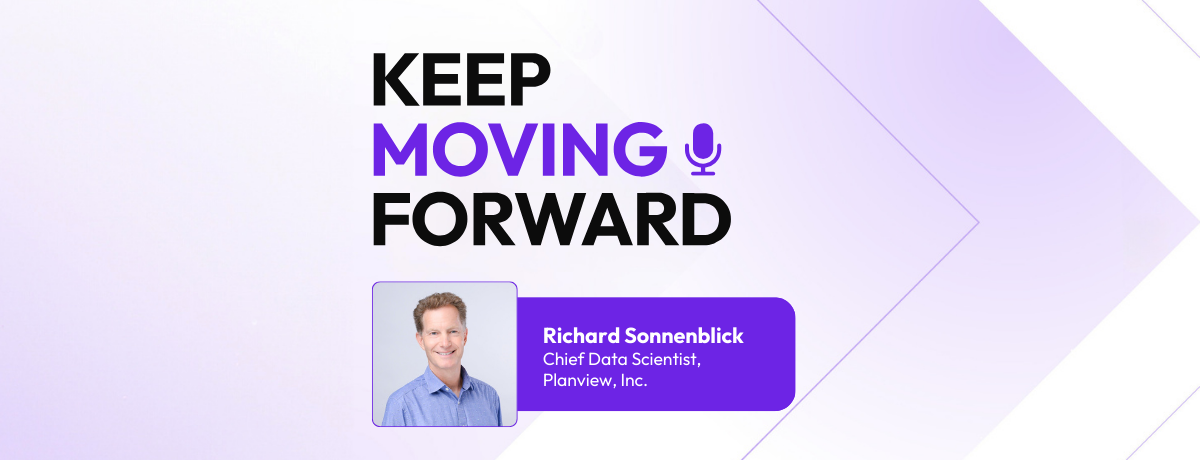
Richard Sonnenblick has watched this play out across industries. As chief data scientist at Planview, he sees what happens when organizations point AI at that pristine system of record: the model learns from optimistic fiction and delivers confident answers built on it.
"The LLM or the machine learning algorithm will have a false sense of perfection around how these plans were actually executed," he shared on Keep Moving Forward. "If you ask the LLM to make a plan based on my historical plans for this team, it's going to make the same mistakes those old plans made — because they were never updated to reflect reality."
Before Planview, Rich spent years in pharma and healthcare, where a decision built on bad data isn't a missed deadline. It's a wrong drug recommendation. That background sharpens his read on what the current AI moment actually demands of senior leaders: not more tech capability, but much better data hygiene.
The Gold Nobody's Mining
The structural problem Rich describes is both predictable and persistent. Companies build project plans in enterprise systems at the start of an initiative. Execution starts, reality diverges, and tracking migrates to spreadsheets, notebooks, Word documents, and "a bunch of notebooks sitting on a series of desks in a laboratory." The system of record quietly becomes a trophy — accurate as of day one, useless as a training dataset.
The fix isn't a new tool. It's the unglamorous work that project management frameworks have always required: variance logs, updated risk registers, real post-mortems. AI makes this discipline more consequential, not less.
"That post-mortem information that you put into your system of record or your risk register is now gold," Rich said. "Associated with what the LLM can do in terms of making meaning of that later for subsequent projects."
Planview has connected over 150 tools to its model context protocol servers — work data, resource data, milestones, timesheets — precisely because breadth and quality of context is what separates genuine insight from hallucination. "Making sure that data is accessible is still the first best defense to eliminating hallucinations," he said. The model is only as good as what it's told.
What the 300-Times-a-Week People Know
Here's the internal data point Rich shared that deserves more attention than it's getting: when you look at actual LLM usage across enterprise teams, some individual contributors are running 300 queries a week. Others haven't opened the tool since a failed attempt months ago.
That gap is not a technology problem. It's an enablement gap — and it's the leadership problem most organizations haven't named yet.
"What is it that those teams who are using it 300 times a week know that those who are not yet using it don't know?" he asked. "It's important for executives to understand that there's this variability and that enablement is a key factor for success."
The conversation worth having inside most organizations right now isn't about AI strategy in the abstract. It's about finding the power users, understanding exactly what they're doing and what time they're reclaiming, and systematically spreading that. Anyone who formed a negative opinion about AI tools a year ago may be avoiding something that has materially changed. Rich is direct about it: "The LLM capabilities that we have today are far better than what we saw even three or four months ago."
The Part You Can't Outsource
Rich's final point lands quietly and sticks. He told us that writing is not just communication. Writing is how thinking happens. "Writing moves the thinking process forward, and if we outsource our writing to an LLM, we have to now have an additional step where we restore our cognitive link to that piece of writing."
That restoration is not automatic. It requires a deliberate process: reading the reasoning chain behind an AI output, not just the conclusion. Bringing critical decisions into actual forums where you have to speak to them. Demonstrating ownership rather than simply forwarding the polished draft.
"We might hand the work over to the AI agents," he said. "But we're not handing the ownership of the work to the AI agents."
The leaders who get this right won't be the ones with the most AI tools deployed. They'll be the ones who understood, early, that the question was never what AI can do. It's what you still hold people accountable for when using it.
Transcript
Richard Sonnenblick:
We might hand the work over to the AI agents, but we're not handing the ownership of the work to the AI agents. So this is very much a process, a people process, tools, question, and the solution where we think about how do we augment what our users are doing humans are doing, while at the same time not having them abrogate their responsibility of ownership over the finished product.
Gemma Versace:
Hey everyone and welcome to Keep Moving Forward, the podcast from X-Team for tech professionals who are passionate about growth, leadership and innovation. I'm your host, Gemma Versace, Chief Client Officer at X-Team. In every episode we sit down with leaders who are redefining how technology teams work, grow, and lead. People who understand that performance begins with connection. Today, I'm joined by Richard Sonnenblick, chief data scientist at Planview.
Rich joined Planview after the acquisition of a company he founded, focused on enterprise software for investment decision-making in product development and R&D. Since then, he's helped build the foundation for data science and AI across Planview's platform, shaping how organizations use machine learning, generative AI and agentic workflows to make better strategic decisions. This conversation explores attention many leaders are facing right now.
AI agents can recommend synthesize and even act, but ownership still sits with people. In high-risk environments like pharma and healthcare where poor decisions carry real consequences, this distinction matters, Rich shares why risk frameworks can guide responsible AI adoption, why data quality is the real differentiator between insight and hallucination and why practical agent-driven workflows can demonstrate ROI in the first 60 to 90 days.
We also look ahead at the mindset shift, leaders need to ensure AI makes organizations better rather than simply noisier. Let's get started. Welcome, Rich. Thanks so much for joining us today.
Richard Sonnenblick:
It's my pleasure, Gemma. Thanks for having me.
Gemma Versace:
Excellent. We always like to start with asking our guests just to tell us a little bit about your background and your work at Planview.
Richard Sonnenblick:
Happy to. So I am the chief data scientist at Planview. I have been here for, well, coming about four years. I originally came in after the acquisition of a company I founded that created enterprise software for investment decision-making in product development and research and development and very data science and analytic focused. So it was a natural progression to bring that company to land that company within Planview. And then, to move on to data science roles.
So four years ago when I joined, Planview had not yet laid the groundwork and the foundation for data science and AI, and we were fortunate to then have a mandate from our CEO who saw that even before ChatGPT landed in September of 2022, that there was a real imperative to create machine learning algorithms to help our customers look a little further into the future, a little deeper into their data, mine their product planning and execution, systems of record that are in the Planview suite of solutions for insights, for early warnings.
For an understanding of how to focus the scarce attention of their customers, their managers, their executive leadership on those areas of work and initiatives that really needed the most attention and the most tender loving care.
Gemma Versace:
Yeah, it seems like they had a very clear outcome that they were hoping to achieve.
Richard Sonnenblick:
That's right. That's right. Even before generative AI, it was clear that there's a wealth of data associated with product management, execution, strategic portfolio management, and agile planning. And that data represents an untapped resource for insights, understanding and the ability to both de-risk your strategic bets, to increase revenue and decrease time to completion or time to market of critical initiatives. And all of that is really now within the wheelhouse of Planview three years later, having created both the foundation for understanding and mining that data for insights just on a customer by customer basis.
And then building a system of intelligence on top of that for both traditional machine learning and generative AI and agentic frameworks. And then creating the interaction points within our software. So on one hand it's weaving in-app experiences that harness AI into the tasks that our customers do every day, whether it's agile planning or strategic portfolio management, and then also creating chatbots that sit as a side panel within our applications so that customers can ask questions about the solution itself.
Can ask questions about best practices or can ask questions about specifically their business context and what are the resources that are over-utilized or what is the work that's at risk. And then finally taking that same chat idiom and switching it into an autonomous frame. So instead of asking questions of the chatbot, taking those same prompts maybe with a little bit of editing and scheduling them on a daily, nightly, weekly basis to either provide an answer to a single request or chain them into a workflow.
And those agentic workflows are now what our users are building to ask questions about backlogs or data quality or work at risk or resources who are overutilized and what resources might appropriately be used to afloat some of that work.
Gemma Versace:
So on this show we talk a lot about execution and especially around how product and engineering leaders really bring on the right delivery capacity fast without losing quality. Lately, the new variable is AI, and not just Copilots, but agents that can plan, recommend and even act with varying degrees of autonomy. Rich, you've lived at the intersection of decision making portfolios and AI all in complex environments like pharma, R&D and healthcare where a poor decision has the potential to cause human injury or even worst case scenario, death.
What is the real risk of handing over work to agents when so much is on the line and what are the steps that we should take as we consider the spectrum of AI autonomy? I know that's a pretty loaded question, but what are your thoughts there around the steps that we can take to will we consider the spectrum of AI autonomy?
Richard Sonnenblick:
Yeah, I think it's an important question and part of the key is in the phrasing here. So handing work over to AI agents. We might hand the work over to the AI agents, but we're not handing the ownership of the work to the AI agents. So this is very much a process, a people process, tools, question and the solution where we think about how do we augment what our users are doing, humans are doing, while at the same time not having them abrogate their responsibility of ownership over the finished product.
When we think about AI and specifically generative AI, there are some net new challenges there, right? Challenges around automation bias and authority bias. So we've always dealt with automation bias, which is an automated system feels authoritatively secure, and so people interacting with an automated system will give it the benefit of the doubt. Well, I think that's true tenfold when you think about the polish grammatically, persuasively, linguistically that we see coming out of today's large language models.
And that authority bias, the ease with which we can accept what's coming out as a response of a large language model because it sounds so polished and confident, is a real threat to our ability to own the work products. So I like what the, how do we combat this? How do we address this? I think risk frameworks are really important here, and I like what the EU AI Act has put forward in terms of denoting risk as a function of impact and exposure and potential consequences, right?
So the prohibited risks are a threat to life, to livelihood, to basic human rights. That's just off the table that AI would never be given access to decisions that would involve that, but then high risk, but still potentially permissible safety infrastructure, a threat to rights that can be ameliorated or mitigated as a function of transparency and making very clear what the thought process, the LLM is. And then finally, other transparency related issues associated with deep fakes or chatbots is kind of the medium risk, right?
And then, it gets less risky from there. So I think it's important first to ensure that the value of what the AI is bringing well outweighs the level of risk and using this kind of risk classification framework is super important for us to decide is there a cost benefit in the large even worth it? And then, if we decide that well, we think we can mitigate the risks and there's huge benefit here in this particular case, then let's talk about how we ensure ownership of the work that is created or co-created with LLMs.
So part of this is transparency and ensuring that the user can easily see exactly the thought process of what the LLM is doing. A good example of that at Planview is within Anvi, you have the ability to see what data Anvi is gathering to answer a question you've asked and what that intermediate set of steps in gathering that data looks like, what the synthesis is around that information and why it's drawing the conclusions that then it provides you with and to provide you not just with those conclusions but suggested actions and why those suggested actions might be relevant or beneficial for you.
So if the user is willing to read all of that, they have ownership and that's important and they can take that ownership to reduce risk. But then further, I think we need to bring in a set of processes where users are going to not just be told you have to have ownership, but demonstrate ownership by bringing the critical decisions that need to be made when other people need to be briefed on them into a forum where you're talking about them, that you have to do more than simply copy and paste something that an LLM has created into the next email or the next Slack message and let it go at that.
You need to demonstrate ownership of the critical decisions that are being made. Obviously there are a lot of things LLMs can do where that kind of ownership is less important. If it's a summary report where you have links back to the original documents or business context, maybe it's not important to show ownership, but for a lot of critical decisions, we're going to have to train our teams to learn how to create ownership when the work product has been built by someone else.
As a journalist yourself, I'm sure you have many times sat down at the keyboard and had an idea. And then as you wrote and rewrote your thought process about that idea changed and your message changed. And I think writing in that sense is thinking, writing moves the thinking process forward, and if we outsource our writing to an LLM, we have to now have an additional step where we restore our cognitive link to that piece of writing.
Even if we don't feel compelled to change it, we should still be able to 100% speak to it and understand what the pros and cons are. It's a long-winded answer, but I think there's a lot there that's super important and it represents fundamental change in the way we create work products.
Gemma Versace:
Your work is focused heavily on decision analysis and portfolio modeling for high risk industries, as we've just been talking about. And now, you're building predictive plus generative AI across an enterprise platform. What did you learn in pharma that shapes how you think about AI agents today?
Richard Sonnenblick:
That's a great question. As a lot of our clients are fond of telling us garbage in, garbage out, so generative AI hallucinates, the less information you give it, the less business context you give it. And so we've worked hard at Planview to ensure that there's access to a lot of data. For us at Planview, over 150 different tools have been given to our model context protocol servers to deliver business, relevant business context to the LLM so that it can provide an accurate synthesis and build insights.
And so part of the challenge there is not just getting access, getting the plumbing done to get all of that data, whether it's work or resources or objectives or milestones or timesheet information into the LLM, but it's knowing that data is of high quality and is complete and holds together. And the challenge there is that while you may be using one enterprise planning solution, you may not actually be using that in totality as your only system of record.
I'll give you an example, right? A lot of companies will use a planning system to build a Gantt chart or an initial project plan, a set of tasks and a set of start dates and end dates. But then as the project actually executes, they may move to PowerPoint and they may move to Excel or a Word document or a text document or simply a bunch of notebooks sitting on a series of desks in a laboratory. And so, the project plan is no longer being updated to reflect reality in that enterprise planning system.
And if you're now asking an LLM or building a machine learning algorithm based on those plans, you're not getting the whole story because those project plans may actually now be very optimistic compared to the one that's sitting in that Excel spreadsheet, that the PMs were modifying day in and day out for weeks or even months. And so, if there is no process to put that updated project plan with all of the cost and schedule variance that now exists back in the system of record, the LLM or the machine learning algorithm will have a false sense of perfection around how these plans were actually executed.
And if you ask the LLM, I want to make a plan that does X, Y, Z, look at my historical plans for this team and make a new one. It's going to make the same mistakes that those old plans made because they were never updated to reflect reality. So there are those kinds of situations that I think if we're relying more and more on generative AI, it's more and more important that we keep our systems of record updated up to and including the last day of an initiative.
And even with a post-mortem, that post-mortem information that you put into your system of record or your risk register is now gold, associated with what the LLM can do in terms of making meaning of that later for subsequent projects that are related or for that same team or for that same product technology group.
Gemma Versace:
One of the things that you mentioned there that I thought was really interesting was the need to continue to provide additional updates and context to the LLM. And it was something that I was going to ask you a little bit more about, that it is so important that as things happen outside of what you can obviously digest and see that's happening across a particular project, how important is it to take that step and take that beat to actually provide that context and that update to the LLM?
Because that is obviously going to ... When you talk about rubbish in, rubbish out, it's so important and I think a big step that a lot of people, obviously people like yourself are very used to knowing how to continue to give it that context. But so many people that use AI in everyday life are missing out on getting some real gold and some additional value because they're not taking that step to take the time to continually update that context window or that context for AI and LLM. Am I right in thinking that?
Richard Sonnenblick:
Absolutely, Gemma. Yeah, no, it is critical to both in your prompting and even using a vertically integrated chatbot like Anvi within Planview Solutions, you're still prompting. It's critical when prompting to be very clear on, I want you to use the following pieces of information as you synthesize or analyze or answer my question and you want to provide context on the persona. I am a product manager for a multimillion dollar set of mobility solutions.
And I am considering adding a new product to our product line, for example, and then the format in which you want that output. I'm looking for a table comparing the different opportunities we have. I'm looking for a market assessment in paragraph form and then, this together with the ability to actually reach out and provide and pull all of that data together is going to ensure, well make it much less likely that the LLM is going to hallucinate.
As an example, we saw very early on a few years ago as we were building out our agentic approach that there was a lot of information on time sheets and time reporting that was needed. And without this information being accessible to the LLM through tools, the LLM just had a tendency to make up information or to take any date that was available from the tools that it had and simply use that date as a proxy for whatever information it actually needed.
And so LLMs have come a long way in the last two years. They tend to hallucinate much less, but making sure that data is accessible is still the first best defense to eliminating hallucinations.
Gemma Versace:
If a CAIO says, we're done experimenting, just show me the ROI. What are two to three practical agent-driven workflows you would start with in a portfolio or strategy execution? And what would you measure in the first 60 to 90 days? So if there's some engineering leaders out there listening right now that are really either midstream or getting to the end of a project, but the CAIO says, "Right, just give me the ROI now." What are some practical agent-driven workflows that you would suggest to measure in those first 60 to 90 days, to really start to show the benefit that can be derived?
Richard Sonnenblick:
Yeah, that's great. So the last examples I gave were more kind of in-app experience and there was a little bit of agentic. So when I say agentic, I refer to reasoning and acting as being what defines agentic and acting involving a series of tools, not necessarily making changes, but maybe deciding what data to pull and looking at the answers and then making decisions about the next step and the next step until maybe there is an action that gets done.
So in an agentic frame here, maybe thinking about data quality and work readiness. So a really great project manager will constantly look at work that is about to begin, based on the start date and check it and make sure that it's complete in terms of its scoping definition success criteria, that it has an end date, that the end date isn't before the start date, that there are resources assigned. Basic stuff, but if you have lots of different things in motion, it's hard to check all of that in the two to five days before a piece of work is about to begin.
So having an agent that just goes through daily and checks to see for all work that is within five days of starting, is it complete in these ways? Does it pass a sanity check? Does it pass a clarity test? And if not, look at either the person who created the piece of work, whether it's a Kanban card or work breakdown structure item in a Gantt chart and send them a note. And if there are resources already assigned, maybe send them a note, reminding them that this is about to start and is there anything else they need.
And so you're nudging leaders, you're nudging team leaders, you're nudging contributors as needed to make sure that that work will start on time and is set up for success, because we know there are enough things that can go wrong once things start, it's bad enough if it gets off on the wrong foot to begin with. And the same is true with work completion. So as something nears the last 15% of its duration, to go back and do essentially the same thing.
To look at the incremental milestones and see if they've been ticked off, to see that some of the work products have been ticked off and deliverables have been moved around, if there are comments on a Kanban card to look at the sentiment or emotional tone of those comments and to pull all this together and say, does it look like this is landing, or does it look like it's still at 35,000 feet or does it look like it hasn't even gotten off the ground yet? And then perform those same nudges.
So this is all what good PMs do rather than just being date jockeys, managing to dates, but an LLM can ... and an agentic set of LLM enabled capabilities can go a long way, so that's one. I hope that's interesting.
Gemma Versace:
Yes, absolutely. And for those, I'm sure that there's lots of people listening that are feverishly taking notes here, Rich, because there's some really great pearls of wisdom coming through as to how to be able to not only embrace and support and utilize AI agents and workflows within businesses, but also some really great strategy and ideas as to how to be able to continually send up the chain, what some of that real life value is adding across the business as well.
Let's fast-forward 12 to 24 months. What's the most important mindset shift that leaders at large enterprise companies need to have, so AI agents can make organizations better rather than just noisier?
Richard Sonnenblick:
Yeah, that's a great question. I think there are a few things, not worrying about agents replacing teams, but worrying that teams who don't use AI will be replaced by teams who do use AI. And I know it's become a bit of a cliche, but it seems more and more true every day. When we look at AI usage either with our internal teams or with our customers, we see that there's wide variability. There are teams and individual contributors that are using LLMs 300 times a week, and then there are others who don't use them at all.
Now, what is it that those teams who are using it 300 times a week know that those who are not yet using it don't know? And so, it's important for executives to understand that there's this variability and that enablement is a key factor for success. So a rising tide lifts all boats and understanding unpacking, simply asking those people who use LLMs 300 times a week, what are you doing and what's the time savings that you think exists for you and how do you think about what's the right time to use AI or use an LLM?
And making sure that gets evangelized through the broader fabric of the company. And I think part of the difference here between those who use it often and those who don't, those who use it often are keeping up to date with the improvements that we see. And anyone who's been paying attention and watching the ball knows that the LLM capabilities that we have today are far better than what we saw even three or four months ago. Like the abilities of the latest Gemini models, latest Claude and Claude Code models, OpenAI models like 5.2.
It's just leaps and bounds, maybe in order of magnitude, better for a lot of tasks, especially coding tasks, but also general language and synthesis tasks than these models were three months ago, let alone a year. So if there are team members who have used these models a year ago or tried to use them and then became disillusioned, they need to be told that things are different. It's moving very fast, and at the same time, executives need to remember that we overestimate the short-term progress and we underestimate the long-term progress.
And I think even though we've seen tremendous short-term progress, there is a sense that, "Oh, we'll have agents replacing 80% of what people do in six months." I don't think that's true. That's said if we're looking five years out, all bets are off. And I think that it would be a failure of imagination to say that the capabilities of LLMs ensconced within agents is not going to be able to assist a wide variety of use cases that our users at Planview are doing manually today.
Gemma Versace:
We ask all of our podcast guests, just one last question and just in 32nd wrap-up. What keeps you moving forward, Rich?
Richard Sonnenblick:
Yeah, there are a couple of things that keep me moving forward. Gemma, I'd say the excitement around the technology, and I couldn't have thought of a more interesting technology if I was a science fiction author where it's this crazy mix of blowing our minds weekly and disappointing us daily sometimes. And the overhang or the capability overhang that we see that is the unexpected value that we find throughout Planview is just unprecedented.
So getting surprised and disappointed is so interesting. I tend to be super curious and that definitely keeps me moving forward. Also, just building with the teams at Planview and building with our customers and seeing ways that we can unlock time and unlock results for our customers in ways that would've seemed like science fiction just a few years ago. We're all adapting so quickly to this new baseline of LLMs. And yet, once in a while I take a step back and realize we're doing some pretty amazing things at Planview and in the industry at large.
And it is such a net benefit for our customers and the teams that are at our customer companies and then their customers as well. So if we're working with a drug manufacturer and we're helping get more life-saving drugs into the hands of their patients, that's awesome. And it makes me feel like we're moving the needle in so many different ways at Planview.
Gemma Versace:
Beautifully said. Thank you so much, Rich. We really appreciated having you on today, and I've thoroughly enjoyed the conversation. Thank you so much.
Richard Sonnenblick:
Thank you, Gemma. It's been my pleasure.
Gemma Versace:
The pace of change in AI right now feels very overwhelming. New capabilities, new promises every week, but what this conversation made clear is that progress is not just about what technology can do. It is about how thoughtfully we choose to use it. Rich brings us back to fundamentals. Risk must be understood before autonomy is expanded. Data quality determines whether AI delivers insight or simply polished confusion and ownership cannot be outsourced even when the output sounds confident and complete.
For leaders, the opportunity is not to chase down every new capability. It is to create the conditions where AI meaningfully improves execution. That means clean systems of record, clear accountability, practical outcomes that nudge teams towards better outcomes before small issues become big ones. The real divide here would not be between companies that have AI and those that do not. It will be between teams that know how to work with it and teams that resist learning how.
Enablement, curiosity, and a willingness to revisit assumptions will define the next chapter. If we get that right, AI does not make organizations noisier. It makes them sharper, faster, and more intentional. Join us next time for conversations with technology leaders who inspire us to grow, lead and innovate. You can find us on Apple Podcasts, Spotify, and YouTube music. If you enjoyed this episode, please share it with your network. We'll see you next time.