
Your team just completed a communication skills training session. The role play went well, everyone said it was valuable, and you left feeling like something had shifted.
Three weeks later, nothing has changed.
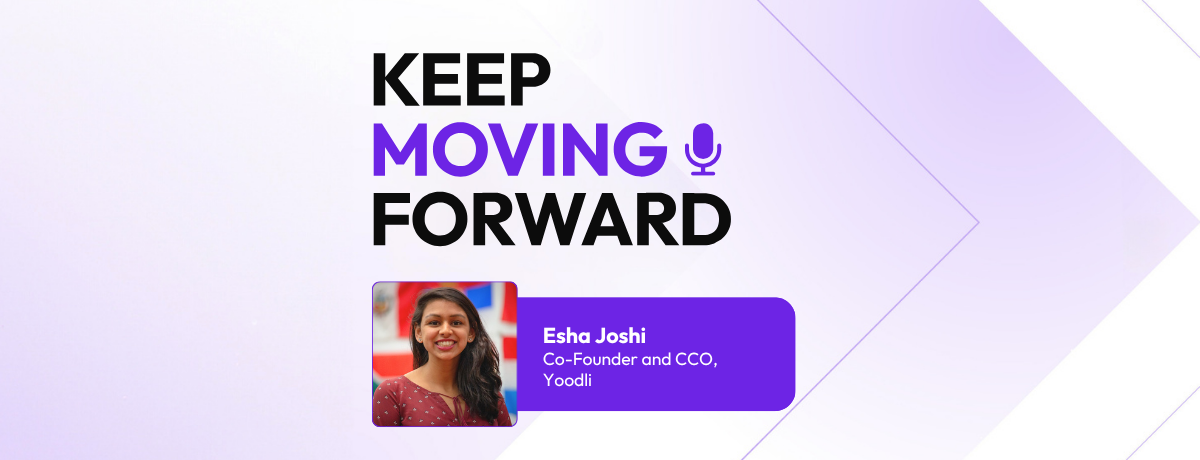
Esha Joshi has watched this play out at Fortune 100 and 500 companies for years. As co-founder and chief customer officer of Yoodli, an AI-powered communication and skills coaching platform, she works with sales, customer success, support, and solutions engineering teams on the conversations that define how they perform. Before Yoodli, she was a software engineer at Apple. She and her co-founder started the company out of the Allen AI Institute in Seattle after noticing the same problem everywhere they looked: brilliant people who couldn't get heard because they didn't have the confidence or training to speak up.
In this episode of Keep Moving Forward, Esha talks about why communication skills training rarely transfers to real work, what burnout taught her about the difference between being available and being effective, and what has to change structurally, not just culturally, for leaders to stop being the bottleneck in their own organizations.
When Communication Skills Training Changes Real Lives
Yoodli started as a simple prototype. A website where you could practice a speech and get feedback on filler words. That was it. But then a doctor used it to prepare for end-of-life conversations. A young man in India recovering from a stroke used it for private speech therapy. A woman told them that practicing a presentation gave her the courage to finally ask for the promotion she'd been waiting years for.
"Those are moments that have nothing to do, per se, with our ARR or our latest product launch," Esha says. "They're like the reason why this thing is worth those hard days."
As Yoodli has grown, Esha has had to let go of a lot: writing code, running sales calls, managing accounts that she'd personally closed. Every transition meant giving up work she was good at. "That's genuinely hard when your old job was something that you were good at for that time," she says. What she's found on the other side of each transition: She's gotten closer to the outcome that actually matters and closer to the stories that remind her why any of it is worth doing.
Behavior Change Doesn't Survive the Walk Back to the Desk
The workshop problem, as Esha describes it, is nearly universal. Instructor-led session. AI role play. Great feedback. And then nothing. "The adoption gap is around whether behavior change is built into the workflow," she says. When it isn't, the training ends the moment the session does.
What actually works is specificity. Not a generic scenario, but the exact conversation that's coming up next week. A high-stakes renewal. A sales kickoff presentation with team reputation on the line. A difficult conversation a rep has been avoiding. "When people have a real use case on the horizon and they can practice something that's really aligned to that use case and them specifically," Esha says, "I think it really clicks."
The second driver is leadership. If the manager has used the tool themselves, if they've practiced their own skip-level feedback conversation and talked about it openly, the team follows. "We don't want anything to feel like homework," she says. "It's gotta be meaningful and it's gotta be championed across."
'Every Decision Had a Path Back to Me'
The same pattern that breaks communication skills training also breaks leadership. A manager stays close, stays available, steps in to help the team think through every difficult conversation. It feels like support. But when the practice never belongs to the individual, the skill never transfers.
Esha lived this at the end of 2025. Her calendar was full, she was responsive on Slack, she was in all the right rooms. But every decision had a path back to her. "My team would come to me with things that they were fully capable of owning, and instead of saying 'that's yours,' I'd say 'let's think through it together' and then I'd solve it for them."
The team stopped building capacity. "Being a bottleneck is not a sign of being indispensable, but it's really just a sign that I haven't built the system properly."
The fix was the same one that makes training stick: explicit ownership. Not "you're responsible for this area," but "you own this decision, this escalation, this outcome."
Specificity and clarity are what make behavior change survive past the moment of instruction, whether that's a workshop or a one-on-one. Vague good intentions don't produce lasting change. The practice has to be tied to something real, and ownership has to be named out loud.
Transcript
Esha Joshi:
When we noticed, you know, a doctor using it to practice end of life conversations, or young men in India recovering from a stroke who used it for private speech therapy or a Toastmasters world champion, refining their delivery. We realized like this wasn't just a nice to have productivity tool. We were building something that could change outcomes for people.
Gemma Versace:
Hi everyone, and welcome to Keep Moving Forward, the podcast from X-Team for tech professionals who are passionate about growth, leadership, and innovation. I'm your host, Gemma Versace, Chief Client Officer at X-Team. In every episode, we sit down with leaders who are redefining how technology teams work, grow, and lead.
People who understand that performance begins with connection. Most of us have been in a room or a meeting where someone with a brilliant idea stayed quiet, not because it wasn't good enough, but because they didn't feel ready to say it out loud. That gap between having something valuable to contribute and actually contributing it is a confidence problem, and as it turns out, confidence is something you can practice.
Today's guest is Esha Joshi, co-founder and Chief Customer Officer at Yoodli, an AI-powered communication and skills coaching platform that helps customer facing teams prepare for high stakes conversations through AI role play. We talk about what it took to recognize that being available isn't the same as being effective and why becoming a bottleneck is a system problem, not a personal failing.
We also get into how the non-CEO co-founder role has to keep reinventing itself as a company scales. And what you have to let go of at each growth stage. Let's get started.
Esha Joshi:
Welcome to Keep Moving Forward podcast today. Esha, lovely to have you here. Hey, Gemma, lovely to be here. Thank you so much for inviting me.
Gemma Versace:
Oh, our pleasure. Our pleasure. We always start off with all of our podcast guests to just tell us a little bit about yourself and the work that you do.
Esha Joshi:
Sure. Happy to.
My name is Esha. I am one of the co-founders of Yoodli. I'm also the CCO, Chief Customer Officer. Yoodli is an AI-powered communication and skills coaching platform utilizing AI role plays. And what we do is we work with Fortune 100 and 500 companies on their high stakes conversations. So we help customer facing teams like sales, customer success, support, and solutions engineering prepare for those really meaningful, high stakes, impactful conversations all in the company methodology and ethos.
Before Yoodli, I was a software engineer at Apple, working on Apple TV Plus and Beats by Dr. Dre, helping to ship the Apple TV Plus product to millions of people. And my co-founder, Varn and I started Yoodli out of the Allen AI Institute in Seattle. Coming from a place of really wanting to help millions of people communicate with confidence and, you know, also increase their communications competence too, to help them get the opportunities they deserve.
Gemma Versace:
Oh, fantastic. Thank you so much for giving us that background. And as you mentioned, you've gone from engineering at Apple to co-founding Yoodli, which is, as you said, all about helping people communicate more confidently, which is an absolutely fantastic mission. What's the through line in the kinds of problems that you've chosen to work on and when you realized coaching communications was the one that you wanted to build your company around?
Esha Joshi:
Yeah. Thank you for the question. I'd say the through line is pretty personal. When I was at Apple, I kept noticing that something was bothering me in that brilliant people around me, especially women in engineering, but also other underrepresented minorities, people of color, folks who had learned English not as their first language, had incredible ideas, but couldn't get heard because they didn't have the confidence or training to speak up.
And I struggled with this too. I am a native English speaker. And I have had the training growing up. I've been very privileged to do so. But still, there were moments where speaking up to people of higher authority or bouncing back from being talked over was difficult. And I felt like I had ideas I wasn't sharing because I didn't have the permission to take up space or I didn't quite know how to bring it up or like where, you know, the political power lead.
And so the problem was always in front of me and I didn't think about it in a product technological way, but I think the moment shifted for me when my co-founder, Varn and me started sort of thinking about this idea more deeply during the pandemic and putting an early prototype in front of people and watching what happened.
And the early prototype was nothing super special. It was a very funny, simple, hacky looking, what we call smart mirror, where you could practice a speech in front of yourself on a website, and then at the end you'd get feedback on things like filler words and like ums and uhs and things like that, and that was it.
That was it. But when we noticed, you know, a doctor using it to practice end of life conversations, or a young man recovering, a young man in India recovering from a stroke who used it for private speech therapy or a Toastmasters world champion, refining their delivery, we realized like this wasn't just a nice to have productivity tool.
We were building something that could change outcomes for people, which is always part of what we're trying to do. And so once you can get into that space where you're practicing in a judgment free way, and you're able to see yourself and hear yourself back, then, you know, you can't unsee it and you're then focused on improving it to be a better version of yourself.
Gemma Versace:
What an amazing launchpad too that, as you said, coming from during COVID where people weren't sitting in front of each other, they didn't have that connectivity and engagement that, you know, we once had when everybody was in the office. So, what a fabulous opportunity for people that, you know, sitting in a meeting online maybe didn't feel that confidence to be able to articulate or share their ideas and to be able to give them this vehicle to do that is amazing.
And then so that's the kind of practical side of it. But then the amazing, the meaningfulness that comes with some of those examples that you just gave there is just a genuine, what a fabulous product that you know, you can no doubt, and you can definitely see why you and your co-founder and Yoodli are so successful because the meaning and the opportunity to give people the opportunity to be able to practice that and be able to get that feedback and grow that confidence is just so amazing.
So thank you so much for sharing that. You wrote candidly about hitting burnout at the end of 2025, and realizing that you were available but not delegating. Can you walk us through what your day-to-day looked like then and what changed once you really explicitly started to deputize to others to own pieces of the business?
Esha Joshi:
Yeah, very good question. I'd say part of the founder mentality is you're always on and you're jumping into everything because you like to hold things very firmly, 'cause you've been part of holding that thing very firmly since the very beginning. And at Yoodli, you know, we've been so privileged, we've worked really hard and we've gone into a place where the company's growing.
And so with that growth we have many more employees at the company. It's their awesome team. Many more customers, incredible customers, and an incredible team supporting those customers. And then of course, the revenue that comes with it. And so it's more difficult to be in everything, and I really shouldn't be. And that's one of the founder things I'm learning as the company grows.
And so to answer your question specifically, what it looks like was I was technically available for everything and my calendar was full of the right meetings and sometimes meetings that I maybe need to take. And now there's scrutiny of all my meetings. Every single week I was on Slack, I was responding quickly, maybe not quick enough in some cases, but so I wasn't actually letting anything go, and every decision had a path back to me.
So my team would come to me with things that they were fully capable of owning and instead of saying that's yours, I'd say let's think through it together and then I'd solve it for them. And it felt like being helpful 'cause it was squashing the thing and moving on to the next thing. But really it wasn't necessarily empowering them for the future. And that's been one of the changes that I'm trying to do, which is have them share with me what they think their proposal is and what they think they shouldn't do and why. And then talk through it together and have them arrive at the answers so that they can help themselves and help each other in a case where I cannot help them or somebody cannot help them.
And that was the thing that made me realize that like being a bottleneck is not a sign of being indispensable, but it's really just a sign that I haven't built the system properly. And again, I had never done that before, it's just my first time. And so we had some folks calling it out, other leaders of the company who I deeply respect, other folks who I also respect were calling it out. And so that shift was making it explicit, like naming the ownership assignments and not saying like, you know, you are responsible for this entire thing, but you own this particular decision, this escalation, this outcome, and you should be proud of it.
And once people truly own something, they stop looping me in by default, unless it's like really something they don't know how to do, or a really big escalation. And so quality of decision making has gotten better, but we can still improve it significantly.
Gemma Versace:
As a non-CEO co-founder, you sit in a really interesting spot, so you're close to the product. You're, as you mentioned, you're close to customers. You are a big driver in the culture of the business, but without the CEO title, how has your role evolved as Yoodli's headcount and revenue has grown, and what have you had to let go of to make room for that next stage?
Esha Joshi:
Yeah, it's sort of a fascinating phenomenon, my reflection of what's happened. And then it's also been sort of deeply uncomfortable and sometimes insecure, sort of figuring out what's the thing you wanna own, because correct, at the very beginning, even now close to everything, product, customers, culture, and the team. And you know, the org chart has me alongside my co-founder, the CEO, and early on, you know, when I think of, look at the sort of the co-founder pairing at the early stage, all the co-founders are doing everything, whatever it takes, and then you sort of do it based on whatever skills you have in that moment.
So for me, that was writing code, running sales calls, running customer success, client calls, hiring certain types of people, answering support tickets. Helping to figure out what kind of product to build, et cetera. And there was no role, it was just do what the company needs today to kind of propel it forward. And as we've grown and we've brought on people more specialized in certain roles, my role has become much more defined around customer success, go to market, and being, what do you call, maybe the connective tissue between what customers actually need and what we build.
And there are people at the company who can do those things too, and some of them are a lot more experienced and so there's a great learning there. But the customer connect, the customer intimacy is really important to stay very close to in my opinion.
But what I did have to let go of with every single transition is something that I was doing before, whether it was writing code or being that person who was prototyping and developing those sort of product requirement documents or certain accounts that I closed that I was expanding, or people that were reporting to me, et cetera, like that's all the things I've had to let go. And that's genuinely hard when your old job was something that you were good at for that time.
And so as I move further away from the things I've moved from, I've gotten closer to probably things that I'm stronger at and have an inclination at anyways. But also closer to the actual outcome, which is whether customers have succeeded. So that's been worth it, and that's been fun.
Gemma Versace:
Amazing. Amazing. And you know, we mentioned about a lot of the changes and a lot of the moves that you've made have been on the back of the growth at Yoodli and Yoodli has grown incredibly fast with, you know, new funding, more enterprise customers, bigger teams. And when you take a look at where things broke or nearly broke, what did those moments teach you about designing ownership and decision making across the teams so the team can move more quickly without everything always having to, you know, roll back to the founders?
Esha Joshi:
Yeah, that's a great question. The break tends to come from the same root cause, which is unclear ownership at the moment of scale. And I say scale because I don't just mean like all companies scale from the 15 to the 60 people, but I even mean within a specific decision making realm, you add a couple more people than even you, you then have to re-figure it out. And so specifically, like something would've worked fine when two to three people know it and then you add headcount and then suddenly nobody knows who makes the call.
And then the bad version of this is when you have two very smart people working on the same problem from different angles and didn't realize until it's too late, or when a decision that could have taken a day sits in someone's inbox for a week because everyone assumes everyone else is tracking it. We've, you know, had a couple of those sorts of silly things.
What I've learned is that the antidote is sometimes quite simple, which is, you know, writing down who owns that and then updating it constantly. And then making it really clear who the new updated, directly responsible individual is. Because that can change as the company grows. That can change every single month, every single quarter, and it's, what I don't want it to become is bureaucracy. Oh my goodness. No, I came from, we came from these bigger companies, that's not it. I just want people to know what to do, have clarity, and then move forward quickly. That's also the way we want.
Gemma Versace:
Definitely, and I think you've hit the nail on the head there with it's all about being able to provide the teams with that clarity because the one meme that always comes to mind, you know, in work I've done, but also when I'm talking to people, is without clarity we all turn into that kind of Spider-Man meme where we're all just pointing at each other thinking, no, you are gonna do it, you are gonna do it. And being able to, you know, from the very beginning, provide that decision making matrix and clarity to the teams is just so, so, so critical.
And I agree with you. I think, you know, you wanna be that kind of, you wanna be the jet ski out on the water, not the barge ship that some of the bigger businesses can sometimes do with all of the bureaucracy and red tape just to be able to make a decision. So I think that's some really interesting advice for leaders listening to really make sure that clarity from the beginning is set across the teams.
A little bit of a change of pace here. So you're building an AI native product that people use to practice real conversations, as you said at the outset. So sales calls and presentations and delivering things like tough feedback. What have you learned about getting teams to actually integrate AI into their daily work versus train at once in a workshop and then everyone reverts to old habits? How have you gone about making sure that you get the buy-in and the stickiness without it being, you know, such a top-down mandate where people feel like they have to be using, you know, approved AI tools?
Esha Joshi:
I mean, the workshop problem is real, and it's almost universal, where like we bring people in, they listen to this instructor led conversation, people learn concepts at different paces with different learning styles. Then they do a role play right after, and in that role play, they reinforce the concepts they just learned with like an AI tutor, and then they practice the conversation with an AI buyer or customer, and then they say, wow, this is amazing. And you have some portion of the population that then is bought in and continues to use it. Then you have some portion that says they're back to doing whatever they were doing before. And not that they didn't find value from that role play, but because then the adoption gap is around whether behavior change is built into the workflow. Behavior change is hard in and of itself.
'Cause in this case, you're watching yourself back, you're hearing yourself, and then you're cringing or you're getting feedback about yourself, both positive and constructive. And that can be tough, right? Depending on who you are and how you take feedback and what your like emotional capability around that is.
And so what we found actually works, and we're constantly iterating upon this 'cause this is super important for helping achieve customer outcomes, but then also, you know, helping tell the story of value. But what actually works is tying the practice to something that has stakes. And so for a company that can be specifically ramping up onboarding, that can be for a sales person running an AI role play session before a standalone event. So before a big customer renewal, which is very rep specific, before a big sales kickoff where you're presenting your monthly business review that has like team reputation, before a difficult conversation, you know, that's coming. And so when people have a real use case on the horizon and they can practice something that's really aligned to that use case and them specifically, I think it really clicks 'cause it gives them all of the necessary components to learn and get ready with their own learning style. So that's one.
The other is when managers use it themselves and they advocate for it. And so if the person running the team has practiced their own skip level feedback conversation, and also they're using sort of the practice as accountability as part of their conversations, then the team follows. It's even much better if you have like the highest leader do that because then the team looks at that and sees it as the status quo. We don't want anything to feel like homework. There's already a lot of that in and of itself with data work. So it's gotta be meaningful and it's gotta be championed across.
Gemma Versace:
It's just such a, when having a look at the product, obviously before you coming on it, as somebody who has managed and do manage sales and customer success teams, it just jumped out to me as just an absolutely transformational product because it's something that sometimes it's not only the person who is presenting that is nervous and wanting to be able to refine and practice and hear themselves, as well as the leader or the manager who might be a little bit concerned about how to communicate or articulate, maybe not so great feedback or some challenges that they're seeing.
So I think it's just such an amazing and important product, but it's also something that allows everybody to learn and practice, you know, with their dignity intact. And as you said, all of those examples that you've just said there really highlight that, you know, it's something that across all different types of industries and markets is just a really fantastic product.
You've talked about the importance of in-person moments, you know, quick syncs that turn into the brainstorms, or really challenging and great conversations, maybe vulnerable conversations when somebody admits that they're stuck. For leaders running distributed and hybrid teams across different regions, across different time zones, what's the smartest way that you've found to use limited in-person time so that it really pays dividends when people, when everyone goes back, you know, to their home office?
Esha Joshi:
Yeah, I love this question. We have something quarterly called Vibes Week. It's our in-person.
Gemma Versace:
I love that.
Esha Joshi:
And it's called Vibes Week. It's a very large cultural backdrop of we just want people to come together and have good vibes. Now, it sort of started off as like a hangout when we were like an eight or a nine person company and now we're nearly over six X that. So we've gotta be more structured and more intentional with the time. And so still called Vibes Week, we're figuring out how that evolves as the company grows, cadence, et cetera, location, et cetera.
But one of the things I'd say is I wouldn't just use it for information transfer. So like there is importance in reviewing roadmap, reviewing metrics, all of that will happen when we all come together, but then also asynchronously. But the in-person time is to have fun, build those relationships, and then have those like meaty strategic conversations. And so when we're all in the same room and there's the good brainstorming and uncomfortable conversations and somebody's like, I'm stuck and I don't know what to do. And somebody else from the go-to-market team is meeting someone from the engineering team and vice versa. That's great. That's the kind of in-person collaboration I'd like.
And there's also value in time that's unstructured. And so somebody mentions some problem and then three people get curious and then 45 minutes later you've cracked a problem that had been on your backlog for months, but it's important. And so those are things you can't really schedule asynchronously. But I think being in person, you can create the conditions for it. And yes, it's fun.
Gemma Versace:
How does Yoodli practice what you preach? So, you know, how does Yoodli eat its own dog food? So are there specific rituals like practicing investor updates, customer calls, maybe, you know, tough one-on-ones, that have meaningfully changed how your team communicates and makes decisions? You know, what are some of those amazing internal case studies and reference stories that you've been able to witness at Yoodli?
Esha Joshi:
Yeah. This is such an important question because if our team, if we are not drinking our own champagne or Kool-Aid or whatever that is, then how can we have empathy for our customers and how can we advise our customers on ways to help them and their learners, their company learners get more value. So it's really important that like we use it, we become obsessed with it, and we're the first to figure out what's going wrong and then share that with customers and then also understand where our customers are coming from.
The empathy piece we spoke about. So we've got two use cases where our team is using Yoodli and one is on the onboarding phase. And then the second is in what I call the ever-boarding phase. So post onboarding, how are you constantly learning and staying up to date? So for the onboarding phase, we have every customer facing, go-to-market rep train and onboard on Yoodli, just like our customers do with their learners.
And so people come in and they will do product certifications. If you're on the go-to-market team, they will do tutor conversations to learn about the Yoodli pitch deck, et cetera, et cetera, and it's, we're improving it. But right now we have a couple weeks and different modules that are built and we can all see how each of these folks are doing. And then for some roles they'll do sort of an in-person live certification based on how important it is for you to know certain roles or certain capabilities of the company, the product, et cetera. So you can do that, anything from compliance to what are the values of Yoodli to what is the product, to what is the pricing, all of these things. And then you do them in bite-sized learning, so nowhere anything more than three to four minutes to keep people entertained. Evidence-backed learning, baked into the onboarding. So that's part one.
Part two is the ever-boarding, and so one of the biggest things that can be a challenging one is because people then learn at different rates beyond the standard curriculum. So for ever-boarding, we recently launched something called Insta Enablement, which we're also championing with our customers, and a lot of them are using it. The idea behind that is as soon as there are product updates at the company, something has shipped, your go-to-market team, the idea is that you instantly enable them with a click of a button. And so last week, six things got released, four of them are huge, two of them are smaller. Our product team clicks a button, and then with an instant, there are these micro learning role plays that get pushed out via Slack to every single go-to-market person. And the role play is customized to each person's learning style, but it contains the same content of those several different feature updates.
And so in 10 minutes, convenient to you, you can go do that role play, it's a tutor and you can learn about what's shipped, and then you can ask it questions based on what you care about and what your role is. And so then you have a really awesome way of like letting people know very quickly what's happening on the product side, because for us, we ship twice a week. And so we have to keep our teams updated, we have to keep our customers updated. It's a good problem to have, but it's a hard one.
Gemma Versace:
And one last question, Esha, because we do ask this question with all of our podcasts. It's a two pointer here. How are you and your co-founders at Yoodli going to keep moving forward, and what does keep moving forward mean to you personally?
Esha Joshi:
What grounds us when things get really tough and messy is the perspective of why we started building this in the first place. And even the people who are using the product in ways that we never thought they would or they could. And so we have certain customers, we have customers on demand that will just call up and just, you know, ask them what's going on, what's good, what's bad, what's ugly about, you know, tell us.
And then also we learn these really interesting use cases of people using Yoodli like a stroke survivor who's using it for speech therapy, or the woman who told us who practicing a presentation in Yoodli gave her courage to finally ask for a promotion that she'd been waiting on for a few years. Right. So those are moments that have nothing to do, per se, with our ARR or like our latest product launch or our growth goals or any of the challenges we're having. They're like the reason why this thing is worth those hard days. And all of those hard years of work. And so going back to stories like those when I'm in a tough spot really helps.
Gemma Versace:
Oh, I can imagine. And not to be too dramatic, but just, you know, those examples that you gave there, it's goosebump worthy. Your platform and your product is changing lives, it's giving people confidence that without it wouldn't be able to, you know, access the type of feedback that they are getting access to. They wouldn't be able to be given the tools and strategies to give them the confidence to be able to, you know, as you said, learn, you know, practicing in private and become confident in private.
So thank you so much for you and your co-founders for creating this amazing, wonderful product. But more importantly, also thank you for joining us here today on Keep Moving Forward. I've thoroughly enjoyed the conversation.
Esha Joshi:
Thanks so much. I really appreciate it.
Gemma Versace:
One thing that stayed with me from this conversation is something Esha said about solving problems for her team. Availability looks like leadership, responsiveness looks like support. But when every decision has a path back to you, you haven't built a team. You've built a dependency. And the fix, as Esha described it, wasn't a mindset shift, it was a structural one. Name the owner, define the decision, make it explicit, then get out of the way.
There's something worth sitting with in the Yoodli origin story, too. A simple prototype, a website where you could practice a speech and get feedback on your filler words. That was it. But then a doctor used it to prepare for an end of life conversation. A stroke survivor used it for speech therapy. A woman used it to finally ask for the promotion she'd been waiting years for.
The product didn't change. The use case revealed itself, and that's a reminder that the most meaningful version of what you are building often shows up before you've planned for it. If you're paying attention, the leaders who scale well stay close to those stories. Not just the annual recurring revenue and the growth goals, but the reason the hard days are worth it.
Join us next time for more conversations with technology leaders who inspire us to grow, lead, and innovate. You can find us on Apple Podcasts, Spotify, or YouTube Music. If you enjoyed this episode, please share it with your network. We'll see you next time.