
Figuring out how to build an AI development team is hard. It gets even harder if you restrict your talent pool to your local market and to full-time employees.
X-Team's Out of Sync 2026 AI Talent Readiness Report found that organizations using embedded, longer-term staff augmentation report 85% strong value capture and 66% structured training, compared with 42% and 35% for internal-only teams.
That tells us that building an AI development team is an organizational design challenge, not a recruitment challenge alone. The organizations with the most mature AI programs use a mix of AI talent models: hiring where you genuinely need new full-time roles, upskilling the engineers you already have, and staff augmentation with senior developers with both domain expertise and AI skills.
What Is an AI Development Team?
An AI development team is the group of engineers, data specialists and governance stakeholders responsible for building, deploying and maintaining AI capabilities.
AI project teams are different from traditional software teams that ship deterministic code. Because AI development teams work with probabilistic systems, the team includes roles a typical dev team doesn't need, like ML engineers who train models, data engineers who feed them, and MLOps engineers who keep them stable in production.
8 Core Roles on a Successful AI Development Team
A successful AI development team is made of a variety of roles. Each function needs an owner, even if one person covers multiple roles early on.
- AI Product Manager. Translates business goals into scoped initiatives, sets the evaluation criteria that define success, and keeps the team building toward a measurable outcome. This role matters because AI outputs are probabilistic, someone has to decide what "good enough" actually means and make that call consistently across the project.
- Machine Learning Engineer. Builds, trains, and tunes the models that power the product, turning research and data into working prediction or generation systems. This is the technical core of the team; without it, there's no model to deploy in the first place.
- Data Engineers and Data Scientists. Builds and maintains the pipelines and infrastructure that feed clean, reliable data to every model and system downstream. Every other role depends on this work, since a model is only as good as the data it's trained and run on.
- MLOps Engineer. Owns deployment, monitoring, and the infrastructure that keeps a model running reliably once it's live, not just working in a notebook. This role matters because most of an AI system's value is realized in production, and models that aren't monitored tend to degrade silently over time.
- AI Platform Engineer. Builds the shared infrastructure and tooling that other teams reuse across projects, rather than each one building its own from scratch. This matters at scale, since it turns AI development from a series of one-off efforts into a repeatable, faster process across the organization.
- AI Software Engineer. Wires model outputs into an actual product surface, connecting inference endpoints to the interfaces people actually use. This role matters because it's the bridge between a model that works technically and a feature that delivers value to a real user.
- Domain Expert. A subject-matter specialist from the business side who translates real workflow logic into requirements and judges whether model outputs are actually useful in context. This role matters because it keeps the team anchored to a real, well-defined problem instead of a technically impressive solution in search of one.
- Security and Governance Lead. Owns model registration, access controls, bias and privacy review, and incident response, serving as the accountable party when questions arise about how a system makes decisions. This role matters because it protects the organization's ability to audit, explain, and defend its AI systems as they scale.
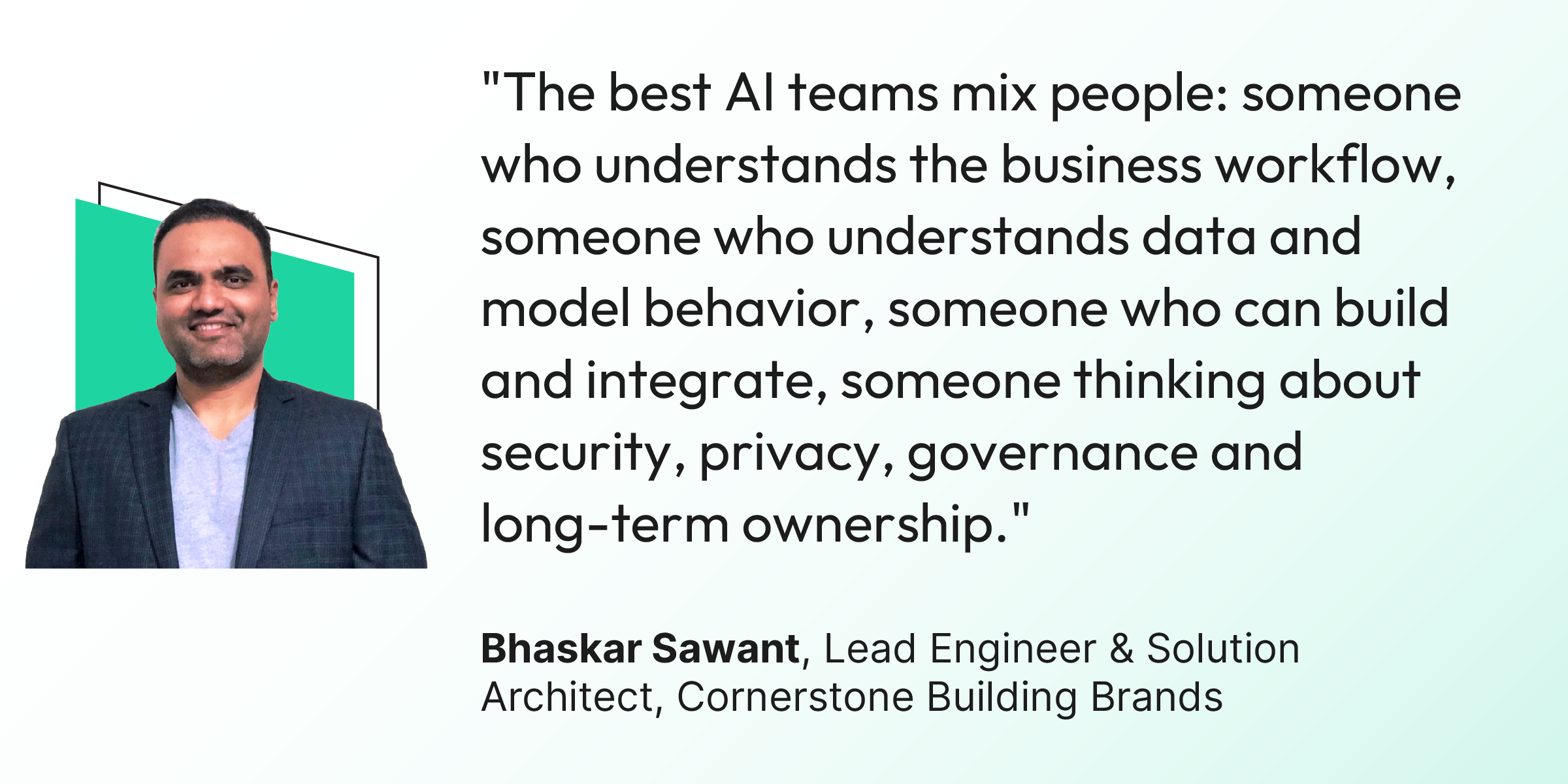
Bhaskar Sawant, lead engineer and solution architect at Cornerstone Building Brands, says the best AI teams have a mix of skillsets and perspectives: "Someone who understands the business workflow, someone who understands data and model behavior, someone who can build and integrate, someone thinking about security, privacy, governance and long-term ownership."
3 Common Structures for AI Teams
Centralized, embedded and hybrid models each work in the right context.
Centralized AI Team
In a centralized team, every AI specialist reports into one AI or ML leader, and that team serves the rest of the company as a shared resource: Business units submit requests, and the central team builds and prioritizes the work. It makes sense when the AI capability itself is the product, or close to it.
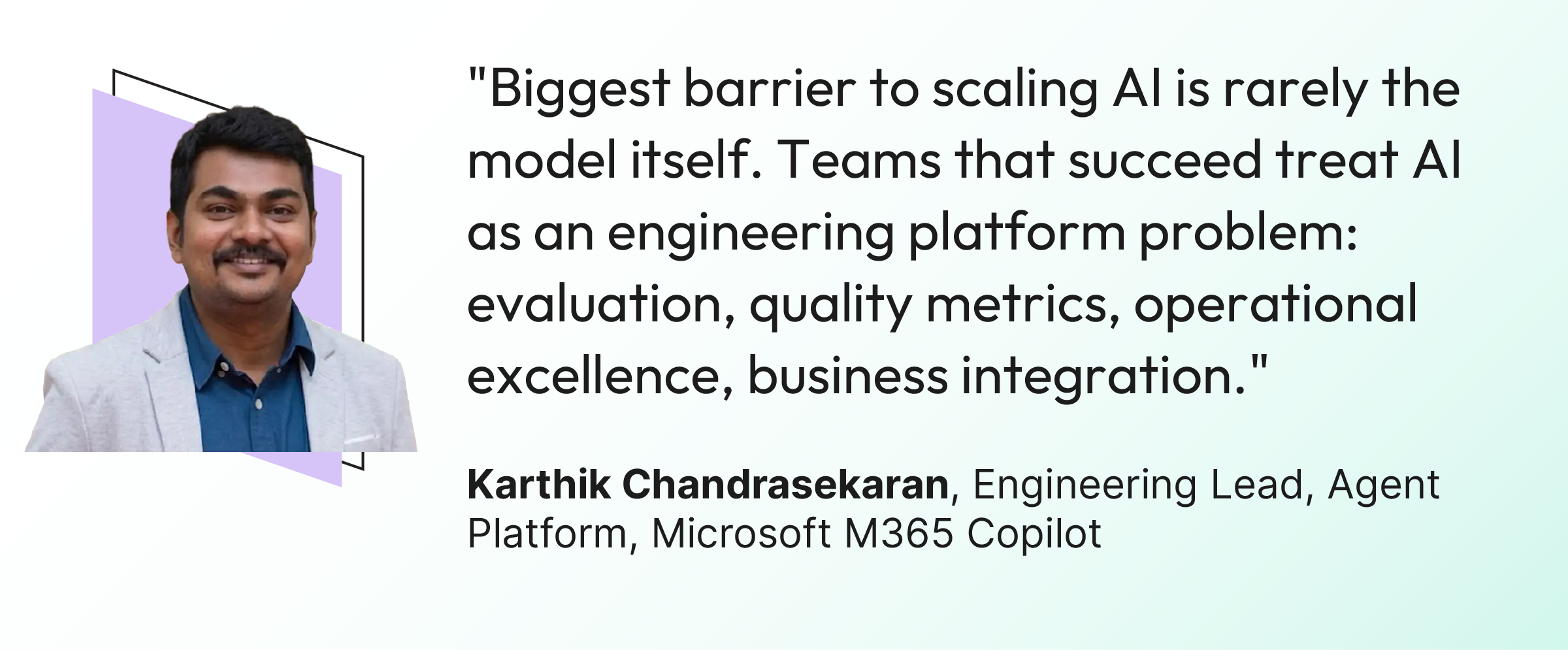
Karthik Chandrasekaran leads engineering for the Agent Platform inside Microsoft's M365 Copilot organization, where he says centralizing platform-level AI work lets product teams across the company build on shared infrastructure instead of each solving agent orchestration independently.
"Biggest barrier to scaling AI is rarely the model itself," he says. "Teams that succeed treat AI as an engineering platform problem: evaluation, quality metrics, operational excellence, business integration."
Embedded AI Team
An embedded team distributes AI specialists directly into the product or business units they support, reporting to those units' leaders rather than to a central AI function. Each unit owns its own AI work end to end, which keeps the people running AI initiatives close to the workflows and existing systems they will affect the most.
That proximity is the tradeoff against centralization: an embedded specialist understands the business context firsthand, but shared infrastructure and standards have to be rebuilt or re-agreed unit by unit unless something else, usually a hybrid model, coordinates them.
Hybrid Model
A hybrid, or hub-and-spoke, model keeps a small central team that owns shared infrastructure, standards and governance, while AI specialists sit embedded inside individual business units for day-to-day delivery. The hub sets the guardrails; the spokes build inside them.
A hybrid AI team model tends to fit smaller, resource-constrained teams best, since a fully centralized AI group can create a bottleneck for a team that size, but a fully embedded model spreads too few specialists too thin. Chris Brooks' team at Crypto Asset Recovery settled on this middle path with a small core owning the shared tooling, with AI-comfortable people embedded directly in the recovery work itself.
How to Build a High-Performing AI Team, Step by Step
Organizations that build durable AI capability start by asking who owns AI and what that means for everyone else.
Step 1: Map Your Current Capabilities and Identify the Gaps
Map what your current engineering team can do before you add anything new and be specific about what you find. Most teams discover the gap isn't where they expected. Pure model expertise is rarely the binding constraint. What's more commonly missing is systems thinking, evaluation design and operational judgment.
"Companies treat AI as a separate specialty group instead of part of normal engineering discipline," Sawant says. "They hire for model knowledge or tool experience, but the project stalls connecting to real systems, users, data and production support."
Step 2: Decide How to Fill the Gaps
The decision isn't only about budget and cost saving. Hiring and upskilling in house, staff augmentation and project-based contracts each carry different implications for continuity and institutional knowledge.
For foundational capability your organization needs to own long-term, a direct hire gives you the cultural alignment and ownership a contractor relationship won't replicate. For specialized expertise needed during a defined phase, embedded IT staff augmentation — engineers integrated into your team, working on your systems — is usually the better fit. For time-boxed work that doesn't require deep integration, project-based outsourcing is appropriate.
The failure modes to watch: bringing in contractors for work that requires long-term institutional knowledge, making permanent hires for skills you'll only need once, or rushing to build an offshore team for AI before you really understand what you need.
Step 3: Assemble the Core Team
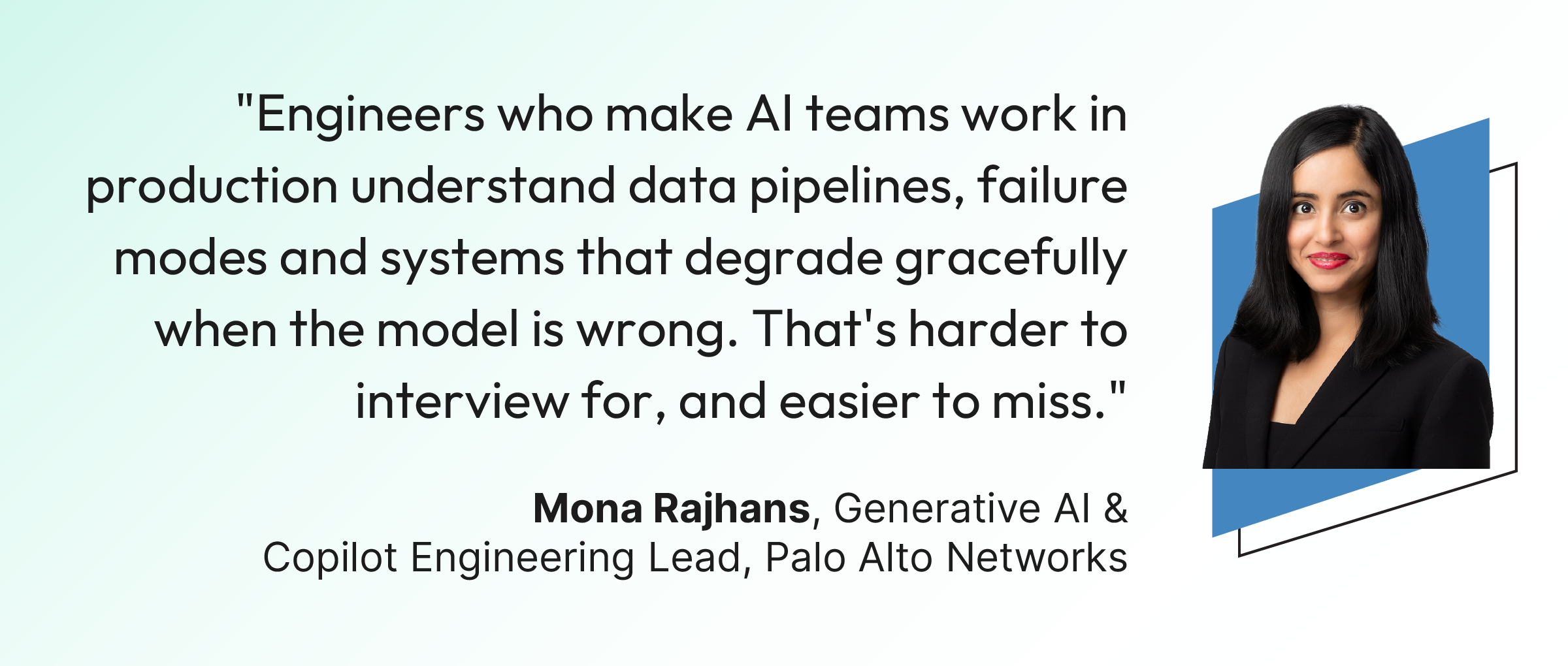
The combination of skills matters more than any single hire. Mona Rajhans leads Generative AI and Copilot engineering at Palo Alto Networks, where she's staffed and scaled AI teams through the full cycle, from early pilots to production systems now working toward patents. Ask her what separates a team that ships from one that doesn't, and she doesn't start with the model.
"Engineers who make AI teams work in production understand data pipelines, failure modes and systems that degrade gracefully when the model is wrong," Rajhans says. "That's harder to interview for, and easier to miss."
Rajhans changed her own process to better identify those types of team members. The candidate who transformed her team's approach came from distributed systems and frontend platforms, not ML. Her interviews shifted away from prompts and model architecture toward operational questions — failure recovery, retrieval fallbacks, telemetry — the concerns that determine whether AI holds up in production.
"That mindset turned out to be exactly what was needed moving from prototype to production," she says. Candidates deep in transformer architectures and fine-tuning often had little to say about reliability, rollout strategy or failure recovery. "Good for a model research team," as she puts it. "Wrong hire for building enterprise AI products."
Strong credentials aren't the only signal. Yatin Agarwal, co-founder of Nextworks, has found that the disposition to learn matters as much as what someone already knows. "They don't need to be the best engineer," he says, "if they have that drive and if they have the passion to pick things up ... we can teach them the methodologies behind engineering."
Step 4: Establish Team Structure and Norms
An AI team that hasn't agreed on how it makes decisions will make them reactively in production, under pressure. Define the operating agreements before the team ships anything.
Start with quality gates and feedback loops: What does "ready for production" mean, and who decides? Rollback needs the same treatment — when something degrades, someone needs to own that call and know how to make it quickly. How the team communicates results and incidents to non-technical stakeholders is worth setting expectations early, before those conversations happen for the first time under pressure.
Knowledge transfer deserves a deliberate answer. When team composition changes — and it will — what the team built and learned needs to stay in the organization. That doesn't happen by accident.
Upskill vs Hire vs Outsource: AI Talent Strategy at a Glance
|
Strategy |
Best For |
Watch For |
|---|---|---|
|
Direct hire |
Foundational AI capability the organization needs to own long term, where deep institutional knowledge and tight control over data and models matter. |
Hiring for highly specialized skills you’ll only need once, slow and expensive course‑corrections if you hire the wrong profile. |
|
Upskill existing team |
Teams with strong engineering fundamentals that need AI capability woven into existing roles and workflows. |
Underestimating ramp time, expecting full delivery velocity while people are still learning, and not giving structured time or guidance for practice. |
|
Embedded augmentation |
Specialized expertise needed during a defined phase (e.g., initial platform build, hard integrations) or scaling delivery without adding permanent headcount. |
Short engagements that churn talent before knowledge is documented, plus cultural misalignment if augmented engineers aren’t integrated into rituals and code standards. |
|
Project‑based partner |
Time‑boxed deliverables that don’t require deep, ongoing integration (e.g., a prototype, a one‑off migration, or a narrowly scoped feature). |
Scope creep into ongoing work, no clear path to long‑term ownership, and over‑reliance on a vendor for future changes or maintenance. |
5 Common Mistakes When Building an AI Team
The most common mistakes in building AI development teams have more to do with people and planning than the technology.
Poorly Defined AI roles
A common failure mode is hiring “an AI person” without defining what they actually own. X‑Team research found that organizations with clearly defined AI responsibilities across existing roles see 61–69% structured training adoption and 28–30% standardized value capture, versus 18% and 3% for organizations with no formal AI roles at all, regardless of team size. In practice, that means specifying who owns data pipelines, who owns model behavior, and who owns product integration instead of expecting one generalist to cover everything.
Hiring for the Wrong Skills
Many teams still hire for AI roles that made sense five years ago — heavy on academic ML credentials, light on production engineering skills. Current research and job-market data show that the work has shifted toward operationalizing models: ML/AI engineers now need strong software engineering, data engineering, and systems design skills to build and maintain production-grade AI features, not just expertise in model training.
Siloed AI teams
On org charts, it can look neat to put data teams upstream, AI teams in the middle, and product teams downstream, but that structure creates slow feedback cycles and fragile systems. Studies of AI operating models find that cross‑functional product teams, where data, AI, and software engineers own the full lifecycle together, ship more reliable systems and adapt faster when data or user behavior changes.
Unclear Governance
In many enterprises, AI governance exists on paper but not in practice: Security, legal, compliance, HR, and business units each own a slice of policy, so no one owns enforcement or outcomes. Common governance failures include treating AI as a one‑time approval instead of continuous monitoring, applying the same controls to low‑risk and high‑risk use cases, and ignoring “shadow AI” usage in unapproved tools, all of which allow risk to accumulate in the gaps between teams.
"Organizations rarely get blocked because the models aren't capable enough anymore," Rajhans says. "More often, they slow down because ownership is ambiguous."
No Metric for Success — or Failure
AI pilots are failing at far higher rates than traditional IT projects, with multiple studies citing failure rates above 80–90% and most of those failures trace back to planning, not technology.
They start from vague business problems, lack an executive sponsor or production owner, and have no clear success criteria or kill conditions.
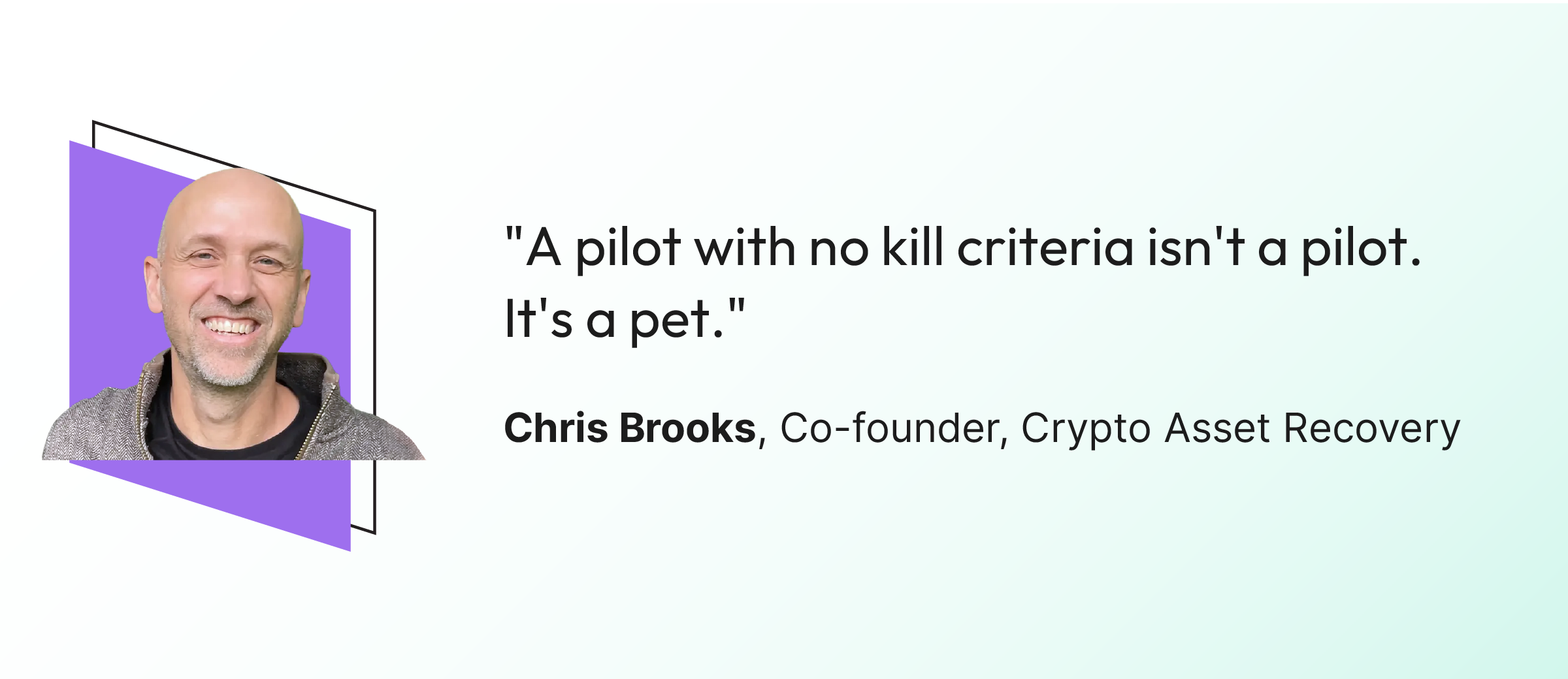
"A pilot with no kill criteria isn't a pilot," Brooks says. "It's a pet."
How X-Team Helps Companies Build AI Development Teams Faster
Embedding engineers who are already AI-ready directly into your existing team, inside your tools and your process, gives institutional knowledge time to compound instead of resetting with every new contractor.
X-Team works across SaaS, fintech, gaming, medtech and Media & Publishing companies, embedding AI-ready engineers into existing teams without the overhead of a full-time hire or the ramp-up cost of a new contractor every quarter.
Download the Out of Sync 2026 AI Talent Readiness Report to see where your organization's confidence and capability line up, and take the AI Talent Readiness Assessment to get a custom read on your own team.
SHARE: