
The resumes pile up. The screening calls happen. The technical interviews run their course. And you still end up with someone who clears every step and then, six months in, needs constant direction, avoids hard conversations, and can't explain a technical decision to anyone outside engineering. It's never been harder to know how to hire the best software developers.
It seems counterintuitive. More than 600,000 tech workers have been laid off since 2022, according to Layoffs.fyi. Application volumes per posting are at record highs. And yet engineering leaders are still missing roadmap targets because they can't find the right people.
What Makes a Great Software Developer?
Most teams define "great" by what they can verify: years of experience, frameworks known, GitHub activity. Those things are easy to screen for. They're also poor predictors of whether someone will actually make your team better.
The developers who move roadmaps forward — who you'd rehire without hesitation — share five attributes that almost never show up in a resume.
Ownership in ambiguity
When requirements shift mid-sprint or a stakeholder changes direction, most developers wait for guidance. The ones worth hiring figure out who needs to know, surface the risk, and push for a decision. That's not personality — it's a measurable behavior. And it's the clearest line between someone performing at a senior level and someone performing below it.
Communication as a senior signal
A meaningful portion of a senior engineer's day has nothing to do with writing code. It's design docs, PR reviews, sync calls with product, and conversations with stakeholders who don't know what a merge conflict is. Developers who struggle to explain technical concepts outside engineering create invisible bottlenecks. You don't always see the cost until you're already paying it.
Product thinking
The engineers who consistently deliver value ask why before they ask how. They push back on requirements that create technical debt without solving the user problem. They treat the work as their problem to own, not a spec to fulfill. That orientation changes what they build, not just how.
Adaptability
The 2025 Stack Overflow Developer Survey found that 84% of developers were using AI tools regularly — and favorable sentiment toward those tools dropped from above 70% in 2024 to 60% in 2025. The engineers worth hiring aren't the ones who adopted AI earliest. They're the ones who can evaluate it critically, use it where it adds value, and recognize where it doesn't. That takes judgment and continuous learning, not just familiarity with the tools.
Net Positive Contribution
Research on developer productivity consistently identifies what's called the "net negative producing programmer" — developers whose defect rate and coordination overhead make the team slower, not faster. The 10x engineer is mostly a myth. The net-negative engineer is not. The goal of your hiring process isn't to find a unicorn. It's to avoid the hire that sets three other people back.
Years of experience, CS degrees, and familiarity with your exact stack are proxies for these attributes. Sometimes they correlate. Often they don't. Knowing how to hire good software developers means evaluating for the real thing, not the proxy.
7 Costly Mistakes Companies Make When Hiring Software Developers
Most of these mistakes are familiar. That's what makes them expensive — not that they're unknown, but that the conditions that create them are almost always present.
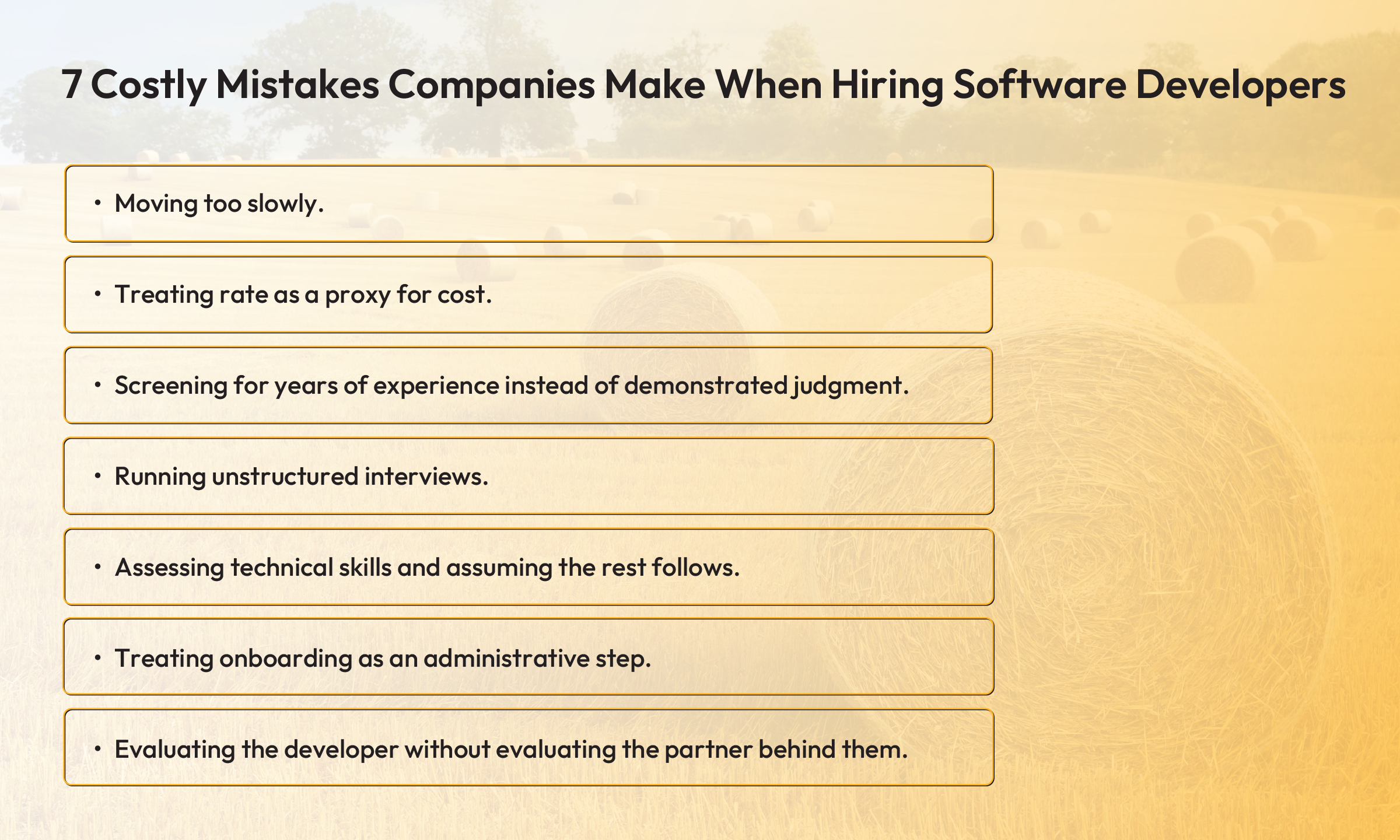
- Moving too slowly. Senior engineering roles take an average of 45–90 days to fill. AI and infrastructure roles average over six months. Meanwhile, a vacant seat costs up to a day in delayed velocity — quietly, without a line item attached to it. The developers you want are off the market within two weeks of starting a search. A process that runs four months to an offer isn't thorough. It's a filter that selects for whoever is still available.
- Treating rate as a proxy for cost. A bad senior engineering hire costs between 50% and 200% of first-year salary to replace — that's ,000 to ,000 for a ,000 role, before anyone accounts for delayed roadmap and rework. In the tech industry, the cheapest option in a hiring process is rarely the cheapest option six months later.
- Screening for years of experience instead of demonstrated judgment. Years of experience is a proxy signal, and an increasingly unreliable one. A developer with three years of AI-augmented output may produce more value than one with seven years of purely manual work. If your job description filters on "7+ years," you're screening for seniority, not capability.
- Running unstructured interviews. Research consistently shows that unstructured interviews predict job performance at a validity of 0.38. Structured interviews — same questions, shared rubric, calibration session — reach 0.51. That difference compounds across every hire you make. Most teams know this and still don't do it, because building a rubric takes time they don't feel they have.
- Assessing technical skills and assuming the rest follows. Ownership, communication skills, and product thinking almost never surface in a technical screen. If you're not explicitly designing questions to surface them, you're leaving the most predictive attributes unevaluated — and discovering the gap six months later when it's expensive to fix.
- Treating onboarding as an administrative step. The first 90 days are when retention is actually decided. Engineers without a clear 30/60/90 plan, a named point of contact, and a defined path to a first meaningful contribution disengage quietly before they're fully productive. That attrition doesn't show up in a survey. It shows up in output.
- Evaluating the developer without evaluating the partner behind them. When you engage an external talent firm, the developer who interviews well is not the complete picture. The partner's onboarding model, communication structure, continuity planning, and escalation process determine whether that developer is still embedded in your team 18 months from now. X-Team's Buyer's Guide to selecting an outsourced development partner gives you a framework for evaluating vendors on the operational factors that predict long-term success — beyond what any pitch deck will tell you.
A Step-by-Step Process for Hiring the Best Software Developers
Use this software developer hiring guide as a repeatable framework — one you can run the same way every time you need to add senior engineering capacity.
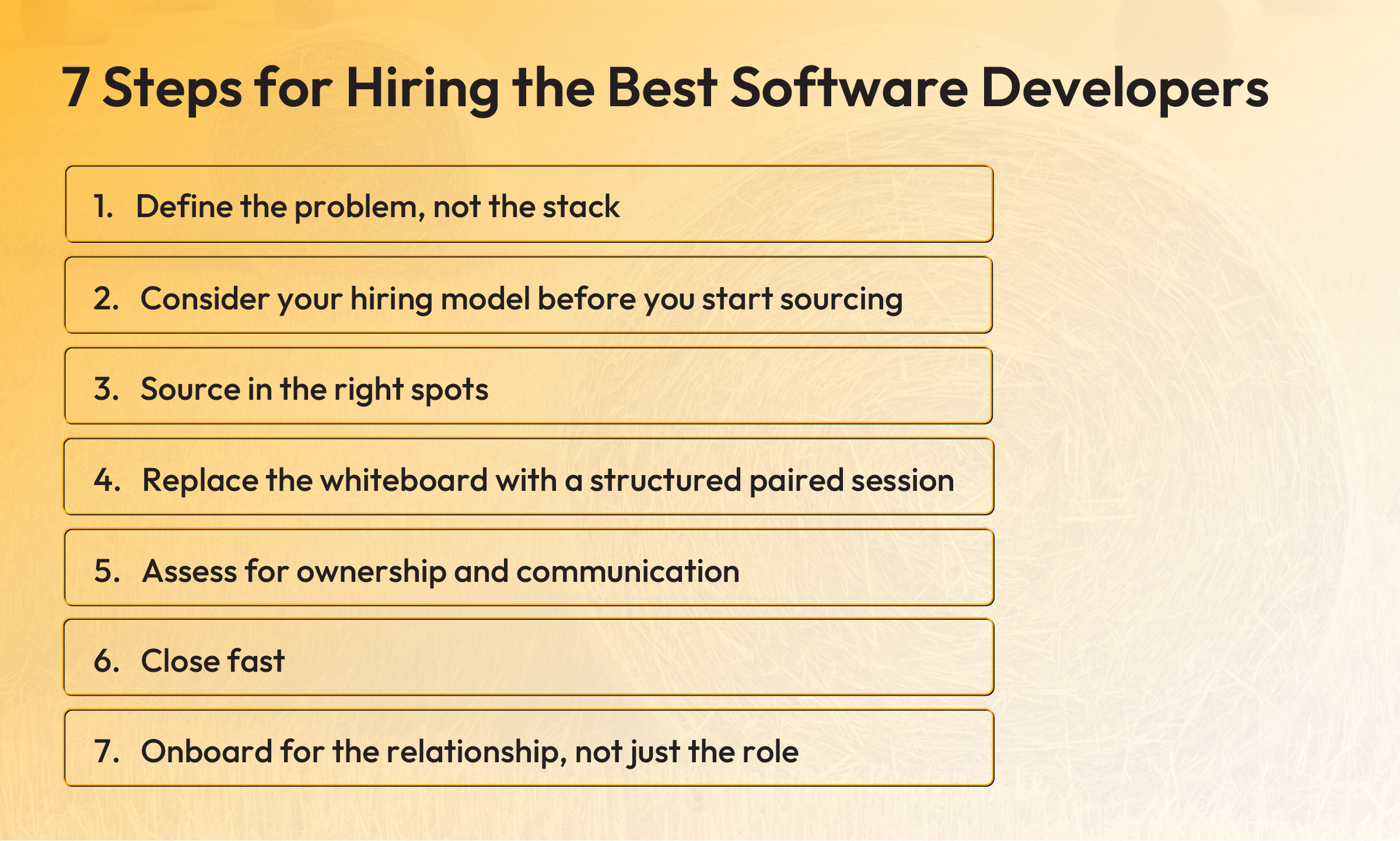
Step 1 — Define the role as a problem, not a stack
Before you write a job description, write a one-page problem statement. What will this developer work on in the first 90 days? What are the three most important decisions they'll own by month six? What does strong performance look like — not in skills, but in outcomes?
Senior engineers read job descriptions looking for evidence that the team knows what it's building and why. A list of frameworks, programming language requirements, and a "7+ years required" filter signals the opposite. Define the role as a set of problems to be solved and the technical context needed to solve them. That's the job description that attracts the candidates you actually want to talk to.
Step 2 — Choose your hiring model before you start sourcing
Model mismatch is one of the most common and most correctable mistakes when hiring software engineers. If you need a senior engineer embedded in a long-running product team, a freelance marketplace optimized for short-term tasks is the wrong tool. If you need to scale quickly across a regulated vertical, traditional IT staffing may not move fast enough or vet deeply enough.
Before you post anything, clarify your non-negotiables: onboarding speed, timezone alignment, domain expertise, compliance requirements, continuity over time. Map those against the model types — top IT staff augmentation companies, curated talent networks, embedded squads, or direct in-house hiring — and choose based on fit, not familiarity with the process. Getting the model right before you start sourcing saves more time than any other single decision in the process.
Step 3 — Source where senior developers actually are
Senior engineers are rarely actively searching job boards. They're working, and they move when the right opportunity reaches them directly. That's why teams that know how to recruit software engineers at the senior level have moved beyond job boards entirely.
The most reliable sourcing insight in engineering hiring is one that's been true for twenty years and is still ignored: the best developers know other best developers. Great engineers cluster in communities, conferences, open-source projects, and specialist networks. They are not refreshing job boards. The implication is that your sourcing strategy needs to be built around access to those communities, not around posting and waiting.
In practice that means specialist talent partners who maintain ongoing relationships with their engineers, vetted networks with active community engagement, and targeted direct outreach to passive candidates through social media and developer communities. Internal referrals build pipeline volume — which has value — but they're not a quality signal. Referrers tend to know developers at their own seniority level, and loyalty to the referrer softens the evaluation. For why hiring external developers consistently outperforms internal sourcing at the senior level, the sourcing channel is a large part of the reason.
Step 4 — Replace the whiteboard with a structured paired session
A 90-minute paired session built around a real, anonymized problem from your codebase produces more signal than any whiteboard exercise. The problem should be something your team has actually solved — a real world engineering challenge, not a contrived algorithm — and the scoring rubric should be agreed on before the session starts, not after.
Senior engineers are hired to work through complex problems that rarely have clean answers. Your assessment should test for that directly, not just problem solving skills in the abstract. Score for correctness, yes. But also for how the candidate communicates when they're uncertain, how they handle an edge case they didn't anticipate, and whether they ask clarifying questions before diving in. Those behaviors predict day-to-day performance more reliably than whether someone can invert a binary tree under pressure.
Step 5 — Explicitly test for ownership and communication
Two questions that reliably surface what you actually need to know:
For ownership: "Walk me through a project where the requirements changed significantly mid-build. What did you flag, to whom, and when?" A weak answer describes what happened to the project. A strong answer describes the conversation the candidate initiated before things went sideways — who they pulled in, what they said, and what changed as a result.
For communication: ask them to explain a recent technical decision to a non-technical audience. Watch whether they adjust their framing when the listener looks confused, whether they're patient with the back-and-forth, and whether they can separate what the listener needs to understand from what they want to explain. Score both against the same rubric you used in the technical session.
Step 6 — Close fast
The companies that consistently win senior engineering hires share two characteristics: a four-step interview process and a hiring manager with the authority to make a decision without a committee.
If a candidate clears your rubric, extend the offer. Waiting another week for alignment from three more stakeholders doesn't reduce risk — it runs out the clock. The candidate you wanted has already accepted something else.
Step 7 — Onboard for the relationship, not just the role
The first commit should happen in week one. There should be a named onboarding buddy — not a process document, a person. The hiring manager should be running weekly 1:1s through the first quarter, not delegating that to a checklist.
What you're building in the first 90 days isn't productivity. It's integration — the engineer's understanding of how the team thinks, communicates, and makes decisions. Engineers who are genuinely embedded in that context by the end of month three stay. Engineers who are technically capable but culturally peripheral don't, and you often don't know which you have until the attrition conversation is already happening.
Where to Find the Best Software Developers
The traditional recruitment funnel breaks at the senior level before it gets started. One Pragmatic Engineer survey reported a hiring manager receiving 600 applications from a single job posting for a senior frontend position in two days — and still not finding the right hire. Volume isn't the constraint. The right access is.
Internal referrals have their place. They build pipeline depth and occasionally produce excellent candidates. But treating them as a quality filter is how teams end up with someone who was socially smooth in the interview and technically adequate on paper.
For scaling software development quickly without the quality tradeoff, the global talent pool is the most underused lever most teams have. The global job market for senior engineers doesn't respect zip codes — Korn Ferry projects an 85.2-million-worker talent deficit by 2030, but that same global pool creates access where domestic sourcing creates scarcity. LATAM nearshore talent combines remote work flexibility, timezone alignment, and strong senior engineering depth across fintech, gaming, and SaaS.
For teams evaluating geography, the best countries to outsource software development depends on the vertical, the compliance requirements, and the communication structure you can support.
Specialist talent partners are the most reliable channel when speed and vetting depth both matter. The difference between a specialist and a generalist staffing firm isn't the size of their bench. It's whether they have an ongoing relationship with the engineers they place — whether they know how those engineers communicate under pressure, what work they've done, and what they're like to work with when the project gets complicated.
In-House vs. Embedded: What the Numbers Actually Show
The comparison usually gets framed as a rate question. It's not.
A fully loaded US senior engineer costs approximately ,000 in year one — salary, benefits, equipment, recruiting fees, and the time cost of a 45–90 day search. A nearshore embedded engineer through a specialist partner typically runs ,000–,000 annually. At that spread, the embedded model stays cheaper than in-house indefinitely, before replacement costs enter the calculation.
*X-Team: 98% post-engagement continuity rate
The cost table matters. But the more revealing number comes from X-Team's AI Talent Readiness Report 2026, which surveyed 324 technology and HR leaders: organizations using embedded, longer-term staff augmentation report 85% strong value capture, compared to 42% for internal-only teams. The advantage isn't speed. It's what the model produces over time — teams using it show higher rates of structured training, embedded governance, and consistent outcome tracking than internal-only teams across every measure.
That's not an argument against in-house hiring. There are real software outsourcing challenges as well as benefits, and most high-performing engineering organizations use both.
How X-Team Helps Companies Hire the Best Software Developers Faster
Every attribute this guide describes — ownership in ambiguity, communication as a senior signal, product thinking, adaptability, net positive contribution — is what to look for when hiring a software developer, and it's what X-Team vets for before an engineer joins the network. Technical depth is necessary. It's not sufficient.
If you're evaluating software development solutions, let's talk.
SHARE: