
Most companies that struggle with how to outsource app development make the same mistake: they treat it like placing an order, not building a team. They hand over a brief, wait for deliverables, and wonder why the output doesn't match the vision.
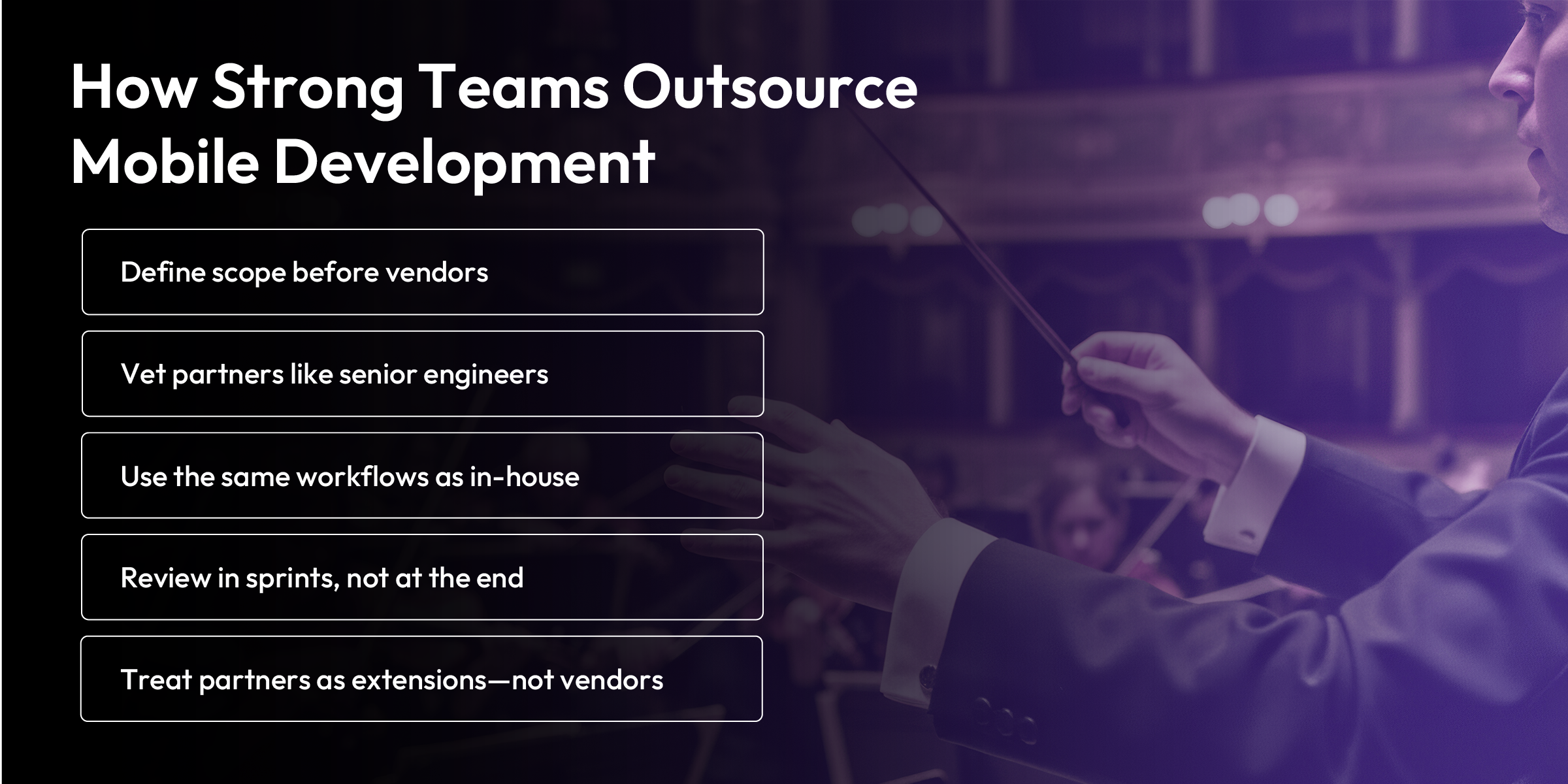
The companies that get it right do the opposite. They define scope with precision, vet partners the same way they'd hire a senior engineer, and manage progress as if those developers sit three desks away. They don't outsource to reduce effort. They outsource to move faster, access expertise they don't have internally, and ship without derailing their core engineering focus. And critically, they pick partners whose engineers actually stick around. A vendor whose team turns over every six months isn't cheaper. They're just billing you for onboarding, repeatedly.
The context matters too. Users now expect AI capabilities as baseline functionality: personalized recommendations, conversational interfaces, predictive analytics. Your outsourcing partner's security practices are part of your risk posture whether you've thought about it that way or not. And if your internal team lacks mobile depth or bandwidth, mobile application development outsourcing is how you stay competitive without burning out the team you have.
The Benefits of Outsourcing Mobile App Development
Speed, talent access, and focus are what move the needle for engineering leaders operating under real constraints — more than any hourly rate comparison. When you outsource mobile app development well, the app development process itself becomes a competitive advantage.
- Elastic capacity without headcount overhead.You flex resources up during a sprint-heavy quarter and scale back once the release ships. No long-term payroll commitments, no recruiting lag, no onboarding overhead. For growing companies juggling multiple priorities, this elasticity matters more than any hourly rate comparison.
- Mobile expertise you can't hire fast enough.Modern mobile development demands native iOS and Android expertise, cross-platform framework fluency, mobile-specific UX conventions, CI/CD pipelines tuned for app stores, and backend architecture built for mobile clients. Mature outsourcing teams bring all of that in one engagement, along with pattern libraries and domain knowledge from dozens of similar builds. If your team is strong on web or backend but thin on mobile, closing that gap with a new hire takes four to six months you likely don't have.
- Faster time to market than internal hiring allows Outsourcing skips the months of recruiting, interviewing, and onboarding. You plug into an existing squad with established workflows, automated testing, and coverage across time zones. For products facing competitive pressure or funding milestones, launching weeks earlier is a strategic advantage.
- What happens when you delay? Roadmaps slip. Velocity drops. Competitors who moved faster capture the user base you were targeting. When outsourcing is the right call, the risk of not doing it is just as real as the risk of doing it poorly. For a broader look at how leading companies structure their approach, see how top brands stay ahead with software development outsourcing.
When to Outsource vs. Build In-House
This decision turns on four factors: timeline pressure, budget constraints, skill gaps, and how central the app is to your business model.
If you're on the fence, a hybrid approach often works: keep product leadership and core IP internal, outsource execution-heavy or specialized components. A sound outsourcing strategy balances control and flexibility rather than trading one for the other.
How to Outsource App Development: A Step-by-Step Process
Step 1: Define Scope Before You Talk to Anyone
The single most common reason outsourced app projects fail is starting without documented requirements. Not a rough idea or a verbal brief. A written scope document that forces the hard decisions before a vendor is in the room, before anyone has committed to a timeline or a budget.
That document should cover: the problem the app solves and who it's for, platform choices (iOS, Android, cross-platform, or web), a prioritized feature list with must-haves separated from nice-to-haves, your MVP definition (the smallest version that still delivers real value), and your success criteria. What does good look like at launch? At 90 days post-launch?
Getting project requirements and project scope documented before any vendor conversation is the difference between managing the engagement and being managed by it.
This isn't bureaucracy. It's the financial shield that prevents scope creep from turning a $300,000 engagement into a $600,000 one. A vendor who doesn't push back on vague scope before the SOW is signed isn't being accommodating. They're leaving themselves room to expand it later.
Step 2: Validate Design Before Development Starts
Wireframes and clickable prototypes are the cheapest way to catch misaligned expectations. Design alignment before development means correcting misunderstandings at the lowest-cost moment, before architecture is built around them.
This step gets skipped constantly, especially when there's schedule pressure. It's also where a significant portion of expensive mid-build pivots originate. A few days on wireframes can save weeks of redevelopment. The teams that skip this step aren't moving faster. They're just moving the rework to a more expensive part of the timeline.
Step 3: Choose the Right Engagement Mode
Three models dominate mobile app development outsourcing. The right one depends on how well-defined your scope is and how much internal capacity you have to manage the engagement.
- Full project outsourcing works when scope is tightly bounded and unlikely to change. The vendor delivers a defined set of features for a predetermined cost, broken into milestones. Budget predictability is high; flexibility is low. Any scope change triggers a change order. Best for MVPs, pilots, Android app development, web app development, and apps with stable requirements.
- Dedicated team works when your roadmap is evolving and you need sustained velocity without hiring. A stable external team integrates into your workflows (daily standups, sprint planning, shared tools) without the overhead of hiring and managing them directly. This model suits companies building a core mobile product who want control without committing to permanent headcount. It also produces the highest retention and fastest ramp, because these engineers embed into your culture rather than cycling through projects.
- Staff augmentation works when you have strong in-house product and technical leadership but need extra capacity for a sprint, a rewrite, or a specific skill. Individual engineers join your team and report to your internal leads.For most technical leaders, dedicated teams offer the best balance of control, flexibility, and partnership depth. You're embedding a squad that understands your product roadmap and technical constraints, not just buying hours. X-Team's model is built on this principle: senior engineers who integrate into client teams, stay for the long run, and maintain retention rates that consistently outperform the industry standard.
Step 4: Research and Evaluate Potential Partners
Look for app development teams and mobile app development companies on Clutch or GoodFirms, on LinkedIn, and through referrals from other technical leaders. Build a shortlist based on relevant portfolio work, domain experience, tech stack alignment, and verified client reviews.
When you review portfolios, ask for live apps: store links, technical documentation, and architecture decisions, not marketing decks. Talk to past clients directly. A candid 20-minute call with a former client reveals more about how a vendor handles pressure, scope disagreements, and production incidents than any case study ever will.
Pay attention to engineer retention. A vendor whose team turns over frequently will cost you more in ramp time and context loss than the rate differential will ever save. The project knowledge that walks out the door when an engineer leaves doesn't come back when the next one starts. Every handoff is a tax — paid in bugs, in re-explained decisions, in weeks of lost momentum you'll never see on an invoice.
Interview three to five vendors. Ask about their process, team structure, communication practices, QA approach, and how they handle shifting requirements. Pay attention to how they respond to ambiguity: do they ask clarifying questions, or do they make assumptions and move on? Vendors who ask good questions during the sales process will ask good questions during delivery. Vendors who don't, won't.
The best development partners earn that status by treating your product constraints as their own. That's what makes them worth shortlisting as a long-term app development partner.
A low-cost approach to de-risking the decision: start with a paid proof-of-concept. A small, bounded prototype tests the vendor's technical capabilities and working style before you're committed to a full engagement. The cost is small. The signal is invaluable.
Red flags: weak communication during the sales process, no domain-relevant portfolio, reluctance to share references, vague answers about team composition or engineer retention.
Step 5: Evaluate AI Capabilities Honestly
Every outsourcing firm now claims AI capabilities. The differentiator isn't whether AI is used. It's how it's used, and who's accountable for the output.
As AI becomes standard in mobile development, covering code generation, QA automation, personalization features, and predictive interfaces, evaluating a partner's genuine AI fluency is now core due diligence. Will Jung, CTO of nCino, captures the broader shift: "A lot of times, experiences today have been based on yesterday's technology." The same is true of your outsourcing partner's toolchain. Here's how to ask it.
The distinction that matters is human-led, AI-enhanced. AI tools like Cursor and GitHub Copilot accelerate delivery, but every AI-assisted output should be owned, reviewed, and approved by the engineer responsible for it. Clients should be able to opt in or out of AI tooling. It shouldn't be a default imposed on the engagement.
Step 6: Structure Pricing and Your Engagement
For well-defined projects with stable scope, fixed-price contracts with clear milestones and acceptance criteria give you cost predictability. For evolving products where requirements will shift, time-and-materials with a capped monthly budget and agreed velocity targets gives you flexibility without blank-check risk.
Typical 2026 cost ranges: $10,000–$60,000 for simple apps; $40,000–$150,000 for medium complexity; $150,000–$400,000+ for complex enterprise-grade builds. Always build in a 10–20% contingency buffer. Scope clarifies as work progresses, third-party APIs change, and platform guidelines update.
Cross-platform frameworks like React Native or Flutter can reduce total project costs 30–50% compared with separate native builds, without sacrificing quality for most use cases. For a deeper look at where to find high-quality teams at competitive regional rates, see the best countries for outsourcing software development.
Step 7: Build a Contract That Protects You
Your contract isn't a formality. It's the document that determines what happens when something goes wrong. Cover scope and deliverables in detail. Tie payment to milestones, not calendar dates. Define acceptance criteria before work starts, not after a deliverable is submitted.
On IP: an NDA alone doesn't transfer ownership. Without an explicit work-for-hire clause, an external developer may retain rights to the code they write by default depending on jurisdiction. Make sure your SOW includes that clause, not just your MSA. Specify that all work product, including code, designs, and documentation, belongs to you upon delivery.
For post-launch, define how bugs discovered within 30 to 90 days will be handled, what the support and maintenance terms are, and what governing law applies, especially for offshore engagements.
Step 8: Set Communication and Workflow Norms Early
The structural stuff matters but it's not the point. Assign a single point of contact on both sides. Agree on meeting cadence: weekly progress calls, async updates via Slack or Teams. Use shared tools: Jira or Linear for tasks, Figma for design, GitHub for code review.
What matters more is how the team is treated. The engagements that work best don't run external engineers on a ticket queue. They run them like embedded teammates — standups, sprint planning, retrospectives, real access to roadmap context. Justin Kerestes, SVP of Engineering at Fanatics Betting & Gaming, puts it plainly: "Trust isn't just built in a moment — it's built in this series of small interactions that ultimately add up." With an outsourced team, those interactions don't happen by accident. You have to design them in. And the vendors whose engineers stay for years rather than rotating out every few months — those are the ones who've been designed in well.
Time zone overlap deserves specific planning, not just acknowledgment. Offshore mobile app development and outsourced teams with a 10-hour gap can still work effectively, but it requires deliberate async documentation, clear escalation paths, and explicit decisions about which meetings require real-time participation. Left unplanned, the gap becomes a 24-hour delay on every question.
Step 9: Manage Development by Milestones
The leaders who get the best results from outsourced teams don't manage by deliverable. They manage by signal. Two-to-three week sprints with demos and incremental builds give you visibility before problems compound. Staging builds and test plans give you something concrete to evaluate. Regular reviews of UX, performance, and platform compliance mean you're catching drift early, not discovering it at launch.
Use an agile cadence even if the overall engagement is fixed price. It keeps both sides accountable. Assign project managers on both sides with clear ownership. High quality output requires structured checkpoints built into every sprint, not good intentions at the end of one.
Step 10: Plan for Post-Launch Before Launch
Mobile apps are never done. OS updates, new devices, user feedback, and competitive pressure all demand continuous iteration. Negotiate maintenance and support terms before the project starts, when you still have leverage. Once you're dependent on the vendor to fix production issues, that leverage is gone.
Run functional, usability, and device testing across multiple OS versions and screen sizes before launch. Involve real users or a small beta group wherever possible. And plan your first two or three follow-up releases before the initial version ships. The teams that treat launch as the end of the engagement fall behind. The ones that plan for what comes next stay ahead.
How to Choose the Right Outsourcing Partner
The evaluation criteria that matter most don't show up in a vendor pitch. Portfolio quality and hourly rate are table stakes. What actually predicts a good engagement is harder to see: how the vendor handles scope disagreements, how they escalate problems, and how stable their engineering teams are over time. That last one is underweighted by almost every buyer. It shouldn't be.
Ask to speak with the engineers who would actually work on your project, not just account managers. Do they ask good questions, or do they just say yes? The best partners challenge assumptions when something doesn't make sense, rather than building exactly what you asked for even when it's the wrong approach. That intellectual engagement is a signal of seniority — and of how much they'll still care about your product six months in.
Ask directly about retention. What's the average tenure of engineers on long-term engagements? What happens when a key engineer leaves mid-project? A vendor who can't answer those questions clearly, or whose answer reveals high turnover, is telling you something important about the continuity risk you're taking on. The cost of re-onboarding a replacement engineer is rarely on the invoice. It shows up in velocity, in re-litigated decisions, in technical debt from someone who didn't know the system well enough.
Check references rigorously. Don't just ask how the project went. Ask how they handled a major scope change, how responsive they were when a critical bug appeared post-launch, and whether the client would work with them again and why. Mike Gibson, CTO of Planet DDS, frames it well: "Empathy plus clarity builds the trust. Once you have the trust, you really unlock things like accountability, autonomy, and then speed within the teams." The reference call is where you find out whether that trust was ever there.
For a full framework on evaluating and structuring outsourced engineering partnerships, see our Developer Outsourcing Buyer Guide.
Common Risks and How to Avoid Them
Outsourcing failure usually comes down to process, not technical competence. The same risks surface across projects, and every one of them is preventable.
- Miscommunication and mismatched expectations. Document everything. Use shared tools. Establish a single source of truth for specs, designs, and decisions. When communication defaults to ad-hoc messages instead of structured rituals, critical decisions get buried and resurface as disputes.
- Scope creep is rarely a vendor problem in isolation. It's usually an organizational one: stakeholders who weren't in scope-definition conversations, new requirements that surface after the SOW is signed, and pressure to accommodate them without a formal change order. Define that process upfront. Every addition should trigger a re-estimate and explicit approval. Protect the core scope. Scope creep is the most common reason projects exceed budget and timeline, and it almost always originates inside the client organization, not with the vendor.
- Security and IP exposure. Strong NDAs, clear IP ownership clauses, access controls, code review requirements, and secure offboarding procedures eliminate most of this risk. For regulated industries (HIPAA, GDPR, PCI), verify compliance experience before signing, and make documented compliance a contract requirement, not an assumption.
- Quality inconsistency is a measurement problem as much as a talent problem. Define quality benchmarks at the start: test coverage, code review standards, performance targets, documentation expectations. Build quality checks into each sprint. Don't audit quality at the end of an engagement. By then, the cost of fixing it is the highest it will ever be.
- The pattern across all of these risks is the same: clarity and structure upfront eliminate ambiguity downstream. Risk mitigation is part of engagement design, not damage control after something goes wrong.
Pricing and Budgeting for Mobile App Development Outsourcing
Cost depends on complexity, platform choice, and the location of your development partner. Lower regional rates don't mean lower quality. Eastern European and Latin American engineers are widely recognized for strong technical capabilities, and global IT outsourcing spending hit $660 billion in 2025 partly because those markets have proven it. What to evaluate alongside rate: time zone overlap, English proficiency for your communication needs, and cultural alignment with how your team works.
Fixed-price contracts work best for well-defined, stable scope. Time-and-materials with a capped monthly budget gives you flexibility for evolving products without open-ended cost exposure. Cross-platform frameworks like React Native or Flutter can reduce total project cost 30–50% compared with separate native builds, a cost-effective choice for most use cases with real cost efficiency gains over the life of the engagement.
The budget line most leaders forget: plan for ongoing maintenance at 15–25% of the initial development cost annually. An app that launches successfully still needs OS updates, security patches, bug fixes, and feature iteration. That cost doesn't disappear at launch. It just moves to a different line item.
The Framework Is Clear. Execution Is Where It Separates.
The companies that outsource app development successfully don't treat it as procurement. They treat it like extending their team, and they build the process, governance, and partnership expectations that make that possible.
The part most leaders underinvest in isn't scope definition or contract structure. It's the question of who they're actually working with two years from now. Outsourcing relationships that compound in value are built on engineers who understand your product deeply enough to push back on bad decisions, not just execute on good ones. That only happens when those engineers stick around.
X-Team connects technical leaders with vetted, senior engineers who've built apps at scale across gaming, fintech, SaaS, and media. Client partnerships average five to ten years — not because of contracts, but because engineers embed into teams and stay. Explore how X-Team works or talk to our team about your mobile project.
SHARE: