
Finding the best java outsourcing company is about more than finding the cheapest price. The vendor with the lowest quote can be a poor fit for your needs.
Java is a popular language that a lot of critical infrastructure still depends on. It's held a top-four spot on the TIOBE Index every month through 2026, and roughly 30% of professional developers report using it in the past year, per the 2025 Stack Overflow Developer Survey.
That popularity means you'll have a long list of vendors to choose from, most of them competing on the same two things: technical skill and price. Both matter, but neither predicts whether the partnership lasts past year one. Engagement model and team culture carry just as much weight in that decision. Get those right, and the best technical talent at the best rate becomes a team that keeps building with you for years.
What 'Best' Actually Means for a Java Outsourcing Decision
"Best" changes depending on what you're optimizing for.
If you're a technical recruiter juggling a dozen open reqs, you're optimizing for time-to-fill, because every week a senior Java seat gets filled sooner is a week your engineering team ships faster. If you're a hiring manager building the case for outsourcing to your own VP, you're optimizing for confidence in the outcome: you want an engineer who performs like your best direct hires. If you're building the broader tech-hiring strategy, you're optimizing for cost per hire and an employer brand that gets stronger every time an engagement goes well.
A vendor that simply says it has Java developers on a bench doesn't move any of that forward. Fit gets you there, not supply. That's why a single "best" company rarely exists; there's only a best-fit partner for what you're trying to build.
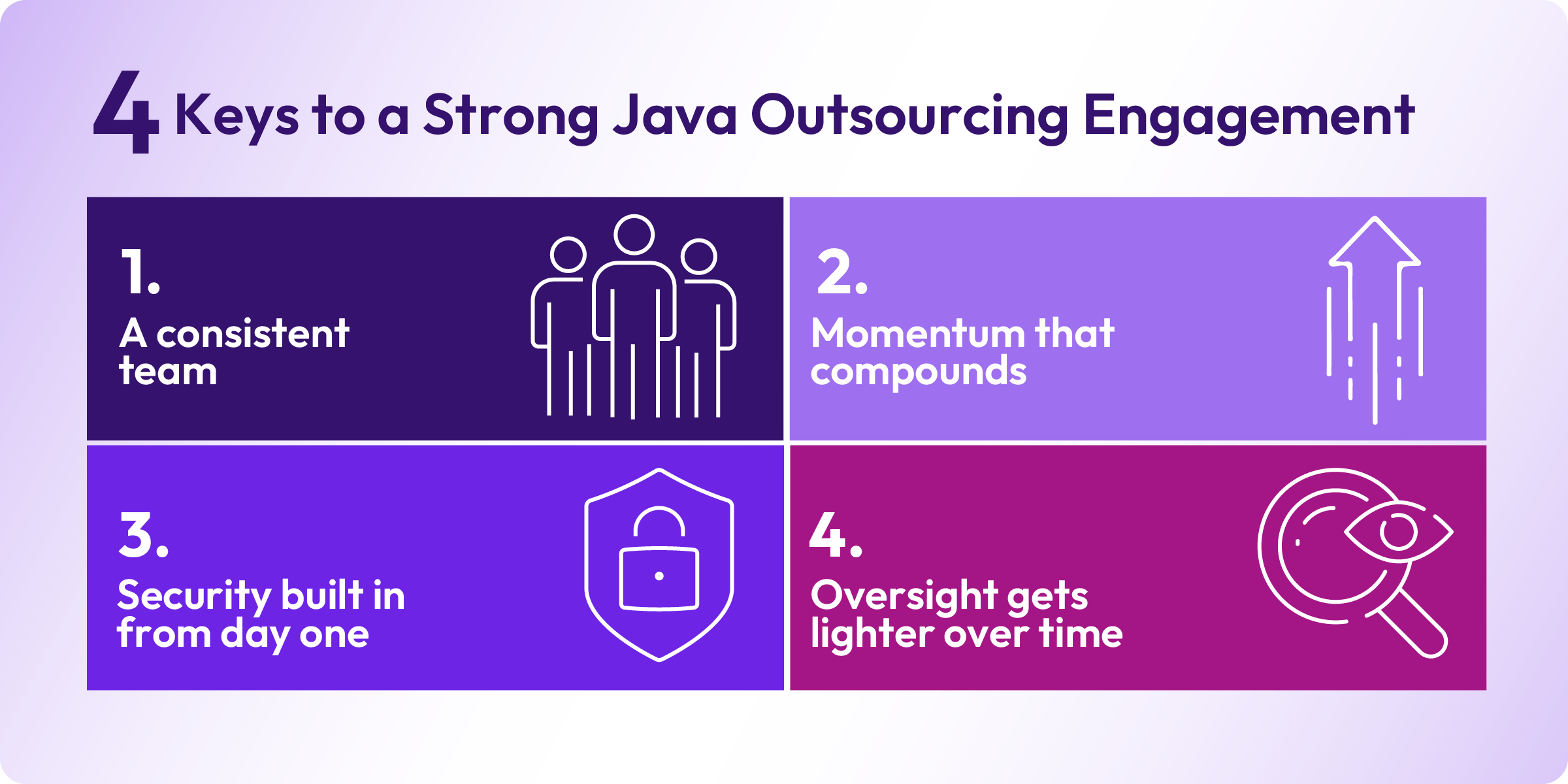
4 Things a Strong Java Outsourcing Engagement Gets Right
Whether the team is based in Eastern Europe, Latin America, or South Asia, the engagements that keep moving forward month after month get the same four things right:
-
A consistent team. The right engagement model keeps the same engineers on your Java systems from the sales conversation through month six and beyond, so the team that ramps up on your codebase is the team that keeps building on it.
-
Momentum that compounds. Low turnover means less re-onboarding and more forward progress, since institutional knowledge about your codebase keeps growing instead of resetting. A stable team gets faster over time, not slower, and stays current on the Java tools and libraries that keep a codebase maintainable.
-
Security built in from day one. Java systems tend to sit close to the data that matters most — financial records, customer PII, core transaction logic. Most of the largest U.S. banks still run their core deposit, card, and lending systems on Java, and the language sits behind a large share of the back-end work that keeps consumer accounts in sync, per recent reporting on Java's role in U.S. financial infrastructure. A vendor with a real security review process treats that as part of onboarding, not an afterthought discovered during an audit.
-
Oversight that gets lighter over time. Outsourcing should reduce your management load, not add to it. When a vendor's engineers understand your requirements and ship review-ready work, your senior engineers get their time back for the work that grows the business.
Comparing the Best Java Outsourcing Companies
Choosing the Right Delivery Model for Java Outsourcing
Most java outsourcing decisions come down to a choice between three delivery models, and the difference between them matters more than which specific company you pick.
-
Freelancers offer the lowest cost and the fastest theoretical start. Vetting and management sit with you, and continuity depends on one person staying on the project.
-
Project shops deliver against a defined statement of work: a migration, a rebuild, a bounded feature set. This model fits work with a clear finish line. Once the scope ships, the team moves to its next client, taking the institutional knowledge it built with them. It's a strong fit for bounded work; for Java systems that need continuous evolution, an embedded model carries that knowledge forward instead.
-
Staff augmentations integrates developers directly into your engineering org, joining your sprint rituals, following your existing review and testing pipelines, and getting measured against your product roadmap instead of a fixed deliverable. It costs more to set up, and it pays that back over the life of the engagement by keeping the same engineers on the codebase.
A one-time legacy migration can be a legitimate project-shop engagement. A Java platform that needs ongoing modernization, patching, and feature work for the next several years is a different problem, and it's the one embedded models exist to solve.
Java Outsourcing Checklist for Technical Hiring Managers and Recruiters
- Will the engineers you meet during evaluation be the same ones on the team in month six, and does the contract structure support that?
- Can the vendor name a retention figure for engineers on similar engagements, and will they let you verify it with a reference?
- Does the vendor's onboarding include your security review process from day one?
- Can you talk directly to the engineers who would join your team, not just an account manager?
- Does the pricing model reward a long-term partnership and reward the vendor for keeping the same engineers on your team?
- Is there a documented plan for carrying institutional knowledge forward as your team grows?
Where X-Team Fits: Embedded Java Teams Built for Continuity
X-Team's Java engineers join as long-term teammates who adopt your stack, your tools, and your existing review pipeline, rather than operating as an outside unit working through a project queue.
This model has already been proven at scale. X-Team supplies more than 120 senior engineers embedded inside Riot Games' engineering organization, working inside Riot's own processes rather than a separate outsourced workflow. That's specialization and continuity at a scale headcount alone doesn't guarantee.
Talk to X-Team about embedded Java teams built for long-term continuity, not one-off delivery.
SHARE: