
The staff augmentation vs managed services decision usually focuses on where the pain is greatest. That’s rarely where the real constraint is.
Both models have advantages and failure modes. X-Team’s Out of Sync 2026 report found organizations using embedded, longer-term staff augmentation reported 85% strong value capture versus 42% for internal-only teams — not because of who the engineers were, but because of where the capacity was structured.
The model you choose doesn’t just determine who does the work — it determines who learns from it, who owns the result and what your team is capable of independently when the engagement is over.
What Is Staff Augmentation?
Staff augmentation, sometimes called IT staff augmentation, is a resourcing model that brings external engineers directly into your team, following your processes, using your tools and reporting to your leads. Delivery stays yours. There’s no separate organizational layer.
What you get is control. You manage the work, set the priorities and decide what gets built and when. A pivot or a roadmap shift is yours to make, the same way you’d make it with internal headcount.
What you give up is fast, easy onboarding. Augmented engineers need context, ramp time and direction. If your engineering leadership is already stretched, adding skilled professionals without sufficient management capacity creates its own drag. Staff augmentation isn’t a plug-and-play model. It closes skill gaps and multiplies what your internal team can do — when that team is positioned to collaborate with their new teammates.
What Are Managed Services?
Managed services is an outcome-based model where a vendor takes ownership of a defined scope — typically an operational function or a discrete project. You agree on deliverables, service level agreements and timelines. The vendor manages the how: the people, the processes, the tools.
What you get is accountability transfer. The vendor is on the hook for outcomes, not just effort. If something breaks in a managed IT services arrangement, you call the vendor. You don’t manage the fix day to day. You manage the relationship.
What you give up is control. Because the vendor owns execution, you cede visibility into what’s being built and how. Changing direction means going back to contract, which takes time and costs money. The managed services model works well for stable, well-defined work. The moment scope shifts, you’re back at the negotiating table.
Staff Augmentation vs Managed Services: Key Differences
Start With the Constraint, Not the Model
Before choosing a model, identify where your real constraint is. It might be hiding.
The visible problem and the root cause are often in different places. Add capacity to the wrong function and throughput doesn’t move.
The misdiagnosis shows up in two patterns. Your roadmap is slipping and the instinct is to add engineers — but your senior engineers are spending significant time on infrastructure maintenance, tier-1 support or legacy system work. The constraint isn’t headcount. It’s an ops burden on your highest-leverage people. The right move may be managed services for the operational layer, freeing your existing team to move the roadmap.
Or: your operational work needs to be handed off, but it’s undocumented and poorly defined. A managed services vendor can’t own a process that no one can accurately describe. The right move here would be hiring engineers via staff augmentation who can help you systematize the work first — making it genuinely handoff-ready — before a managed services arrangement takes over.
When Staff Augmentation Is the Better Choice
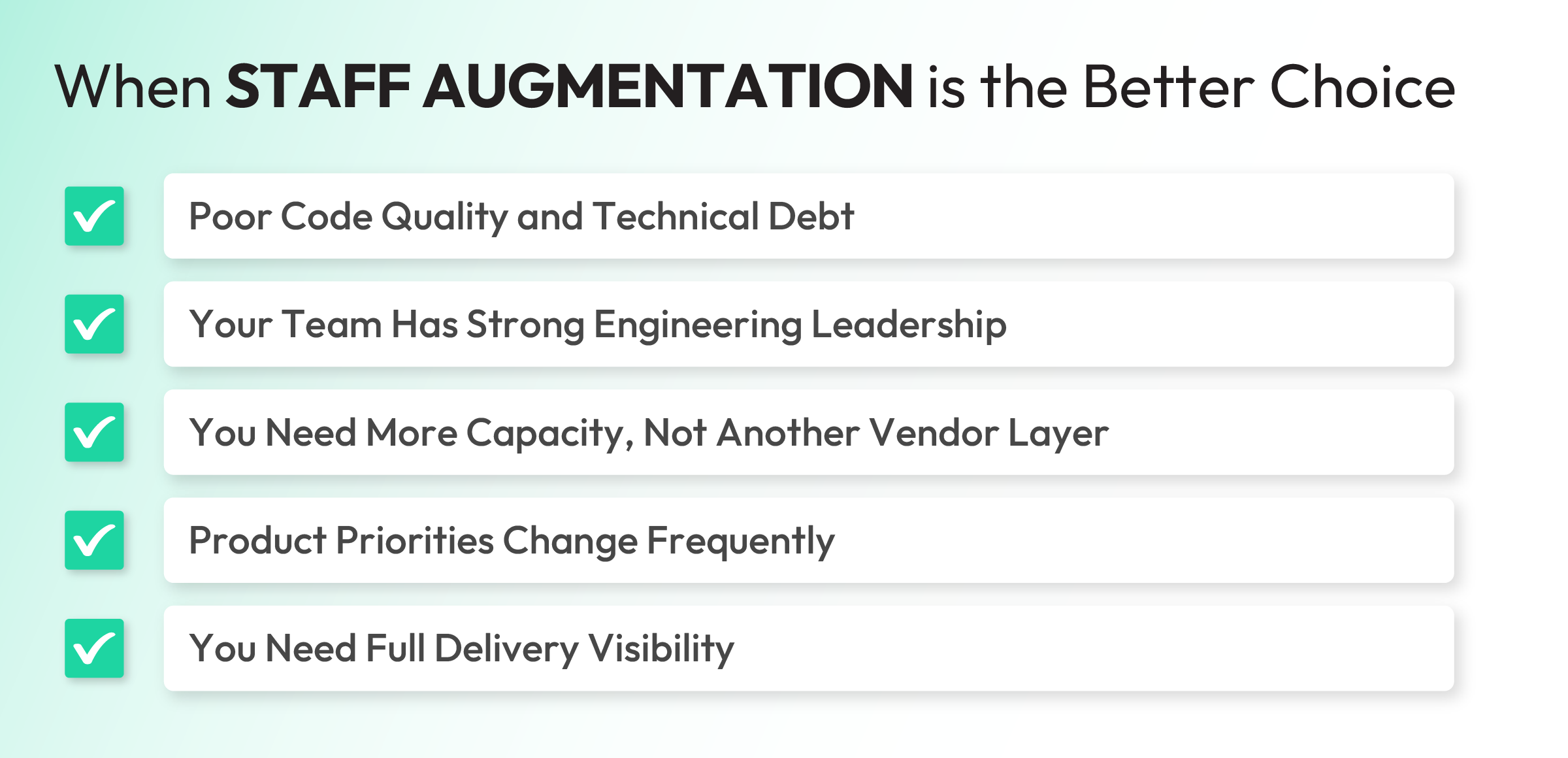
For teams where the actual constraint is delivery capacity — where engineering leadership is strong and the work is product work — staff augmentation is the stronger fit.
Your Constraint Is a Specialized Skill Gap
Staff augmentation closes a specialized skill requirement in one to two weeks. Managed services arrangements take weeks to months: scoping, legal review, contracting. When a roadmap priority shifts and you need engineers with specific experience fast, you don’t have time for an RFP.
Your Team Has Strong Engineering Leadership
Staff augmentation requires someone on your side to direct the work. If your engineering leadership is capable and available, augmented engineers integrate cleanly and multiply output without adding organizational complexity. If leadership capacity is the actual constraint, that’s a signal pointing toward managed services.
You Need More Capacity, Not Another Vendor Layer
If your internal team has the skills and direction but needs more hands on product delivery, augmented engineers solve the problem without introducing a vendor layer. They join your internal team. They don’t create a new one. Managing a managed services relationship — change requests, status reviews, escalation paths — solves the wrong problem when what you need is more capacity on existing work.
Product Priorities Change Frequently
In product-focused organizations, the roadmap moves. Market feedback comes in, a competitor ships something unexpected, a technical discovery changes what’s feasible. Staff augmentation handles this naturally — redirect the team the same way you’d redirect full-time engineers. Managed services aren’t built for this kind of flexibility. Every meaningful scope change requires renegotiation, which takes time and often costs money.
You Need Full Delivery Visibility
Some leaders don’t want to hand execution to a third party — not because of cost, but because delivery visibility is itself a strategic requirement. Staff augmentation preserves that visibility completely. When delivery control is the constraint, the answer to who owns the outcome should always be you.
When Managed Services Are the Better Choice
The managed services model gets underestimated by teams that frame it as a fallback. In the right situation, it’s the stronger choice.
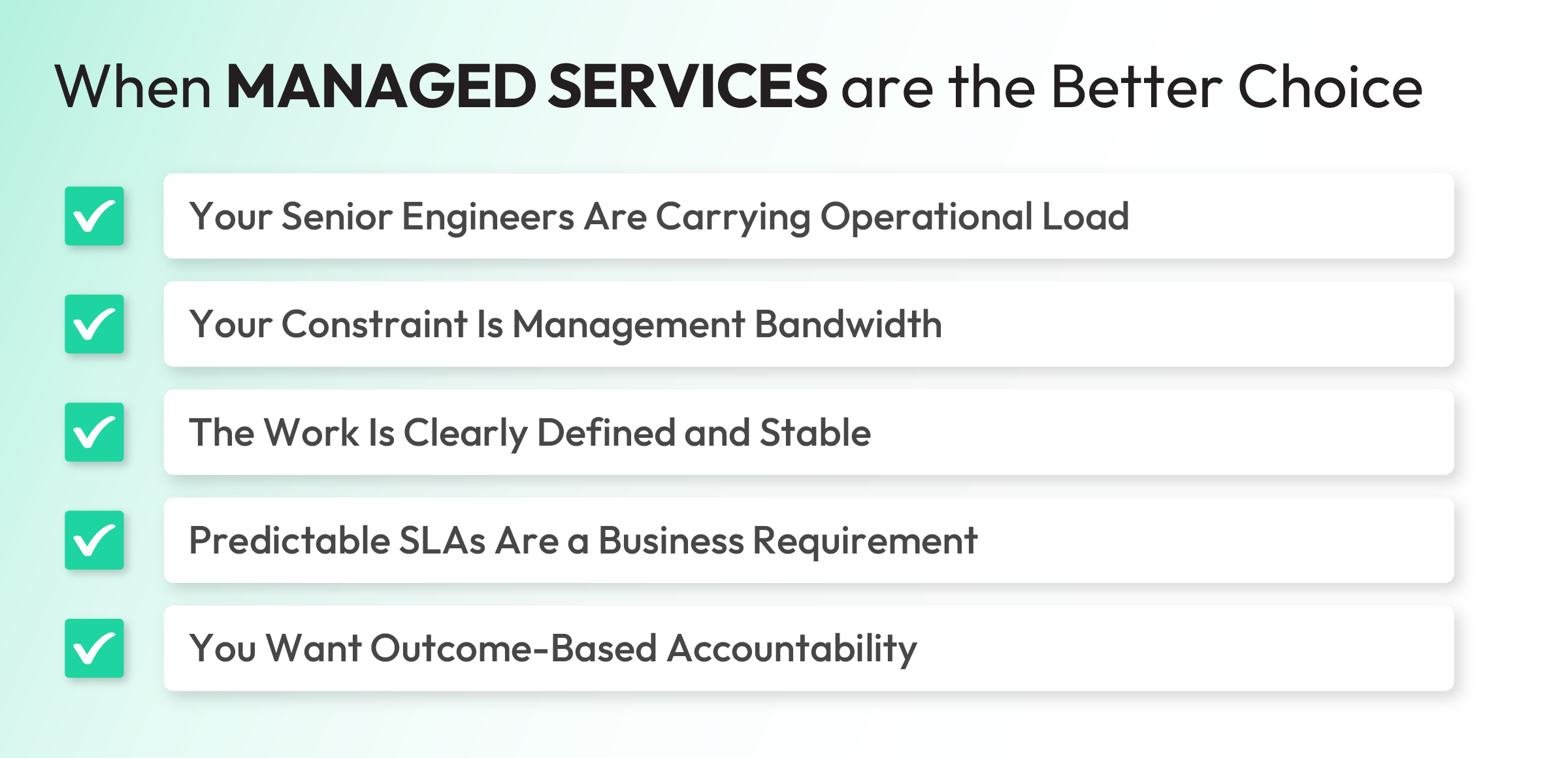
Your Senior Engineers Are Carrying Operational Load
If your best engineers are spending significant time on operational work — monitoring, support, maintenance, legacy systems — the constraint isn’t headcount. It’s misallocated talent. Offload that layer to a managed services partner and your existing team gets back to the product work they’re built for. That trade can do more for delivery velocity than adding more engineers.
Your Constraint Is Management Bandwidth
If you don’t have the engineering leadership bandwidth to onboard, direct and manage augmented resources, the model breaks down quickly. Managed services remove that requirement — the vendor handles management internally. For organizations where management bandwidth is the actual constraint, that’s the right call, not a shortcut.
The Work Is Clearly Defined and Stable
The best managed services arrangements are built around work that can be specified precisely upfront: migrate this infrastructure, maintain this support queue, run these scheduled processes. When scope is clear and stable, the fixed-accountability model works. When scope is unclear or evolving, you’ll spend more time managing contract amendments than you would have spent managing the work directly.
Predictable SLAs Are a Business Requirement
Some functions need guaranteed response times, uptime commitments or compliance-driven accountability — not because leadership is unavailable, but because the business requires contractual accountability baked in. The predictable costs and defined service level agreements that managed services offer make them the model built for those requirements.
You Want Outcome-Based Accountability
There are cases where the right move is to hand a vendor a defined problem and hold them to results. “Reduce support ticket volume by 30%” or “migrate this infrastructure by Q3” — structured as managed services engagements, the vendor is accountable for outcomes, not just effort. That structure holds when the scope supports it and serves your business goals.
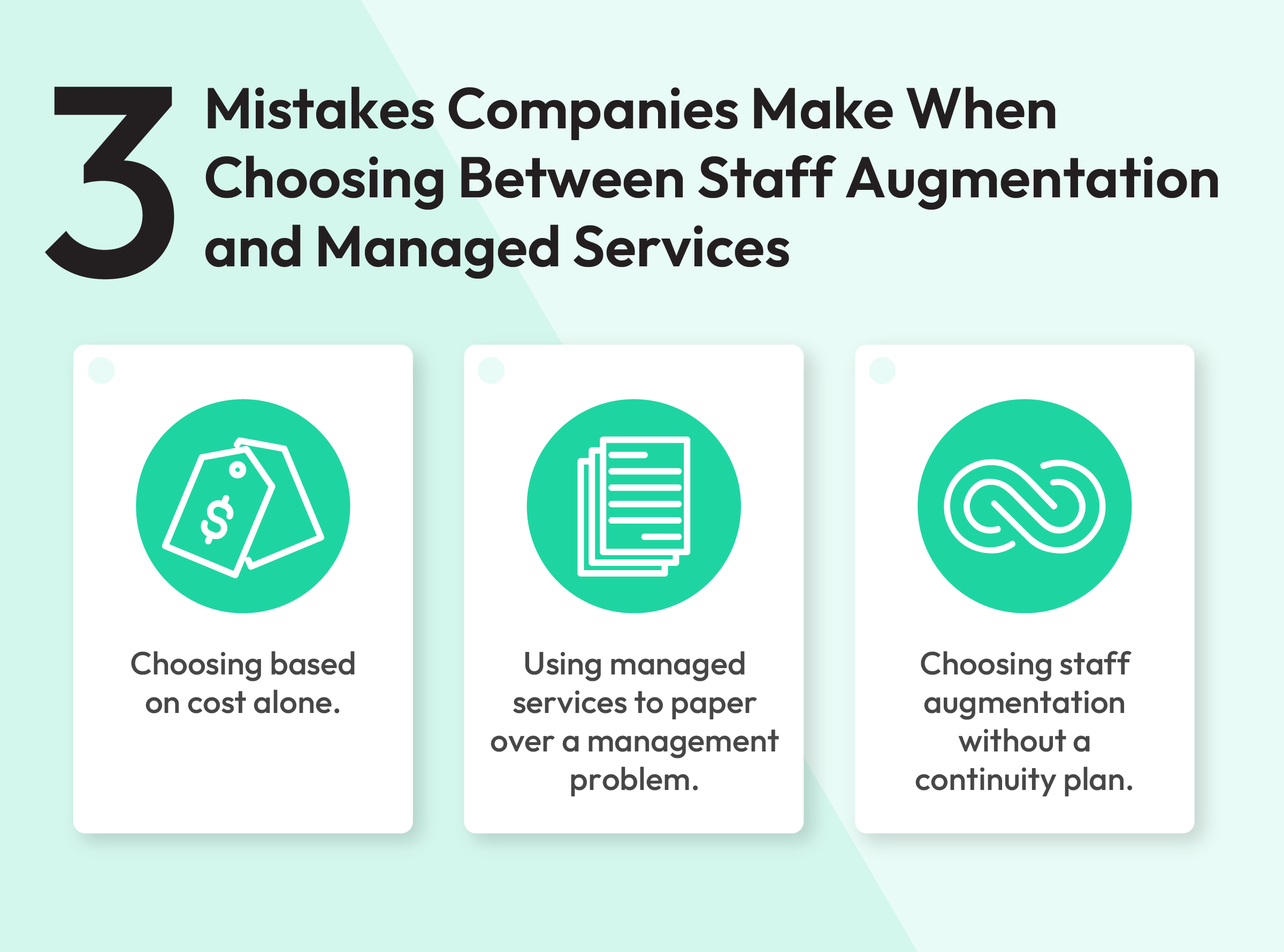
3 Common Mistakes Companies Make When Choosing Between Staff Augmentation and Managed Services
Most bad model decisions aren’t made by people who don’t understand the models. They’re made by people who skipped the diagnostic step — and chose based on the visible symptom instead of the underlying constraint.
- Choosing based on cost alone. Managed services can look cheaper on paper because the per-hour rate is lower. But factor in the legal and scoping overhead of contracting, the cost of change requests when priorities shift and the institutional knowledge that leaves with the vendor at contract end — the total cost often looks different. A long-term commitment to the wrong model is more expensive than the rate difference suggests.
- Using managed services to paper over a management problem. If your engineering organization lacks the leadership capacity to direct external resources, managed services is a workaround, not a solution. The leadership gap doesn’t disappear — it moves into the vendor relationship, where it shows up as escalation failures and scope drift.
- Choosing staff augmentation without a continuity plan. Augmented engineers carry institutional knowledge. When a contractor leaves, that knowledge leaves too — unless you’ve built deliberate systems to capture it. Integration model and governance practices matter as much as technical capability.
Decision Matrix: Staff Augmentation vs Managed Services
Most mature engineering organizations don’t choose one model exclusively. They use managed services and staff augmentation in parallel — staff aug for product development work where control and flexibility matter, managed services for repeatable operational functions where stable SLAs matter more than the ability to pivot.
Why Partner With X-Team for Staff Augmentation
X-Team’s engineers stay embedded in your workflows across months and engagements — attending your standups, shipping within your sprint cycles and adapting as priorities shift. Codebase familiarity deepens. Product knowledge stays internal instead of leaving with the contractor. That continuity is what drives the performance gap between the embedded model and the body-shop version, and it’s what makes staff augmentation function like an extension of your team rather than a staffing transaction.
Download the X-Team Buyer’s Guide to compare resourcing models, evaluate vendor fit and make the case for the approach that’s right for your team.
SHARE: