
Finding the right AI augmentation companies has become one of the harder calls in enterprise technology. The market has expanded fast, the terminology has blurred, and the vendors who can actually close the gap between an AI roadmap and the team required to execute it are harder to identify than the ones who cannot.
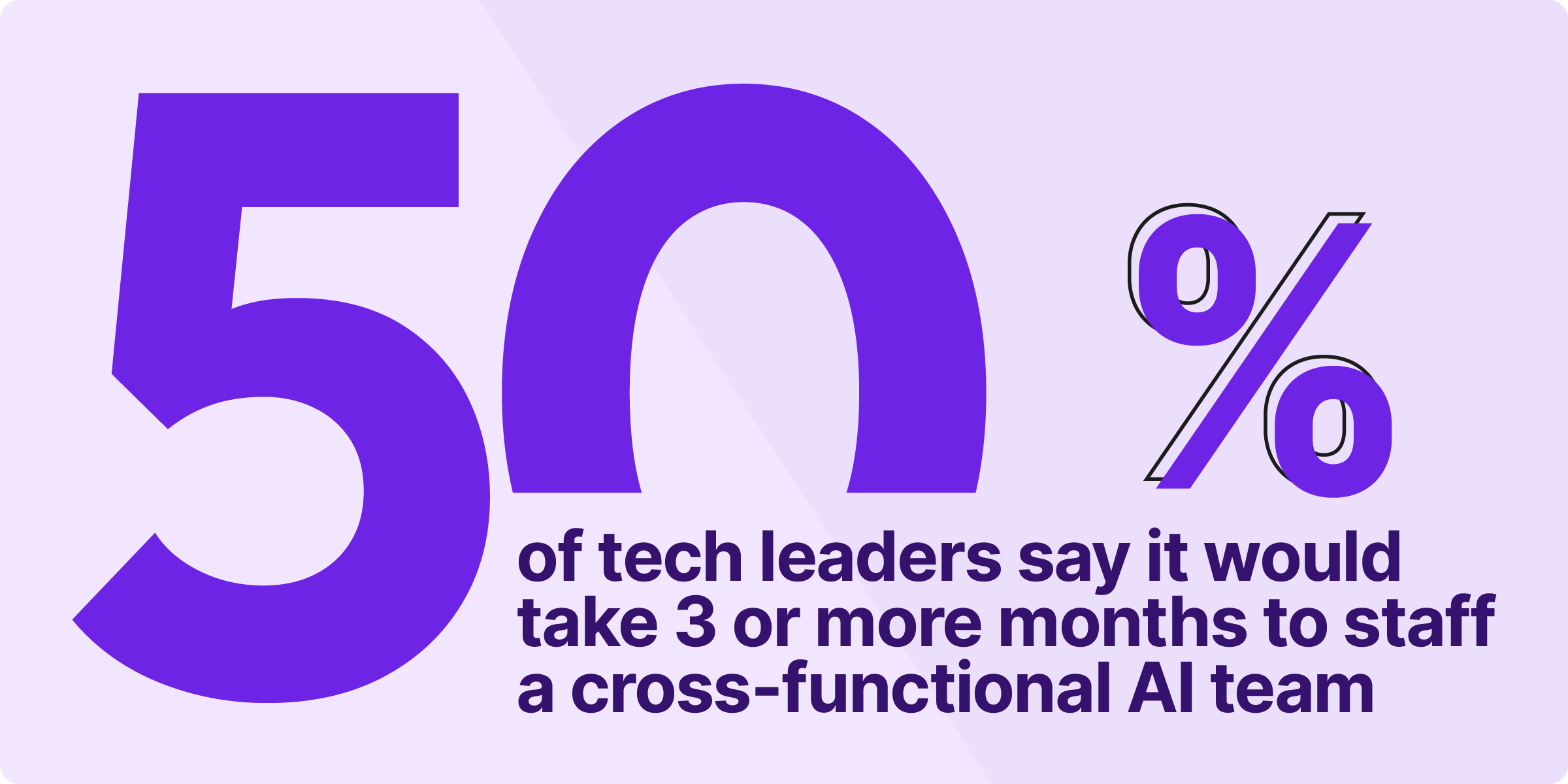
X-Team's 2026 AI Talent Readiness Report surveyed 324 U.S. technology and business leaders and found something more troubling than a slow hiring market: 53% were confident they could source AI-capable talent, yet 50% said it would take three months or more to staff a single cross-functional AI team. The AI talent shortage is real, but confidence and capability are not the same thing.
The organizations building durable AI programs are the ones treating AI talent the way they treat their best internal engineers: with investment, continuity and genuine integration.
Solving the AI Talent Gap with AI Staff Augmentation
The median time to hire a senior AI engineer through traditional recruiting runs 89 days, and that does not account for ramp time after an offer is accepted. Demand for AI engineering talent capable of shipping production systems is running 30 to 50% above general software contractor rates. AI staff augmentation addresses the gap by embedding external specialists directly into internal workflows, preserving client ownership of architecture and priorities while augmented engineers operate inside the same tools, sprint cadence, and repositories as internal staff.
AI workforce augmentation strategies including embedded AI engineers, hybrid workforce models, and AI-native delivery teams have emerged as the practical answer to a structural problem that faster recruiting cannot fix on its own.
How We Evaluated the Top AI Staff Augmentation Companies
The 15 companies below were selected based on AI specialization depth, vetting rigor, enterprise readiness, compliance infrastructure, embedded collaboration model, time to qualified candidate, scalability, industry expertise, retention metrics, and documented delivery outcomes.
Top AI Staff Augmentation Companies
The list covers AI-native specialist firms competing on technical depth, enterprise platforms competing on scale and compliance, and flexible nearshore and marketplace vendors competing on speed and cost. Each profile covers core services, key attributes, and potential tradeoffs.
X-Team: Best for Long-Term Embedded Engineering Teams
Founded in 2006, X-Team built its model around a conviction that developers do their best work when they feel connected to what they are building. Every engineer works with a single client at a time. The result is a 98% developer retention rate and partnerships measured in years, not quarters. Clients include Fox, Riot Games, OFX, and Kaplan.
- Headquarters: Austin, Texas (fully remote, global)
- Core Services: IT staff augmentation, dedicated development teams, DevOps and cloud, frontend and backend development, QA
- Best for: Gaming, media, e-commerce, health tech, and fintech needing stable embedded teams with genuine cultural integration
- AI Specialization: Python, React, Node.js, Go; strong AI tooling integration; AI-adjacent industries
- Enterprise Readiness: High; Fortune 500 clients; NDAs and IP protection built in
- Key Strengths: Single-client focus; rigorous technical and cultural vetting; active developer community
- Potential Limitations: Less suited to pure AI/ML research; best value in long-term engagements
- Ideal Customer Fit: Organizations burned by churn that need engineers who stay and ship like insiders
Turing: Best for Rapid AI/ML Placement
Turing's ALAN platform vets engineers from a network of four million and delivers the top 1% in three to five days. Leadership comes from Meta, Google, Microsoft, and Amazon.
- Headquarters: Palo Alto, CA
- Core Services: Staff augmentation, LLM infrastructure, AI system deployment, workflow automation
- Best for: Rapid placement of senior AI/ML engineers and LLM specialists
- AI Specialization: Very deep; ML engineers, LLM specialists, multimodal AI, agentic systems
- Enterprise Readiness: High; Fortune 500 clients; built-in IP protection; 2-week trial
- Key Strengths: 3-5 day placement; four-million-engineer network; top-1% vetting
- Potential Limitations: Premium cost; AI matching can miss cultural fit
- Ideal Customer Fit: AI-first product teams needing senior ML or LLM specialists fast
Andela: Best for Global Talent Access at Enterprise Scale
Andela's Talent Decision Engine and AI Academy layer structured vetting on top of 150,000 engineers across 135 countries. Clients include Goldman Sachs, Mastercard, and GitHub.
- Headquarters: New York, NY (fully remote, global)
- Core Services: Remote engineering teams, AI/ML placement, data and analytics staffing, enterprise upskilling
- Best for: Large enterprises with long-term AI needs and interest in Africa and LATAM cost arbitrage
- AI Specialization: Deep; 17,000+ certified AI-native technologists; AI Academy targeting 15,000 trained by end of 2026
- Enterprise Readiness: Very high; Forrester-validated $80K cost savings per hire
- Key Strengths: 48-hour candidate surfacing; 150,000+ vetted engineers; strong Africa and LATAM cost arbitrage
- Potential Limitations: 12-month minimum contract; $50,000 direct-hire conversion fee
- Ideal Customer Fit: Enterprises with procurement infrastructure for global contractors and a stable AI roadmap
Toptal: Best for Senior Specialists Who Need to Deliver Immediately
Toptal accepts fewer than 3% of applicants through a process that includes live project simulations. No minimum commitment. Clients include Duolingo, Hewlett-Packard, and Shopify.
- Headquarters: Palo Alto, CA (fully remote, global)
- Core Services: Freelance augmentation, dedicated teams, project-based hiring across engineering, design, finance, product
- Best for: Pre-vetted senior AI architects, ML engineers, or data scientists deployed in days
- AI Specialization: Strong; senior AI/ML engineers, data scientists, AI architects across major frameworks
- Enterprise Readiness: Very high; 4.7/5 on G2; 2-week risk-free trial
- Key Strengths: Top-3% acceptance rate; live project simulation screening; no minimum commitment
- Potential Limitations: Premium pricing ($60-$200+/hr); no project management included
- Ideal Customer Fit: Enterprises and Series B+ companies where speed to quality is the priority
BairesDev: Best for Nearshore Latin American Engineering at Scale
Over 1,250 projects for clients including Google, Pinterest, Adobe, and Johnson and Johnson. LATAM talent onboards into US cadences in roughly two weeks.
- Headquarters: San Francisco, CA (operations across LATAM and six continents)
- Core Services: Nearshore staff augmentation, AI/ML engineering, custom software development, full project delivery, DevOps
- Best for: US and Canadian tech teams needing large-scale nearshore AI/ML ramp-ups
- AI Specialization: Strong; AI/ML engineers, data scientists, cloud specialists
- Enterprise Readiness: Very high; 96% customer retention; 4,000+ employees across six continents
- Key Strengths: US timezone alignment; two-week onboarding; nearshore cost efficiency at enterprise quality
- Potential Limitations: Higher cost than offshore; primarily LATAM talent pool
- Ideal Customer Fit: US and Canadian enterprises needing large-scale nearshore AI engineering
ScienceSoft: Best for Compliance-Heavy Regulated Industries
34 years of operation, ISO 9001 and ISO 27001 certifications, and clients including NASA and IBM make this the clearest option when compliance is the dominant constraint.
- Headquarters: McKinney, TX (offices in UAE, Europe, and Mexico)
- Core Services: IT staff augmentation, AI/ML development, data science, cloud, computer vision, cybersecurity, enterprise consulting
- Best for: Regulated industries needing consulting depth alongside AI developer augmentation
- AI Specialization: Strong; dedicated AI, ML, computer vision, and data science practices
- Enterprise Readiness: Very high; ISO 9001 and ISO 27001; IBM, Oracle, Microsoft, and ServiceNow partnerships
- Key Strengths: Consulting depth with staff augmentation; 750+ AI-capable engineers; 2-4 day interview scheduling
- Potential Limitations: Premium pricing; process-heavy; not suited to rapid single-developer placements
- Ideal Customer Fit: Healthcare, finance, and retail enterprises needing AI consulting and augmentation under one compliant vendor
ELEKS: Best for Production GenAI and Agentic AI Systems
ELEKS's Data Science Office was named AI/ML Team of the Year. Documented projects show up to 30% time savings through AI-assisted development.
- Headquarters: London, UK (delivery centers in Ukraine, Poland, US, and globally)
- Core Services: AI/ML, data science, staff augmentation, dedicated teams, custom software, DevOps, cloud, R\&D consulting
- Best for: Enterprises building production-grade GenAI applications or agentic AI systems
- AI Specialization: Very deep; agentic AI systems, RAG-based GenAI, conversational AI, ML lifecycle management, computer vision
- Enterprise Readiness: Very high; 30+ years of enterprise delivery across finance, healthcare, logistics, and energy
- Key Strengths: Full-spectrum AI capability; production-grade deployments; strong compliance governance
- Potential Limitations: Eastern European timezone requires coordination for US West Coast; premium enterprise pricing
- Ideal Customer Fit: Regulated-industry enterprises building production AI products requiring deep GenAI or agentic systems experience
Innowise: Best for Full-Cycle Development Plus AI/ML Augmentation
Innowise has a 93% returning client rate across 18 years and 1,300+ projects reflects delivery maturity the newer platforms cannot manufacture.
- Headquarters: Warsaw, Poland (offices across Europe and US)
- Core Services: IT staff augmentation, dedicated teams, custom software, AI/ML, Big Data, IoT, DevOps, cybersecurity
- Best for: Companies needing full-cycle development combined with AI/ML augmentation
- AI Specialization: Strong; AI/ML engineering, automation, cloud-native systems; IBM and Oracle partnerships
- Enterprise Readiness: High; 3,000+ IT professionals; ISO certifications; 93% returning client rate
- Key Strengths: Flexible engagement models; strong in healthcare, fintech, manufacturing, and logistics
- Potential Limitations: Less depth in LLM and agentic AI than AI-first firms
- Ideal Customer Fit: Companies needing a long-term partner covering software delivery and AI/ML augmentation under one roof
Mastech Digital: Best for Data, AI, and Analytics Talent With Governance
The only publicly traded AI-focused staffing firm (NYSE: MHH), giving enterprise procurement teams a vendor whose financial health is auditable in ways private firms cannot match.
- Headquarters: Moon Township, PA (US, Canada, UK, India)
- Core Services: AI/ML staff augmentation, data engineering, MLOps, GenAI application development, agentic AI solutions, ServiceNow consulting
- Best for: Enterprises scaling AI programs from strategy through production with strict compliance requirements
- AI Specialization: Very deep; data science, ML engineering, MLOps, AI solution architects, agentic AI deployment
- Enterprise Readiness: Very high; NYSE-listed; ISO 27001:2022 certified; delivery pods across US, Canada, and India
- Key Strengths: Only publicly traded AI staffing firm; deep AI data foundation expertise; compliance governance built in
- Potential Limitations: Premium cost; enterprise contracts can move slowly
- Ideal Customer Fit: Enterprises with data modernization, agentic AI, or GenAI requirements and strict compliance needs
Proxify: Best for ISO-Certified Compliance With Performance Visibility
Proxify's performance transparency dashboards give clients direct visibility into developer output without managing the contractor relationship, a problem most marketplace platforms ignore.
- Headquarters: Stockholm, Sweden (global remote)
- Core Services: Developer staff augmentation, software engineering, data and AI professionals, DevOps, QA, compliance management
- Best for: Companies needing GDPR-compliant, ISO-certified augmentation with clear performance visibility
- AI Specialization: Moderate to strong; AI/ML engineers and data scientists within a 6,000+ vetted network
- Enterprise Readiness: High; ISO 27001 certified; compliant with Dutch DBA Act, UK IR35, and 24-Month Rule
- Key Strengths: World-class technical vetting; performance dashboards; no misclassification risk
- Potential Limitations: $5,500-$10,000/month per developer; thinner bench outside JavaScript and Python
- Ideal Customer Fit: US and European companies with GDPR or international compliance requirements
Lemon.io: Best for Startups Needing Senior Developers Fast
Human-led vetting with no AI-only shortcuts. Vetted candidates in 24 to 48 hours with a free replacement guarantee in the same window.
- Headquarters: Palo Alto, CA (talent: Europe and LATAM)
- Core Services: Senior developer staff augmentation, full-stack engineering, AI/ML development, DevOps, mobile and web
- Best for: Startups and SaaS companies needing one senior developer placed fast
- AI Specialization: Moderate; AI/ML engineers and LLMOps specialists; manual vetting ensures alignment
- Enterprise Readiness: Moderate; 4.8/5 on Trustpilot; all-inclusive hourly rates
- Key Strengths: 24-48 hour matching; human-led technical screening; free replacement guarantee
- Potential Limitations: 160-hour minimum; $14,000 direct-hire conversion fee; strongest in JavaScript and Python
- Ideal Customer Fit: Startups and SaaS companies needing a senior developer placed fast without enterprise overhead
Revelo: Best for LATAM Marketplace Flexibility
400,000-engineer LATAM network with direct profile browsing and US timezone alignment throughout.
- Headquarters: San Francisco, CA (talent: Latin America)
- Core Services: Software engineering staff augmentation, AI/ML specialists, cloud engineering, flexible engagements
- Best for: US companies scaling engineering teams with LATAM talent for cost efficiency and timezone coverage
- AI Specialization: Moderate; AI/ML and data specialists within a large LATAM talent pool
- Enterprise Readiness: Moderate to high; 4.8/5 on G2; 400,000+ pre-vetted engineers; payroll and compliance included
- Key Strengths: Largest LATAM developer network; US timezone alignment; marketplace transparency; cost arbitrage
- Potential Limitations: Marketplace model places evaluation burden on the client
- Ideal Customer Fit: US product teams prioritizing LATAM cost efficiency and timezone alignment
Why Embedded AI Teams Outperform Traditional Outsourcing
Traditional outsourcing optimizes for utilization. The vendor's team stays busy, scope gets delivered, and the engagement ends at handoff. That model works for discrete projects with stable requirements. It breaks down with AI because AI operationalization does not end at launch.
Production AI systems require continuous evaluation of output quality, monitoring for model drift, and iteration on the underlying logic. Every handoff resets the context required to do that work.
Embedded AI teams build that context instead. Engineers working inside the same repositories across multiple quarters develop an understanding of AI strategy, architectural constraints and business logic that no documentation transfers cleanly, and that accumulated knowledge is what makes AI operationalization sustainable.
What to Look for in an AI Staff Augmentation Partner
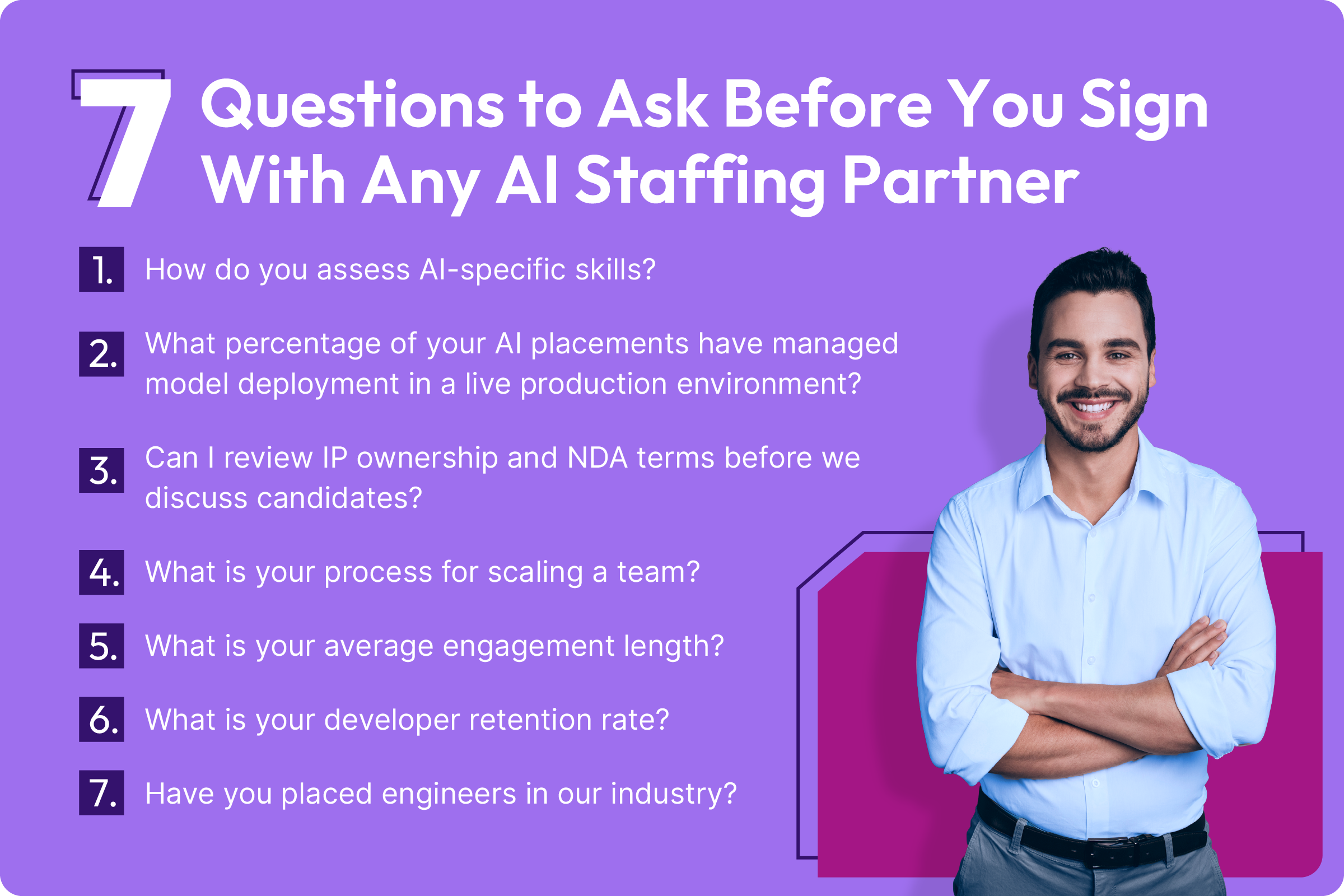
The decision happens before you see a resume. Choosing the wrong AI staffing partner does not just slow delivery. It introduces IP risk, governance gaps, and context debt that compounds for months. These seven criteria are where that risk either gets managed or gets ignored.
AI-Specific Vetting
General software vetting does not translate to AI technologies. Ask any vendor to describe their AI-specific assessment for technical skills: Which frameworks, what depth, and whether there is a live exercise for production scenarios.
Production AI Experience
A candidate who has built proof-of-concept models in notebooks is a different hire from one who has managed model deployment, monitored for drift, and resolved inference latency in a live system. That gap shows up immediately in production.
Embedded Collaboration
AI developers for hire operate on a spectrum from async availability to full sprint integration. The engineers who deliver the most are the ones in your standups, pushing to your repositories, and available real time in your timezone when something breaks.
Security and Governance
When engineers are working with fine tuned proprietary model weights, training data, or customer data inside AI pipelines, any vendor without clear NDA practices and security governance before candidate review is a structural risk.
Ability to Scale Quickly
The vendor placing two engineers this month needs to be the same vendor placing six in three months without restarting vetting. Confirm this before signing.
Long-Term Retention
Churn inside an embedded team is among the most expensive failure modes in AI staffing solutions. Every departure resets context. Ask for documented retention metrics before signing anything.
Industry Expertise
Domain context is not replaceable by technical talent alone. For teams building AI app development services or AI-native products, matching vendor experience to your vertical belongs at the top of the evaluation.
Taken together, these criteria separate a staffing engagement that compounds in value from one that requires constant management just to stay productive.
Why Tech Leaders Choose X-Team
X-Team's research found that 92% of executives are confident about their AI talent strategy while only 26% of the individual contributors executing that strategy share the confidence. That gap between what leadership sees and what engineering teams experience is where most AI programs stall.
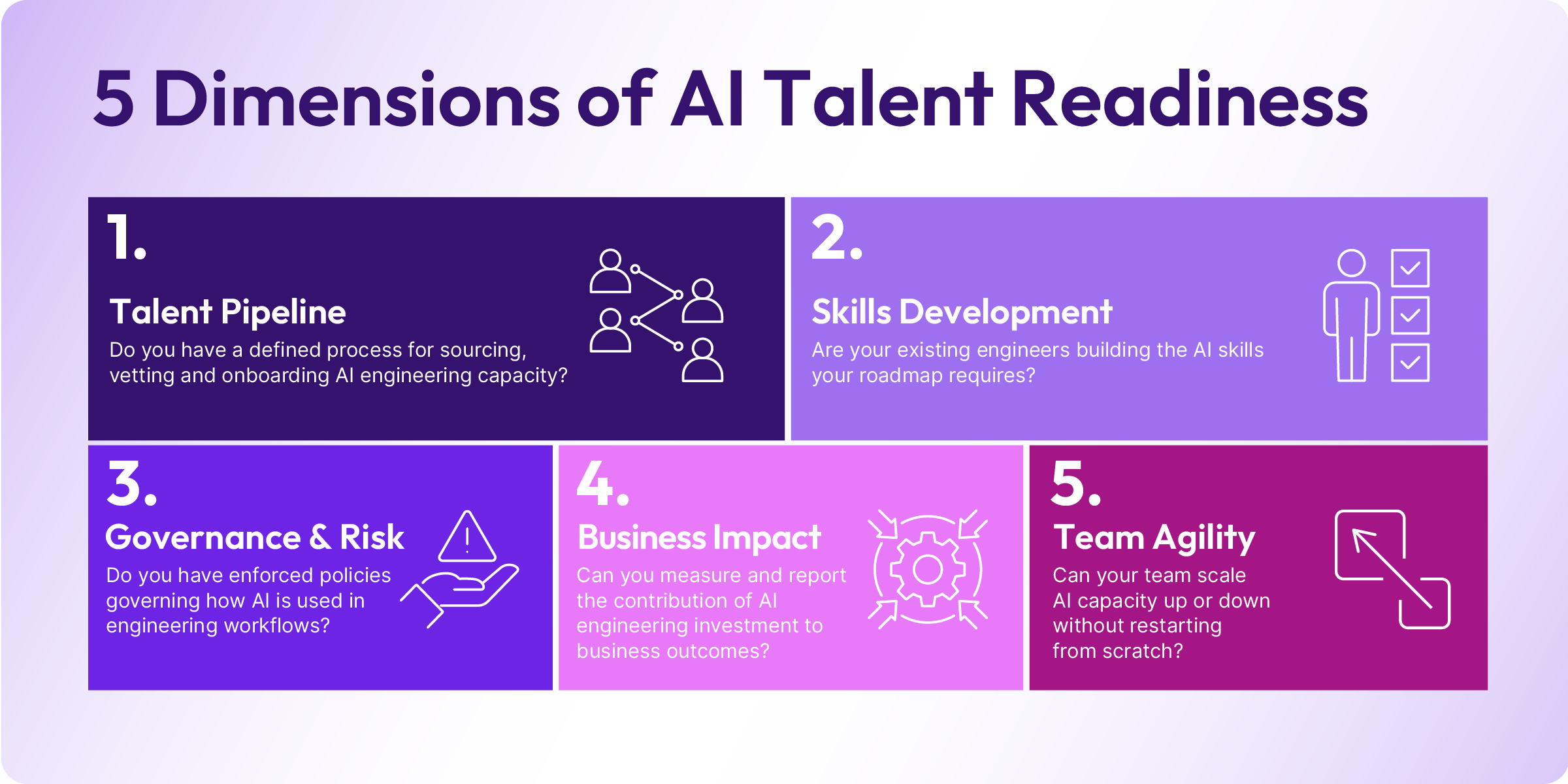
X-Team works inside that gap. The single-client developer focus, strong developer community and investment in continuous learning are all designed to place engineers who stay, integrate deeply, and perform like insiders rather than contractors on rotation. For a direct measure of where your organization stands across the five dimensions of AI readiness, the AI Talent Readiness Assessment maps current capability against what execution actually requires.
SHARE: