
The return-to-office debate has been running for years, and most of it has been framed wrong.
The argument keeps landing on where people sit — how many days, which days, in-office or remote — rather than on the question that actually determines whether teams perform: are the right people in the right place at the right time to do their best work? Dan Bladen has been watching organizations get this wrong, and his diagnosis is that the word "hybrid" is part of the problem.
As CEO of Kadence, a workplace intelligence platform helping organizations design smarter, more intentional ways of working, Dan sits at the intersection of real estate data, people strategy, and the operational decisions tech leaders make every day about where and how their teams work. He's based in Silicon Valley, leads a team across the UK and the US, and counts Professor Nicholas Bloom of Stanford — arguably the world's leading authority on flexible work — as an investor. He's not arguing from ideology. He's arguing from data, and from years of watching what happens when leaders reach for attendance policies instead of doing the harder work of building cultures people actually want to show up to.
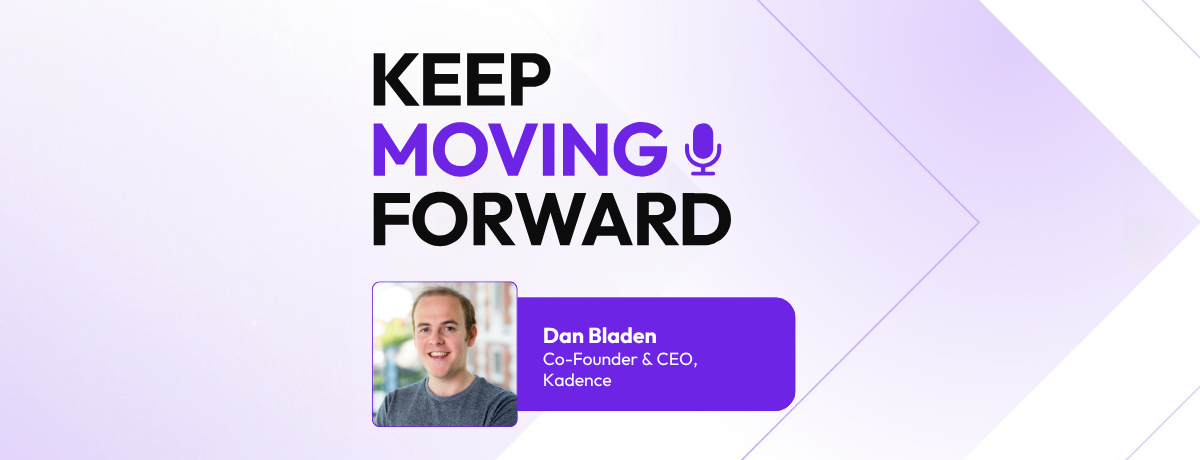
In this episode of Keep Moving Forward, I sat down with Dan to talk about why "hybrid" has become a loaded term that obscures more than it reveals, where return-to-office mandates break trust, and what the leaders building high-performance teams are doing differently — in the office and out of it.
The Word 'Hybrid' Has Stopped Being Useful
Dan doesn't ease into this. The word itself, he argues, is working against you. "I don't have many great hybrid things in my life," he says. "If I've got a hybrid washer-dryer, it's not great. If I've got a hybrid sofa bed, it's not great either." The word implies compromise — a middle ground that isn't quite one thing or the other. It's accumulated so much political weight that it shuts down productive thinking rather than enabling it.
What organizations actually need, in his framing, is agility. Not a fixed schedule, but a system that ensures people are in the right place, with the right people, to do their best work on any given day. The intentionality matters more than the number of days. A team that plans its in-office time around the work that benefits from proximity is doing something categorically different from one that mandates three days because it sounds reasonable.
The research backs him up. Dan's investor Professor Bloom and his Stanford team ran a controlled study with Trip.com — odd birthdays worked hybrid, even birthdays stayed in-office — and tracked results over 12 to 18 months. Hybrid workers showed 15% higher productivity in creative output and a 30% lower resignation rate. "You just need to backwards-engineer the best environment for your business to perform at its best," Dan says. For most companies, that lands somewhere around two to three days in-office. Not because someone decided it sounded balanced, but because that's where the data points.
What Return-to-Office Mandates Are Usually Code For
When mandates go wrong, Dan identifies two patterns — and neither is really about location.
The first is the more cynical one: RTO used as a quiet workforce reduction. Companies that told people they could relocate, then called them back knowing many wouldn't comply and wouldn't receive severance. "That's not particularly redemptive," he says.
The second pattern is more common, and in some ways more damaging. Leaders who don't know how to manage people they can't see. "What I think that is code for is: I don't actually lead beyond walking around. I lead through vibes, not OKRs, KPIs." The people you most want to keep — the engineers who can work anywhere — are exactly the ones who see through it fastest and act accordingly.
Dan is clear-eyed about what drives this. In Silicon Valley, he knows leaders at growth-stage companies who have told him directly that they don't have the middle management layer to make distributed work — their senior leaders need to be in the room because the leadership infrastructure to manage async simply isn't there. That's an honest reason to return to the office. What it isn't is a model that transfers to every organization or every team.
There's also the metric problem. Many companies have tied bonuses or performance reviews to attendance, and Dan thinks this creates entirely the wrong incentives. "I don't care whether Steph Curry gets his three-pointers from our half or from just outside the opponent's half. As long as he gets three-pointers repeatedly, that's what I care about." Attendance might be a useful leading indicator — for new joiners building trust, for teams finding their rhythm — but fixating on it as an end goal is like measuring corners in a football match. It's not the goal. It's sometimes a path toward the goal.
He has empathy for the impulse behind all of it. "Leaders want to feel like they're surrounded. They want to feel like everyone is with them on this journey." That's real. But presence mandated isn't the same as presence chosen. "If you can get it to be a magnet, that's way better."
Heads Up, Then Heads Down
For engineering leaders figuring out when in-person time earns its place, Dan's framework is direct: there are two kinds of work, and they belong in different environments.
Heads-up work — setting direction, making decisions, aligning on what to build and why — benefits from being in the same room. The communication bandwidth is higher, decisions move faster, and new team members build trust with colleagues more quickly than they will over video. "You've got billions of years of speaking face-to-face and reading each other's languages," Dan says. "That's not going to be replaced in five years of Zoom calls." There's also a talent argument here: the ability to hire that engineer from Estonia or Ecuador — bringing in world-class people at a cost that wouldn't be possible if you required them to sit in your San Francisco office — is one of the real competitive advantages this moment offers.
Heads-down work is different. Deep execution, the focused build cycles where engineers are in flow — that belongs in whatever environment lets them concentrate without interruption. "They want to be plugged in, Red Bull on hand, going for it. Let's just crank." Pulling engineers into an office during a deep build cycle because it's their designated in-office day isn't building culture. It's burning focus.
One of the more practical things Dan raised — and one I'm taking away personally — is using personality frameworks as an operational communication tool. He knows his CTO is an INTP and has built a custom AI model to sense-check whether a message or idea is going to land well with him. The principle extends across the team. "Why is that person slow to respond on Slack? Oh, he's an ENFP. Just pick up the phone." The point isn't to reduce people to a type. It's to stop burning time on friction that's entirely predictable — especially across distributed teams operating in multiple time zones, where that friction compounds fast.
What stayed with me from this conversation is how clearly Dan distinguishes between presence and culture. Presence is easy to mandate. Culture isn't. The organizations building something worth showing up to aren't the ones with the strictest attendance policies. They're the ones that have done the harder work of making the office worth choosing.
Mandates fill desks. Magnets fill rooms.
Transcript
Dan Bladen:
Agility should be built into the foundation of how companies work. And that's the infrastructure, ensuring that people can be in the right place at the right time with the right people to do their best work.
And so for us, hybrid quote unquote means one to four days in the office a week. Perhaps for others it means one day a month, but it's much more coordinated. It's much more intentional and purposeful. And so we just think it's the responsibility of leaders to enable people to work in the best possible places to get the best work done.
Gemma Verace:
Hey everyone, and welcome to Keep Moving Forward, the podcast from X-Team for tech professionals who are passionate about growth, leadership, and innovation. I'm your host, Gemma Versace, Chief Client Officer at X-Team. In every episode, we sit down with leaders who are redefining how technology teams work, grow, and lead. People who understand that performance begins with connection.
The conversation around flexible work has been running for years now, and most of it has been framed wrong. The debate keeps getting stuck on where people sit, rather than how teams actually perform. And in a world where AI is reshaping the pace of work, the cost of getting that wrong is going up.
Today's guest is Dan Bladen, CEO of Kadence, a workplace intelligence platform helping organizations design smarter, more intentional ways of working. Dan has spent his career building technology that meets people where they are, from managing infrastructure at a large London church to founding and scaling companies on both sides of the Atlantic. He's currently based in Silicon Valley, leading a team that spans the UK and the US.
In this conversation, we get into why "hybrid" might actually be a broken word, and what agile working really means in practice. Dan shares how leaders break trust during return-to-office mandates, why attendance is the wrong metric to fixate on, and how AI is compressing the time between insight and action for workplace teams. We also talk about using personality frameworks as a practical communication tool, and what it actually takes to build a culture people want to show up for.
Let's get started.
Well, welcome to Keep Moving Forward. Dan, thanks so much for joining us today.
Dan Bladen:
Hey, pleasure to meet you.
Gemma Verace:
Wonderful. We do like to start all of our podcast episodes off with asking our guests to tell us a little bit about your background and in particular the work that you're doing at Cadence.
Dan Bladen:
I grew up building tech. My grandfather designed the launch mechanism for fighter jets on aircraft carriers for the British and US Navy. So kind of spent the childhood tinkering with things a little bit in his garage. I did work experience at British Telecom as a teenager. My dad — well, we lived next door to a ton of people near BT's HQ in the UK. So I used to get like old computers given to me and would network them all together and play LAN games and have LAN parties with friends on these devices.
At 18, I left school. I actually went and worked for a church for five and a half, six years and did a theology degree alongside working at the church. And then we ended up firing our IT manager at the church. So I ended up heading up all the tech and audio visual and infrastructure for this pretty large church in London.
Fast forward — my wife and I went traveling around the world. I married quite young, at 22. When I got married, we went traveling around the world for six months shortly after we got married. I came back from South America, around India, with a kind of business ideas and started getting into startups. So yeah, a bit of an eclectic mix of background.
Gemma Verace:
Yeah, what a fascinating background as well. I mean, that is a really unique way of segueing into the IT world. But it sounds also that, you know, your upbringing with your grandfather and father, that it might also be quite innate and in your DNA, particularly within the IT space.
Let's get straight into it. In relation to kind of talking through how you can really get the best out of teams in a hybrid working relationship, both in the office and also remote — as you know, a lot of businesses were already doing remote pre-pandemic. But you know, with somebody like myself in Australia, it was very unique. There was only a small amount of people that actually were quite consistently doing working from home arrangements.
So you've said in the past that you know, hybrid working arrangements are not a perk, it's infrastructure. What did you see in the market that made you really confident that hybrid work environments should be the default going forward?
Dan Bladen:
Yeah, I think that word hybrid's actually a little bit broken now in — not quite mid, but 2026 — like, it's such a loaded term. And Gemma, I don't know about you, but there aren't many great hybrid things in my life. Like if I've got a hybrid washer dryer, it's not great. If I've got a hybrid sofa bed, like it's not great either.
And so I think hybrid's not a great term for what I think was really happening, which is how do people have agile work wherever they are, and how do we have an agile workforce? And that's really what we are trying to say here, is that agile and agility should be built into the foundation of how companies work. And that's the infrastructure — ensuring that people can be in the right place at the right time with the right people to do their best work.
And so for us, hybrid quote unquote means one to four days in the office a week. Perhaps for others it means one day a month, but it's much more coordinated. It's much more intentional and purposeful. And so we just think it's the responsibility of leaders to enable people to work in the best possible places to get the best work done.
Gemma Verace:
Yeah, absolutely. And you're very right, I don't think I've ever seen a hybrid washer dryer that I have enjoyed trying to work out. So I think that's a really interesting perspective. You mentioned that your current business is more pushing towards in-office with one or two days spattered across the week or month remote.
When companies do push return to office, what's the first thing that breaks trust, do you think? Is it policy, leadership behavior, or the day-to-day overall office experience? What are the most common failures that you see as part of the return to office push?
Dan Bladen:
I think the most common failure is where return to office is a blanket attempt to let people go. Right? If people have moved away from HQ — they were told they could move away, or perhaps they were told they're never gonna need to return full time — and then it's just used as a, okay, we can chop off a few thousand people with this move and we don't need to pay them out because it's their decision not to come back. Like, I think that's a big part of it and is not particularly redemptive.
The other parts of it I think are much more to do with where it just doesn't make sense for the outcome or output that's being asked of the team. Like, does it make productive sense for this to happen? You know, you've gotta think that you've hired — you're a smart person, you've hired smart people to join your smart organization to build and create smart things. And so these people are gonna see through lazy leadership where it's like, I'm bringing people back into the office because that's how I know how to lead people.
What I think that is code for is: I don't actually lead beyond walking around. I lead through observing face-to-face. I lead through vibes, not necessarily OKRs, KPIs — like what's actually moving the machinery or the factory line of the business forward. So I think that's what people see through.
It is interesting, right? Being in Silicon Valley, I have a bunch of friends at growth companies and public companies here where they have said to me they just don't have the middle management layer and middle management levels of leadership quality to make remote work. So they've had to bring people back because they just need their senior leaders more exposed face-to-face with their people. So I do think it changes dependent on the organization, but those are some of the failures I see — where it's kind of mandates over mission changes.
Gemma Verace:
Yeah. Wow. And that's a really interesting take — that there's probably a large majority of businesses that may also have that problem where they're not having the senior leadership, the real movers and shakers of the business and, you know, the visionaries, being able to walk around the office and have those one-on-one conversations in an authentic and meaningful discussion or engagement. It could actually be impacting the overall productivity and performance of the business. That's a really interesting insight.
For a lot of the audience listening as CTOs or VPs of engineering, what advice would you give? So if a CTO or VP of engineering wants office time to help improve execution — not just attendance — what are the three rules that you would put in place first, and what would you measure in the first 30 days to be able to kind of get a read on if it's working or not?
Dan Bladen:
Yeah. I'm not sure I've got three exact rules for you, but perhaps some kind of common practices to put in place.
So I think there are different types of work. There's heads-up work, where you are creating and deciding what direction to go — there's just a higher bandwidth of communication that can happen when you're face to face. You and I both know, Gemma, that decisions get made faster. If you and I were to agree where to have coffee today, we're gonna have a much better time doing it face to face or right now on this call than we are over email doing back and forth with text. Right? It's gonna have a higher throughput of decision making. And that's what we're seeing amongst companies that are building product in particular — when you can get people face to face, speed to decision is much, much faster. Which is why you see a lot of early stage companies, particularly in Silicon Valley, having much more of a face-to-face cadence to their weeks.
At the same time, you know, you've got the world of talent out there that you have the ability to attract. You can go and get that incredible engineer from Estonia or Ecuador — or insert other country that begins with E — and you're able to bring them in at a cost you might not have been able to bring in the same guy, or girl, from England. Right? And so that's, I think, one of the amazing things that this moment in time allows, particularly early stage companies, to do.
At Cadence, what we do is we try and have people in the office at least two days a week. What we find — particularly for new joiners — is that it helps them get to a level of trust with the rest of the team quicker. We are humans. We've got billions of years of speaking face-to-face and reading each other's languages. Like, that's not gonna be replaced in five years of Zoom calls.
And then when the work has been decided — like when we know what the mission is — having engineers... if your audience is CTOs, VP Eng, having engineers getting distracted by heads-up work, or "hey, what are you doing over here?" — that's not where most of them want to be, right? They want to be plugged in, wired in, Red Bull on hand, going for it, executing on the task that they've got in front of them. So I like to think of it as: how can I create a cadence where we need to be heads up, set direction, decide direction, and then heads down — let's just crank.
Gemma Verace:
Yeah, that's perfect. I love that. It's that whole kind of, you know, you're up here, you're working on the business, you need to connect, you need to engage, you need to be able to engage with those people that you need to be helping if you are creating a new product for or creating efficiencies for, but then immediately get straight back up to, as you said, do the heads-down work.
I think that's a really smart way and some really good advice for those listening as well. Engineering work has long focus cycles and lots of async collaboration. How should leaders decide which moments truly benefit from being in the same room and being able to, you know, eyeball each other, versus when it should stay remote by design? What's some advice that you would give around that?
Dan Bladen:
Well, first off, I think we're all operating in an entirely different paradigm now. I would've given you a different answer 90, 180 days ago than I would give you today in, you know, mid to late April. Like, AI has changed everything and the way in which remote and hybrid companies have gotten into a cadence of documenting things — having rich wikis, having really great notes and documentation, having call transcripts like this — is all gold for the AI inside of your company to forge ahead. And it just gives it so much incredible context.
I do think that in this moment, hybrid and remote companies have a real advantage because they've already built — or hopefully they've already built — the documentation, and they've got that muscle for documenting really well. So that's what I'd say. I think first off, this is an entirely different paradigm right now.
Gemma Verace:
To stay on the topic of AI — where do you think AI actually really helps in hybrid operations and where is it just noise? You've mentioned a couple of things that obviously it can kind of help accelerate, and that really rich gold data that comes from note taking is obviously a huge advancement. What other suggestions or ideas have you implemented that you've seen work, versus some of the things that you see out there that, you know, might look really shiny and a little bit sexy, but it is just noise — it's not really adding meaningful pace to the business?
Dan Bladen:
Yeah. Specifically, I think for our work, so for our customers — VP Workplace, Global Real Estate leaders — what is true is always true again: they are being asked to do more with less, faster. Right? It's just that every one of those is amped up slightly more right now.
And so with Cadence AI — we were the first to market with AI in our market back in 2023 — it is being able to do more with less, faster. Perhaps your team has shrunk. Perhaps your space has shrunk. Perhaps you've got less budget to execute on the goals that you've been given, but you've been given bigger goals again. Cadence AI is coming alongside our leaders and helping them do their best work.
It could be things like — one of our customers, a multinational company based out of New York: they would take about three months to do what we call a stack plan. So who should be sat next to whom inside the offices — if it's synergistic to put product next to marketing, or product next to the engineering team in this condensed 50-person pocket over here. How does all of that work? I've got 80 people starting next week in New York. Where are they all gonna sit? What cadence are they gonna be in? Are they gonna share desks with Gemma and Dan and Michael? How does all that work? Before Cadence, that would take about three months to do on average. For this particular 10,000-person company, they are now doing that in less than three days with Cadence, which is just absolutely fantastic.
We had another example the other day — a global law firm that we work with out of Australia, offices all over the world. They've just acquired — or just doing a big partnership with — another law firm. They need to find 15 desks on floor four in Sydney using Cadence Space. They thought they might need a hundred. They actually were able to find the 15 that they really needed with Cadence. Better using their space.
And so time to insight, Gemma, is way faster with these types of tools. Where I think the magic is, is when you can go from time to insight to from insight to action. And the more action that can be automated by that AI insight, the better. The real kind of — the porridge is just right, Goldilocks — is when that agentic action is the action you would've wanted it to take. Like, you know, a well-trained employee, or an employee that you've grown in confidence with over the years, where they act as an extension of what you would've done.
Like, that, I think, is what we are really aiming for. Is: "Oh yeah, by the way, Dan, I moved the 18 people that are starting on Monday in Boston on floor five. I arranged for them all to have a coffee gathering at 4:00 PM for the newcomers, and then they get walked to their desks on floor three and floor five." You know, like, that is the kind of stuff that I'm really excited about getting into Cadence from the get go.
Gemma Verace:
I mean, some of those — as you said, making decisions quickly, but being able to also reduce the time taken for really critical tasks — is sensational. And yeah, it sounds like a fabulous value add for all of your clients. Back into the hybrid situation, what do you think most leaders will get wrong about hybrid in the next 12 to 24 months? And what do you think the best teams are going to do differently to build high trust and high performance cultures?
Dan Bladen:
Yeah. What are they gonna get wrong? I mean, I think we live in an environment right now that is — perhaps it's changing in the last few months — but living a little bit out of fear of what the zeitgeist is, or at least what the ruling class zeitgeist is, for return to office. And I think we've over-rotated one way and then we've over-rotated another way.
What I think the best companies are doing is: what is the problem that needs to be solved? What are the jobs that need to be done? And what is the authentic way to do that for my organization to get the best outcomes? And for most companies, that means being in the office two and a half, three days a week — saving time on commute, saving money on office space, having a chance to get your head down, as well as a chance to get your head up. Like it is — I just used the phrase Goldilocks — it is the Goldilocks for, I think, most companies.
And the data's there too. There's been a lot of very highly focused, extensive testing by the team at Stanford and teams at Harvard. One of our investors is Professor Nicholas Bloom from Stanford, who's like the global authority on the future of work. And they did blind tests with Trip.com, a global travel firm. Anybody that had an odd birthday was hybrid. Anybody that had an even birthday was in office. They saw over, I think, a period of 12 to 18 months — and this is all detailed in a Nature publication — that with hybrid they had 15% higher productivity from a creation of ideas perspective. They had a 30% less resignation rate as well, which was the key. Like, they had a 30% less resignation rate, which was just massive.
And so we like to say there's a triple bottom line there: people benefits, profit benefits, and there's also planet benefits, which a lot of our customers care about as well — particularly now they need to report on their emissions if they're a public company. So that's what I'd kind of warn against: over-rotating one way or another because it's fashionable or you feel like you're out of control. The way to get control and the way to do it is to have your business perform really well. And I think you just need to backwards engineer what the best environment is for your business to perform at its best.
Gemma Verace:
Yeah. And that confidence in the individuals to be able to know where they're going to get the most out of themselves for that particular day or week as well. And that comes back to that really high trust environment between leadership and employees too. What's a metric that you've seen leaders really love that you think has also created the wrong incentives?
Dan Bladen:
Oh wow. I mean, just attendance is number one. I think we know some companies that will only give you your bonus if you've hit your attendance requirements. Which is slightly odd, right? I don't care whether Steph Curry gets his three-pointers from our half, or whether he gets his three-pointers from just outside the opponent's half. Right? As long as he gets three-pointers repeatedly, that's what I care about. I care about the outcome.
So I think it's kind of a false economy to have attendance being tracked. Now, is it a leading indicator for an employee that's gonna become a leader? Yes. Is it a leading indicator for an employee that's going to become a better team member in terms of how they interact with one another? Is it a leading indicator that they're gonna ramp faster? Yeah, all those things are true. But fixating on one leading metric is like saying you're gonna win a soccer game, or a football game, by how many corners you take. Like, it's not the goal. It is a way to help achieve the goal, but it's not an end in and of itself.
Gemma Verace:
No, that's a really, really good call out. And I think it's something that a lot of listeners to this podcast are still trying to grapple with themselves — they want to be able to encourage attendance, but they also, to your point, want it to be meaningful. They want it so that when they're in office, they're getting the right, genuine and meaningful interactions and engagements.
Dan Bladen:
Yeah, and it's hard. And it's hard, Gemma.
Gemma Verace:
Culture. Yeah.
Dan Bladen:
Leading — leadership is lonely. Leaders want to feel like they're surrounded. They feel like they're pulling really hard. I know this feeling. And they want to feel like everybody else is with them on this journey, everyone else is co-laboring with them, equally yoked with them as well.
And so, you know, some of that is turning up regularly and wanting to feel like people are part. So I've got tons of empathy for it. I feel it. You want to have people with you — like, presence as proximity. You know, it's biblical, let alone built into our DNA. And so I've got a ton of empathy for it. When you mandate it, that's wrong. If you can get it to be a magnet, like that's way better.
Gemma Verace:
Yeah, that's really powerful and compelling — when, as you've mentioned it, you've got people waking up in the morning on the days they're going into the office, excited about the level of engagement and interaction and collaboration and, you know, magic that can come with those in-person connectivities. That's a really good call out.
Dan Bladen:
Right. Do you remember achieving the goal with your company? Do you remember the most high-fiving over Zoom or high-fiving over a beer after work? Right? Like...
Gemma Verace:
No, that's...
Dan Bladen:
Those are the moments. And I think one of my coaches used to say: humans are made for mountaintops and for tabletops. And like, you know, sharing bread, making sure you can — you're on this journey with people. And so, yeah, I think for any leader, making sure you have those mountaintop moments — looking out, expanding, surveying the situation — but then the tabletops of this current moment.
Gemma Verace:
Absolutely. We at X-Team are a fully remote culture, but we do have a fabulous founder who came up with the idea very early on. We are getting to 20 years of remote-first this year, but five to six times a year there are things called outposts that all of us can elect to go to and collaborate and do co-working together, work really closely with each other, be able to meet new people that have come into the fold and really be able to get that interaction and collaboration that, as you said, you know, it's within our DNA that we want that level of interaction.
So I definitely agree with you there. What's an example of a small operational change that has produced a big jump in collaboration quality that you've been a part of or that you've witnessed?
Dan Bladen:
In remote cultures or in hybrid cultures, Gemma?
Gemma Verace:
Yeah, well, I guess both. Probably more so related to the hybrid nature of what we've been talking about today.
Dan Bladen:
Yeah. One of the biggest hacks that I think anybody can have in this moment is understanding the Myers-Briggs types, Enneagram personality profiles, of their employees. Like, I think everyone talks about it, everyone loves knowing what Enneagram they are, but I still think it's massively underutilized in the corporate world.
For example, I know that my CTO is an Irish INTP. And so I've got like a whole custom AI built for understanding if I'm communicating with him well or not — "hey, will this idea fly? I'm emailing him at 11 o'clock or Slacking him at 11 o'clock at night. Is he gonna wake up?" Now I know him well enough, and I'm schooled enough on this particular individual to know innately what's gonna work.
But let's say it's an ENTJ — they're a bit more aggressive, they're a bit more assertive than my natural personality type would be. So I would role-play, you know, with my ENTJ custom GPT, for example. So like, this is such a hack for understanding: why is that person slow to respond on Slack? Oh, he's an ENFP. Oh yeah, I just should pick up the phone to him. Duh — rather than getting frustrated here in the Bay because my Salt Lake City ENFP, or my London ENFP, is not responding to me in 30 seconds on Slack. Pick up the phone. Oh, he's that personality type, she's that person.
So like, I think you can sometimes overindex on that the other way too, and you put everything through this box and everybody has to conform to it. But like, that is just such a hack for speed. And I think it provides context and empathy for where the other person is coming from.
Gemma Verace:
That is brilliant. I think I'm definitely going to use that as a key takeaway. I think that's an amazing piece of advice for people — as you said, over time you start to get more of an innate understanding and there's a relationship built, but what a fabulous and respectful way also to be able to understand what people's makeup is and the best way to communicate to them. I think that's some absolutely sage advice.
One final question that we do ask all of our guests: what gets you going in the morning? What keeps you moving forward, every single day?
Dan Bladen:
I've got three young kids. So I think that's probably number one. I've got...
Gemma Verace:
The alarm clock. Yes.
Dan Bladen:
A Northern Irish wife that wouldn't let me lie in bed too long. Maybe she's the best. I've got a team in the UK eight hours in front of me, so I start my day feeling...
Gemma Verace:
Wow. That will do it.
Dan Bladen:
And then yeah, I think my faith, right? I believe the best is yet to come. I believe that I'm being ultimately looked after and I believe that I've been given talents and opportunities to try and make better, to try and be my best, and to try and make sure that I'm doing the best with what I've been given. So on my good days, Gemma, I'd hope to think that was my default. I can't say that's every day.
Gemma Verace:
I love that. I have to say I don't have any favorite guests, but that's — that's my favorite response to that question. I love that. It was very layered in, in, you know, practical reality of children. But also, as you said, you know, all of the things that quite literally get you up and going with your UK team, and then the ultimate belief that yeah, everything will be okay if you continue to trust and believe. So I've thoroughly enjoyed our conversation today. Dan, thanks so much for joining us on Keep Moving Forward.
Dan Bladen:
Gemma, thank you. Keep moving forward.
Gemma Verace:
Yes, thank you.