
Half of the 324 US technology, HR and business leaders X-Team surveyed this year said it would take them three months or more to staff a cross-functional AI team. Their executives were far more relaxed about it. Ninety-two percent said they were confident in their organization's ability to source AI talent, compared with 26% of the individual contributors doing the work.
That gap shows up the moment you try to hire AI developers. The title covers everything from data scientists tuning models to application engineers wiring a large language model into a product, and the people who do the second job well have only been building with these tools for a few years.
This guide covers the skills worth paying for in 2026, what AI developers cost, which hiring models hold up after launch and how to run a process that doesn't eat a quarter.
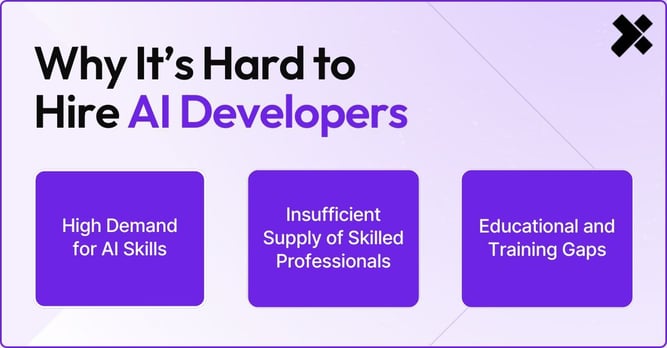
Why AI Developers Are Hard to Hire
Plenty of engineers list AI on their résumés now. Far fewer have shipped an AI feature, kept it accurate after launch and explained its failure modes to a product team. Three things make the search harder than it looks.
The Role Keeps Changing
Two years ago, most AI hiring meant machine learning engineers training models from scratch. Today much of the work builds on foundation models, with retrieval pipelines, evaluation suites, agent workflows and the guardrails around them. Job descriptions written for the first role tend to attract the wrong candidates for the second.
Nobody Owns the Pipeline
In X-Team's AI Talent Readiness Report, 24% of respondents didn't know how their organization adds AI engineering capacity at all. HR leaders reported 29% confidence in sourcing AI talent, compared with 78% for data and AI teams. When recruiting and engineering disagree about what they're hiring for, searches stall.
Experience Is Hard to Verify
A polished demo is easy to build. Production experience is harder to fake. The candidates worth hiring can tell you what their system got wrong, how they found out and what they changed.
Skills to Look for When You Hire AI Developers
Strong AI developers pair solid software engineering with a working knowledge of how models fail. These are the skills that separate them in 2026.
Python and Machine Learning Frameworks
Python remains the working language of AI. Look for depth in PyTorch or TensorFlow and familiarity with libraries such as scikit-learn and Hugging Face Transformers. If your team trains or fine-tunes its own models, you may want to hire PyTorch developers or hire TensorFlow developers for that work specifically.
LLM Application Engineering
Most new AI features build on foundation models from providers such as OpenAI, Anthropic and Google. That calls for experience with retrieval-augmented generation (RAG), prompt design, fine-tuning and tool use. Teams building heavily on large language models often hire LLM engineers to own this layer.
Evaluation and Guardrails
An AI feature that works in a demo can drift once customers start using it. Ask candidates how they measure accuracy, catch hallucinations and test changes to prompts or models before release. Developers who've built evaluation suites keep you from learning about problems through customer complaints.
Data Engineering
Models are only as useful as the data behind them. For most production systems, experience with pipelines and platforms such as Databricks, Snowflake and Spark matters as much as modeling skill.
MLOps and Deployment
Shipping a model means versioning it, monitoring it and rolling it back when something breaks. Look for experience with Docker, Kubernetes and CI/CD, and with tracking model performance after launch. If you need someone to own that work end to end, hire machine learning engineers with production deployment experience.
Cloud and Cost Control
Inference costs add up fast. Developers who've worked on AWS, Azure or GCP and can trade off model size, latency and spend keep your AI budget predictable.
Security and Governance
AI systems touch sensitive data and open new attack surfaces such as prompt injection. Look for candidates who understand access controls, data handling and the compliance rules in your industry.
Communication Across the Business
AI projects stall when engineers can't explain trade-offs to product, legal and finance. The developers who move projects forward write clearly and can describe what a model can't do as easily as what it can.
How Much Does It Cost to Hire AI Developers?
The Bureau of Labor Statistics put the median annual wage for US software developers at $135,980 in May 2025, with the top 10% earning more than $214,670. Developers with production AI experience are scarce, so expect offers toward the upper end of that range.
Salary is only part of the cost. Four things move the total.
Seniority. A senior engineer who can design an AI system and own it in production costs more than a mid-level developer, and needs far less direction from your team.
Specialty. Fine-tuning, evaluation and MLOps each narrow the pool of qualified candidates, and narrower pools cost more.
Time to hire. Every month an AI role sits open delays the roadmap it supports.
Engagement model. A full-time hire carries recruiting fees, benefits and onboarding time. Contractors bill hourly. Partners such as X-Team scope pricing per role across IT staff augmentation services, permanent placement, RPO and project-based work.
3 Models for Hiring AI Developers
You have more options than a traditional full-time hire. The right one depends on how long the work runs and how much it depends on knowing your systems.
Full-Time Staff
Full-time AI developers build deep knowledge of your product, data and goals, and they're there to maintain what they build. That continuity matters for core AI systems that will evolve with your business.
It's also the most expensive and slowest route. You're competing with large technology companies for the same people, and salaries, benefits and ongoing training add up. University partnerships, bootcamps and communities such as GitHub and Kaggle can widen your pipeline, but they won't shorten a search on their own.
Independent Contractors
Contractors let you bring in specialist skills for a defined piece of work, such as a single AI feature for a product launch, without a long-term commitment. For contained tasks with a clear finish line, they can be the most cost-effective choice.
The trade-off is continuity. A contractor finishes the project and moves on, and your in-house team inherits whatever surprises surface later. X-Team's research found that short-term contractors had governance embedded in workflows 13% of the time, compared with 47% for embedded, longer-term partner teams.
Embedded Partner Teams
An embedded partner team supplies vetted AI developers who work inside your repositories, rituals and review processes for as long as the roadmap needs them. It's a fit for AI work measured in quarters, where context compounds.
In X-Team's research, embedded, longer-term partner teams reported strong value capture 85% of the time and structured training 66% of the time, compared with 42% and 35% for internal-only teams. The catch is choosing well. Partners vary widely in how they vet, so compare AI staff augmentation companies on retention and fit as well as rates.
How to Run an AI Developer Hiring Process
A good process filters for production judgment early, so you don't spend weeks interviewing people who have only built demos.
Define the Work Before the Title
Decide whether you need someone to build applications on existing models, train and deploy models or manage the data underneath them. Then write an AI developer job description that names that work, the stack and the compensation range.
Test With Your Own Problems
Give candidates a scoped problem from your domain, such as improving retrieval quality on a sample dataset, and talk through their trade-offs. A strong candidate asks how you'll measure success before writing any code.
Check Communication and Staying Power
Ask candidates to explain an AI concept to a non-technical stakeholder and review a sample of their written documentation. Then ask about their longest engagement and why it lasted. Developers who stay through several releases know which shortcuts cost the team later.
Onboard With Full Context
Set clear expectations about how the role connects to business goals, and give new developers access to data, documentation and model history from the first week. AI developers ramp faster when they can see why past decisions were made.
FAQs About Hiring AI Developers
How Much Does It Cost to Hire an AI Developer?
The cost to hire an AI developer depends on seniority, specialty and engagement model. For a US benchmark, the Bureau of Labor Statistics put the median annual wage for software developers at $135,980 in May 2025, and developers with production AI experience usually command more. Contractors bill hourly, while partners such as X-Team scope pricing per role.
How Long Does It Take to Hire AI Developers?
Hiring AI developers often takes longer than filling other engineering roles. In X-Team's 2026 AI Talent Readiness Report, half of the 324 leaders surveyed said staffing a cross-functional AI team would take three months or more. Working with a partner that already has vetted AI engineers can shorten that timeline.
What Is the Difference Between an AI Developer and a Machine Learning Engineer?
An AI developer usually builds applications on top of existing models, using techniques such as retrieval-augmented generation, prompt design and evaluation. A machine learning engineer usually trains, tunes and deploys models and owns the pipelines behind them. Many roles blend both, so define the work before you choose a title.
What Skills Should You Look for When You Hire AI Developers?
The skills to look for when you hire AI developers in 2026 are Python and frameworks such as PyTorch, experience building on large language models, evaluation and guardrails, data engineering, MLOps, cloud cost control and clear communication with non-technical teams. Production experience matters more than the length of the list.
Should You Hire AI Developers Full-Time or Through a Partner?
Whether to hire AI developers full-time or through a partner depends on how long the work runs and how much it depends on your systems. Full-time hires suit permanent, core AI functions. Embedded partner teams suit roadmaps measured in quarters, and short-term contractors suit contained tasks with a clear finish line.
Where Can You Find Qualified AI Developers?
Qualified AI developers come from university and bootcamp partnerships, open source communities such as GitHub and Kaggle, specialist recruiters and staff augmentation partners. Each source trades speed, cost and vetting effort differently, so match the source to how soon you need the role filled.
Keep the Context Your AI Team Builds
AI work compounds. The engineers who built your retrieval pipeline know why it's tuned the way it is, and that context leaves when they do.
X-Team supplied Riot Games with more than 120 senior engineers, who helped integrate LLMs for localized content creation. When you're ready to hire AI developers who embed in your team and stay through the roadmap, talk to X-Team.
SHARE: