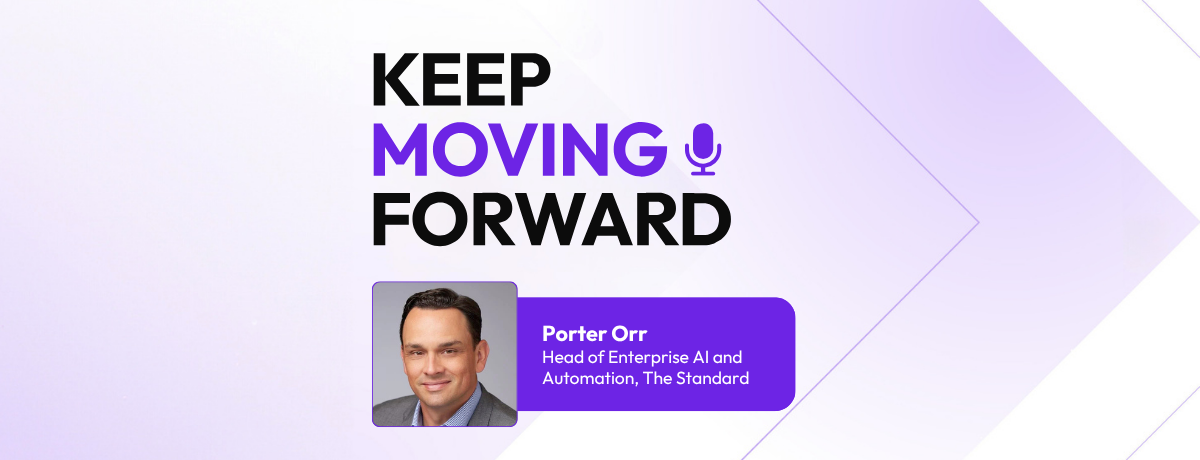
Most organizations track enterprise AI adoption by counting the numbers: logins, usage rates, automation percentages, hours saved. Porter Orr, Head of Enterprise AI at workplace benefits provider The Standard, watches for something else entirely: what they call the tool.
In this episode of Keep Moving Forward, Porter explains why measuring AI success only in cost savings is a mistake, how his team built adoption in stages, and the exact language shift that tells him a tool has been fully embraced in organizational workflows.
Why Most ROI Conversations Think Too Small
Porter leads the team responsible for applying AI across claims, underwriting and billing, the side of the insurance business where cost savings have historically been paramount.
Porter pushes back on that framing directly. "Typically when you think through that and you talk about automation, the number one thing you think about is reducing operational expense as a result of labor," he says. "I don't think that that's healthy for the company... But I also think, more importantly, you're missing a whole lot of the value on the table."
His preferred ROI model is a concept he borrows from Gartner called value compounding. Applied to a claims example, one AI capability can reduce labor cost, but it can also free up time for more complex customer conversations, raise quality, lower risk, and improve capital performance. "So right there, I have five different things that I've delivered value on as a result of one AI capability," Porter says.
From Chatbot to Helpful Colleague
The Standard's adoption path started small and low-stakes. In 2023 and 2024, the company built an internal knowledge bot called Ask Stan, designed to answer employee questions with zero friction and zero threat.
When Microsoft Copilot arrived, the transition was seamless. "We have upwards of around 85% of our employee base using it every day," Porter says, "just because they enjoy using it, and it's really cut down on a lot of friction."
But usage numbers aren't the only signal Porter pays attention to. He listens for language. Teams move from doubt, questioning what the AI is doing and why, to validation, understanding its decisions, to trust, where the tool gets a name and gets talked about like a colleague. "So they go from 'it,' and they start saying things like, whatever you would call it, right, like let's say it's Stan, 'Well, what does Stan say?'" he says.
How Co-Ownership Accelerates AI Adoption
AI adoption, in Porter's telling, isn't something that happens to a team. It's something a team builds for itself through low-stakes wins, shared ownership, and governance that earns confidence instead of demanding compliance.
To facilitate that, Porter structures his team around what he calls a fusion model: technologists, business operators, and service staff working together every day instead of handing projects off between departments. "It's not, 'well, what does delivery say about that, and what does the business say about that,'" he says. "It's, ‘what do we think about that?’"
Governance runs underneath all of it, built in from day one rather than bolted on afterward. It’s easy to assume that could slow things down. Porter sees it as the opposite. "If you do it by governance by design, I think it actually ends up speeding up things at scale," he says, pointing to a mantra he leans on often: Slow is smooth, and smooth is fast.
Transcript
Porter Orr:
We're really used to, as, especially in a larger enterprise, we'll say, "Hey, I did this thing. I built this thing," and what's the immediate ROI? It could lead you to some preternatural decisions as an enterprise leader when you think through that. Because typically when you think through that and you talk about automation, the number one thing you think about is reducing operational expense as a result of labor.
And I don't think that that's healthy for the company, and I don't, in the short term or in the long term. But I also think, more importantly, you're missing a whole lot of the value on the table.
Gemma Versace:
Hey everyone, and welcome to Keep Moving Forward, the podcast from X-Team for tech professionals who are passionate about growth, leadership, and innovation. I'm your host, Gemma Versace, Chief Client Officer at X-Team.
AI investment is no longer the question. Every organization has a budget, a pilot, a roadmap. The harder question is what happens after launch. Most companies are tracking automation rates and hours saved while the tools they built quietly gather dust.
Today I'm joined by Porter Orr, Head of Enterprise AI and Automation at The Standard, a workplace benefits provider. Porter describes himself as an operator at heart, someone who has always been drawn to how complex operations run. That thread goes back to his time as a naval aviator, through his work at The Walt Disney Company, and then into insurance. AI, for Porter, is where that curiosity landed: how do you use technology to make complex operations genuinely better?
In this conversation, Porter discusses Gartner’s idea of value compounding and why measuring AI by automation rates misses most of what it can actually deliver. We talk about designing AI that employees enjoy using, what low adoption is really telling you, and how to build governance in from day one… rather than bolt it on at the end. And he shares the clearest signal he knows for whether an AI initiative has truly taken hold.
Let's get started.
Welcome to Keep Moving Forward, Porter.
Porter Orr:
Thank you. Excited to be here.
Gemma Versace:
Yes, we're excited to have you on. We'd like to start all of our episodes with our guest just giving us a little bit of background as to what your work has been to date, and specifically the work that you are currently doing at The Standard.
Porter Orr:
Sure. Yeah, absolutely. So, in my current role, I am the head of enterprise AI and automation at The Standard. And for those that aren't aware, The Standard is a workplace benefit provider where we sell insurance products to employees, things like disability and life insurance.
And so, excited to be here today. I've been at The Standard, to answer your question, for around two years. And so that's when we started our AI team journey, was back in 2024. So we've been doing it for about two years now, and we're currently focused on really several different areas within my team.
The first, it all starts with strategy and governance. We do everything by governance, by design, and so we created the team very methodically around that. And then we also build and deliver capabilities, whether we partner with other people, we build or buy capabilities off the shelf, or we build them internally.
We're really focused on applying AI in such a way that maximizes our corporate strategy, and helps promote it using a combination of what we call compound AI systems, primarily, where it's a variety of multiple things working in the background to really help automate different key capabilities within our business, such as claims decisioning or operations around underwriting, or maybe in billing, things like this that are really core to insurance operations.
How can we make that better for our customers? So that's really our current focus of our team.
Gemma Versace:
Really interesting work that you're doing there, and obviously sitting across quite a number of different requirements that you're responsible for there at The Standard.
And thanks for giving us some really good insight into the work that you're doing, not only at The Standard, but also what The Standard provides to its clients. You've also got quite a bit of an interesting background before getting to The Standard. Can you give us a little bit of background as to what you were doing previously?
Porter Orr:
Absolutely. Yeah, it's non-traditional, to say the least. So I started my career studying computer science as an undergraduate quite a long time ago, and during that time, 9/11 occurred. And so when that happened, after graduating, I decided to serve in the military.
So I joined the United States Navy, and I served as a military officer for 10 years. And as a naval aviator, I became a pilot. And it was important to me because, one, I'm a purpose-driven, mission-driven person by nature, but also I was the third generation of military members.
Gemma Versace:
Oh, wow.
Porter Orr:
I felt compelled to serve, and it was my honor.
I enjoyed it. I met my wife, started having kids, met some really lifelong friends, and got to travel around the world. Learned a lot. Afterwards I had the option to kind of go back to graduate school, and I wanted to take my leadership lessons and my passions around leadership, which I really fell in love with, is being a naval officer, and apply that in the context of technology and business.
And so I received an MBA, and I kind of did this mid-career pivot, and I was able, I was lucky enough to go to MIT Sloan, where I received a full-time MBA. And in between kind of leaving the Navy, joining MIT, I read this seminal book, and you might even be aware of it. It's called The Second Machine Age. It's an oldie but a goodie.
It came out around 2015. It was written by two economists that were MIT professors at the time, and I read this book and I was enamored with it. And really it was around imagining what the future looks like for all industries when computers and machines work together. Being a computer scientist by trade, I was really interested in that.
And I was just, I mean, I was hooked. So I formed all of my studies at MIT around that, how to kind of understand the technology, advanced analytics and AI, but also the operational implementations of that and what that would mean, and kind of design my curriculum around that particular premise. And then I went into the workplace, and that's exactly how I applied it.
I just pursued opportunities across multiple different industries that were really around applied AI through the lens of how could you do the same business model of what you're doing, but in a different way, in an operational sense, as a result of what technology could do. So I did that at theme parks and cruise ships at Disney World, which my kids loved.
So I worked for the Walt Disney Company, and then I went and worked with the United States Army actually as a civilian for a while out of Austin, Texas, doing defense innovation. And then I eventually made my way to insurance, which certainly wasn't the Mickey Mouse, but I loved it. I fell in love with insurance 'cause it's really complex.
And I've been there for six years, and I've been at The Standard for two. And I just really enjoy the industry. Like I said, I'm a purpose-driven person. And so, for me, insurance is an essential thing of society, right? That we all kind of need this peace of mind and this financial peace of mind of what happens if something happens to us.
And I think that's a really important social contract. And I wanted to work for a company and apply AI to help kind of show what AI can do, but in a really good, healthy way for society and for the economy. And that's why I chose The Standard, because that's what we're all about.
Gemma Versace:
That's amazing. And firstly, thank you for your service. Absolutely amazing that you spent such a large portion of your life serving within the American Navy. So absolutely fantastic. And what's the through line that you do see, that you've been able to see across all of the different environments that you've worked in?
Porter Orr:
Great question, Gemma. I'm an operator by trade, and so the common through line that I would say is, no matter what industry you're working in, and whether you're producing a good or providing a service, or you're doing knowledge work, operations are incredibly complex, right?
And it is, it's almost like a living thing, right? When you have an operation up and running and doing really well, it is a living, breathing organism. And I've always been enamored with how complex they were. And so the through line, if you will, was operations are really exciting.
But AI, fundamentally, when you think about it, is not a technology. It is around understanding how can we use computers to automate more things, which then inherently feeds back to how would you do operations in this world. That was kind of the throughput that got me into that next stage, right?
So I learned core operations within the Navy, and then I expanded on that operational knowledge at Walt Disney, which is known for operations, research and application. But then through the lens of technology, and that's really been the through line, right? If you get into insurance, insurance is so complex for those that don't know.
My old mentor used to say, you can learn insurance in five minutes. You can spend 40 years learning it and you'll never be an expert. And it is very true. And so operations are just really complex. So that's what I really kind of saw as the through line, was everybody's got complex operations, but if you apply AI and automation and other technologies in a wise way, you can really understand how to do that in the future, that's beneficial for everybody across the value stream.
Gemma Versace:
Yeah, fantastic. And you know, for our audience, just to say, some really fantastic insights for them to take away. To stay on AI, there's a lot of excitement about AI ROI, but you push back on how most organizations measure it. What's wrong with the way that we are currently keeping score, in your opinion?
Porter Orr:
I do push back. I push back because I think it's too transactional, one for one, meaning, you know, we're really used to, as, especially in a larger enterprise, we'll say, "Hey, I did this thing. I built this thing, and what's the immediate ROI, and what does that NPB over the next five years? I want it now."
I'll spend a couple months and how do I get it? And I think that could lead you to some preternatural decisions as an enterprise leader when you think through that. Because typically when you think through that and you talk about automation, the number one thing you think about is reducing operational expense as a result of labor.
And I don't think that that's healthy for the company, and I don't, in the short term or in the long term. But I also think, more importantly, you're missing a whole lot of the value on the table. So what we measure and how we think about it at The Standard is what I call value compounding. And I stole that term from Gartner, but I really like the idea that it's called value compounding.
And the idea is that AI, if you design it the right way, if you implement the technology in accordance with an AI workflow, an operational workflow that's designed around what the technology can achieve, and you understand how a human and a machine can work together to be a collaborative team, then all of a sudden you can say, where can we capture value in a multitude of different areas, right? And this is where it compounds. So I'll give you an example, right? A difference of what a transactional perspective would be versus a value compounding perspective. We're gonna take the idea of claims.
So everybody's insured, you know, they, you have an insured, most likely, and you've probably dealt with an insurance claim. So a transactional mindset would say a person could do 20 things per day before AI, and now they can do 30 things per day. And so I've increased them by 50%, and that means that I can have X amount less people to do the same amount of things that I used to do.
Right. That's very transactional, very media. I think, though, that you miss a significant portion of the value that you actually created, and I think that's not actually good for the long term. And so the other way to look at that is to say, if we have a capability that enables people to save time on doing a thing, then how can we reinvest that time to really drive competitive differentiation?
Meaning maybe we spend more time on the phone with Gemma because she just had a troublesome diagnosis. Or maybe we talk to Porter, and Porter's really, you know, he's got a long-term disability, he's trying to get back to work, but he can't go back to the old job that he wants, but he wants to find gainful employment.
Maybe I spend more time with Porter helping him do that. Right. Also, maybe I don't spend as much time on the things that are pretty simple as an employee, but I can spend a whole lot more time on the things that are really complex. And when we switch into that, what we call applying expertise, then you can increase quality. For an insurance company, increasing quality is a really big deal because that also translates to reduced risk, which then translates to capital performance. So in one initiative you could say, "Hey, I could just reduce labor expense." Or you could say, well, I can have better customer satisfaction, better employee experience, lower churn.
I could also increase quality, and I could also increase capital performance. So right there, I have five different things that I've delivered value on as a result of one AI capability versus a one-for-one transactional mindset. So that's how we think about it. Now, to be candid, it makes tracking ROI challenging, because you're tracking it all over the place. But I think what's really important is that you understand that there's value at multiple different places, and then you need a leadership team that believes in that and is willing to say, invest in it and stay true to that vision.
And I think that if you do that, then you can really achieve great things together.
Gemma Versace:
Yeah, absolutely. And what a refreshing way to look at it as well. I think, again, for our listeners listening, it just absolutely makes sense that, yes, you can get those short gains from a cost impact or cost-out perspective introducing AI, but your people-first and client-centric strategy, in what you've just described there, is ultimately going to ensure that you get significantly more ROI in the long run, over customer satisfaction, customer retention, employee turnover, employee satisfaction, as you said. It's a really fantastic strategy that's going to ultimately have AI that isn't looked at also from a fear perspective within your employees.
I think that's a really good dovetail into our next question, because in doing some research with having you on the podcast, we've been reading through some of the previous statements and some of the strategies that you have shared publicly previously, and you've talked about making AI enjoyable for employees, not just useful. What does that actually look like in practice inside an insurance company? And I know some of the examples you just gave can kind of highlight how employees can feel more empowered and they can provide more value, not only to their job satisfaction, but more value to clients.
How is it making it more enjoyable for employees in their day-to-day work as well?
Porter Orr:
I'll tell this through a couple lenses, you know, past, current, and future, if you will, 'cause it's been a journey. So, in the past, the way we started, we kind of just wanted to get our feet wet, right? And we just said, "Hey, let's go use this," and try to figure out what's really challenging for our employees day to day, and, honestly, it was access to knowledge.
And so this was kind of 2023, 2024, the company created what we call Ask Stan, and it was essentially a knowledge management bot, right? And so you can ask Stan any question, and it kind of looked through all of the information that it had as far as context, and it would provide answers to employees.
And it was a very non-threatening way to, one, explore the technology and learn from a technical lens, but also introduce AI in a non-threatening way to the organization, to get them to start to use it and want it. And then Microsoft Copilot came along, and they started to do this, right? And we all now have Copilot, where Microsoft shops, we have Copilot embedded within anything.
And it's phenomenal. It works great. And so now it's really much more advanced than what Ask Stan used to be. And so we can access knowledge. And now we have upwards, I think, of around 85% of our employee base using it every day.
And just because they enjoy using it, and it's really cut down on a lot of friction. The other thing that makes it enjoyable is we also help by just promoting creative ideas around the company, right? And so we have a lot of really motivated people that really want to help The Standard succeed, because it's about helping people, right? So again, it's purpose-driven, and so we have very passionate employees, and they can just say, "Hey, I've got this problem. I went and I used Copilot and I did this, and I put this data in there, and look at what I can do." And then they kind of show that around the company, and it creates this almost grassroots effort of change management champions that kind of promote growth, and that's been phenomenal, right?
To see and to look at. And so that was kind of the interim state that's moving into the current state. And where we're at now, we're really starting to see a pivot into these core work tracks, like underwriting and claims, where, you know, you could imagine you've been doing the same thing maybe for decades, the same thing the same way. And it's really time intensive, and you've got lots of things going on, and you're clicking between multiple screens.
And they're starting to see that when we design these, what we call custom workflow products, wow, is life easier. Wow, this is great. This is so awesome. I don't need to do all this data entry. I don't need to go chase down these documents. It's already here, and you've provided context automatically to me as the employee. This is great because now I don't have to do all of that kind of busy work, but instead I can reinvest it, like I said, right? Like talking to Gemma or talking to Porter, and spending the time on the complex things where it's really hard to spend time maybe previously.
And so this is where we're at right now, where our employees are saying, "Not only can I chat and find knowledge, but, man, when we start to really apply this in a workflow sense, I see this daily in our efficiencies." And I think that's only gonna amplify in the future, as long as you have this kind of value compounding mindset, where you're saying, "Hey, we believe in our employee base. We believe that we want to be an empathetic company, and we want to drive expertise within our company. Let's invest in that, and let's trust our employees to capture the value through this technology in multiple different ways." So that's really how we've found it to be enjoyable.
Gemma Versace:
That's amazing. And, you know, also, too, I think when you talk about your employees adopting AI and adopting the technologies that you are providing to them, there seems to be quite a level of trust from your employees to say, "Hey, look, there's a reason why we are getting access to this tooling." And ultimately they can, and have, seen the value compound over time, that they want to continue to make sure that adoption is high. And adoption, as you mentioned, is one of the primary success measures that you're tracking. What does it tell you when adoption is low, even after a technically solid deployment of a new tool across the teams?
And have you ever had that experience where you've rolled out something and it has been low? What do you think drives that? Why do you think that would be the case?
Porter Orr:
There's a couple of reasons, I would say, and in no order of priority. Yes, to answer your question, we have had, you know, "Hey, we've launched this," and we've had low adoption. I think there's a couple of things that are going on, right? And it's usually a mixture of it, but I'll just kind of bucket them.
The first is, you've likely been doing the same work the same way, maybe for a decade, maybe two or three of them stacked on top of each other. And so when you start to say, "Hey, do this thing that you do every day and you're really comfortable with, and do it fundamentally differently," there is inherently a change management adoption curve, right? It's like, "I don't want to do that." And I think all of us are guilty of that, especially me. There is this period of transition where you launch something, and people just kind of need to get used to it, right? They need to kind of mess with it. They need to understand it, they need to see the light, and kind of tweak it.
And I think on the technical side, that's also really key, 'cause you gotta listen to that feedback and you can't get your feelings hurt, right? You say, "Okay, we thought we had really something great, but we can continue to tweak this and improve it," which is having a proactive product mindset. I think that's really critical to help drive that adoption to increase later. One other big reason, though, is often I find that, in experiences in the past, you will build a technology thing, like a product, but you've kind of neglected the operational model to a large extent. And so what you'll end up having is, "Hey, we gave you this tool. It's great. You should use it." But, oh, by the way, you still have to click on that screen, and you have to still go move the file over there, and now, instead of saying, "Hey, this is easier for you," which has actually added complexity within the workflow. And technologists, myself included, have been guilty of this in the past, right, where you just say, "Hey, I built a technology," but I didn't build it through the lens of the end user. And so how do we think through the lens of an end user, but also through the lens of the workflow that they operate within? So that's another huge area where you can say, "Hey, we launched this," and it's not perfect, but maybe let's dial out a little bit and understand how we may change the workflow, or what are the other things we need to add to it to make it a little bit better.
Gemma Versace:
Yeah.
Porter Orr:
So those are the primary two driving reasons that I see, is you just gotta kind of get used to it. Let it settle in a little bit, right? Like, it's like a new suit. It's not comfortable, like the old suit, or maybe a pair of jeans is a better analogy, right? You have those jeans, I have those jeans, you put them on, you're like, "Oh, these fit perfectly." Then you buy the new ones, you're like, "Oh, these are snug and I don't like 'em." But eventually they kind of become your favorite jeans, and it's similar to that. Or, "Hey, we bought a pair of jeans and we thought it was pretty good, but there needs to be some tailoring here to make it truly useful for you."
And that's making sure that it's designed within the operating model that it's designed to work within, so that employees want to use it and it's not a burden.
Gemma Versace:
Yeah, and it really, everything that you are saying, is highlighting just how the employee and the client, your employees, are really at the forefront of every decision that you're making around AI, and what tooling that you're putting in front of them. And you are being really thoughtful and deliberate in really wanting the employees to have their commitment, and not just their compliance, in adopting and getting excited, but also utilizing and getting good buy-in to the AI tooling that you are rolling out across The Standard, which is just, I used the same word again, it's just really refreshing to hear as well. And, in a regulated industry, you touched on it a little bit earlier, in a really highly regulated industry, like insurance, how do you build AI that's both auditable but also fast enough to stay competitive? Because that seems like there would be some tension there.
Porter Orr:
There is, a hundred percent, there's tension. And the short answer is governance by design. You gotta start with governance by design. And so I had the benefit, or we had the benefit as a team, of kind of trying to do this as technologists. And I think we all kind of have battle scars, if you will, a little bit, is what my previous leader used to call them.
And as technologists, it's really easy to go and tinker and build a thing and say, "Yeah, this is great." And you don't really think about governance. Then you go, especially in an insurance company, and you say, "Hey, let's go use this." Everybody's like, "Wait, what, timeout? You wanna, what, with what?" And what's the privacy, and what's the security, and how are you making decisions, and what does X state say about that? And all of a sudden you go, "Whoa, this is really complex." And so we have the benefit of some of those battle scars, but if you do governance by design, especially within a regulated industry, I think it's even applicable outside of regulated industries personally, but you get to a place where, as long as you design your governance program to not be a barrier but to be an enabler, right, and that's the mindset that you bring into that team, you can still mitigate risk and you can still govern data and AI usage, but you do so in a way that enables innovation and growth, but in a risk-mitigated way.
And so it's slightly slower than frontier-edge stuff, right? But the thing is, we're not competing with ChatGPT and OpenAI, or Anthropic, or pick your big tech player. That's not who we compete against within our industry. So it's okay, and we should take more time to make sure that we're doing governance a little bit by design and making sure that we're doing the right thing, because in the long term, we believe that's what's best for our customers. So it's best for our employees, and that's what's best for the company and its capital performance. Like I said, it's all about reducing risk that helps us achieve good capital performance as a financial service provider, right? So—
Gemma Versace:
Yeah.
Porter Orr:
If you do it by governance by design, I think it actually ends up speeding up things at scale, because you're not constantly hitting these, "Hey, question from legal, or question from privacy, or question from security, or question from other teams. How are you doing this?" Everybody's like, "Yeah, you did this right from the get-go. You thought through this, you thought through that, you thought through this. We talked about it, we're in alignment." It's, I like mantras, and one of 'em that I always say is, slow is smooth, and smooth is fast.
Gemma Versace:
Yes.
Porter Orr:
If you're smooth, you're fast. If you're just fast and you're hitting roadblocks, you're actually not that fast, right? The tortoise and the hare type of analogy. And so smooth is fast in this, and governance by design, I think, is really critical. So that's how we've attacked it at The Standard.
Gemma Versace:
Yeah. Thank you. And I think it's really interesting that you used "smooth" there, because for a lot of listeners that are either in the process of implementing tooling or already have it in play, how do you structure the relationship between business teams, technology, and service operations so AI doesn't become a handoff problem, so you don't feel that clunkiness, so it doesn't feel different as it's moving through the teams? How do you and your team work through making sure that you do get that smoothness in the transition process?
Porter Orr:
Yeah. Oh gosh. Great question. The main way I would say is, we don't look at it through the lens of, "Oh, you're the tech people, go build the tech and bring it to the business people, and then run it by the service people." That's not the mental model. Instead, what we think about is, we don't use this word, but I'm gonna use the term, it's like a fusion team, right?
So what I mean by that is, our operational business partners, and the technology people that are helping them, and the service people that are supporting, are constantly working together every single day. And we even organize around that concept, and that's really critical for several reasons. The first, and the most practical, is if you're going to apply AI, you are going to need to understand core operations to ensure that you actually capture the value that we just spoke of, right? You have to understand where you're applying it, which means in a very complex operational environment, you need to know what the operations are.
Gemma Versace:
Yes.
Porter Orr:
Which means that you would need to embed as a technologist with the people that are subject matter experts, to learn what they're telling you, and you need to be able to communicate what you're doing to help them, and you work as a symbiotic unit, right? And the same thing applies for a service team. And so if you take that model and you say, "Hey, let's focus on this particular thing and let's assemble around that," then what you end up having is really a team that is able to just be really smooth, because no one's really left behind, right?
And they believe in it. And it also drives adoption, because they fundamentally believe that this is a thing that they've co-designed. They have ownership in it, they see the light, and they felt like they were on this journey. And so if you have a really great team, I found that it's not, "Well, what does delivery say about that? And what does the business say about that?" It's, what do we think about that? What do we think about that? It doesn't care where we report, but we're here to build a thing together as a team. And I think that is how we've approached it here, to be very successful in certain tracks of work.
Gemma Versace:
Fantastic. Thank you. And some really great advice for people listening today, to be able to make sure that you do get that smoothness. And, smooth is fast, I love that. I want to ask you specifically, what's your checklist, or instinct, if you like, for knowing when an AI initiative has actually embedded itself into your business operations versus when it's still running on enthusiasm? How do you do that check, that temperature check, to be able to say, "Yeah, okay, it's really embedded," and you've got that smoothness, to use that term again?
Porter Orr:
This is a great question. And this is gonna sound kind of weird, half the day I feel like I'm living in a science fiction novel with some of the things that I say. And so what I'm gonna say here is, I think it's often more helpful to think about AI as a teammate versus a tool.
Gemma Versace:
I love that.
Porter Orr:
Right? It's an embedded teammate, and it's not here to replace you, it's here to augment you. And together, the both of you are gonna work together to generate more value in the future than either of you could separately or in the past.
Gemma Versace:
Mm-hmm.
Porter Orr:
So if you think about that AI and machine teaming, right, as that's the model, I think if you design it that way and you think about it, the thing that triggers, that I notice in meetings, is you go from this doubt phase to this validation phase, of like, "Okay, we'll see how it works," and then you eventually get to the trust phase, and the language changes.
So the language in the doubt phase is, "Well, what is the AI gonna do and how is it gonna do that? How is it gonna know that it's right, and how are we gonna know that it's wrong?" And it's almost just like a challenging tone. And it's, "The AI," you enable it, in the interim state, it turns to "it," "What does it do, right? What is it doing and why is it making that decision? Okay, I can understand why it arrived at that decision." In the trust phase, when you switch, you could have it in the, "Ooh, we're all excited, it's all launched." But when you get to the up-and-running, and it's a teammate, like a fully embedded mental model teammate, it becomes a thing. It's a thing. It's like a person that has a name, and so they go from "it," and they start saying things like, whatever you would call it, right, like let's say it's Stan, "Well, what does Stan say?" Stan's, it's like Stan's the thing that you used to call AI, and now you call it Stan, and you've gone through the spectrum of doubt, to validation, to belief.
Stan is a teammate. And that's a telltale sign that I use, that a team is really truly adopting it and liking it, as opposed to using other words about it or AI. It's a teammate, right? It's like a synthetic teammate. And I think that that is the ultimate goal of success, at least for me, for an operational team to kind of think about it that way, and then start to use their own language that way and trust it that way.
Gemma Versace:
It's a fantastic checkpoint for you to be able to say, "Yeah, okay, this is, we're embedded now. Stan is part of the team." Last question, Stan is living, yes, Stan is contributing. Last question, we ask all of our guests, what keeps you moving forward? What gets you out of bed in the morning? What's that thing for you?
Porter Orr:
Ooh. Like I said, I'm a purpose-driven person, right? I like to invest my energy into things that make a difference, whatever that might be. From a professional lens, the reason that I get up out of bed every morning is because I think, as a society and as an economy, we're at the precipice of a very big change in human history, right? We are going to see, we've already seen massive changes, and it's only gonna accelerate in the rate of these changes. The way that we work in the future is going to fundamentally be different.
Gemma Versace:
Mm-hmm.
Porter Orr:
We are going to enter what many now are calling the buzzword "AI native," right? That's the latest buzzword that people say, AI native. So we're entering this AI native realm. So what gets me up every day is, I want to contribute my life energy, my professional expertise, into an organization and an effort that tries to promote doing that in the right way, 'cause I think we have a cognitive choice right now to apply AI and other technologies to get to that future responsibly, but it's not gonna happen on its own. It's going to take people making the right decisions, having moral courage, standing up and making sure that they're making the long-term bets for society and not the short-term wins.
And so that's what gets me up in the morning, is trying to at least show that you could have value around AI, long-term value compounding around AI. And you can also do it in a way that helps society, that helps your community, that helps your company, helps your employees, and helps yourself. And that's a win, and that's a long-term gain.
Gemma Versace:
Yeah.
Porter Orr:
But if we sit passively back and we just say, "Yeah, it's this, technology's gonna do what it always does, and I guess somebody else has gotta do it," then there's a risk of the future that I get concerned about. So what gets me up every day is to really fight for that future that I want to live in, that I want my children to live in. And that's to be doing AI in the right way for the right reasons. And that's why I work at The Standard, because that's what we're all about. We're all about trying to bring financial peace of mind to the people that trust The Standard to be there when they have a problem. And that's what we're all about, right? That's what we wanna do. Let's go apply AI to help that purpose, and let's make sure that it's not only helping the customer, but our employees as well, and our shareholders.
We can do that, and that's what motivates me to get up every day, is to fight for that future and to be proactive in terms of setting the right values, as a society and as an economy, around this fundamental shift that we're gonna see play out over the next three to five years, I would—
Gemma Versace:
I think that is my favorite answer to that question that I have ever had, Porter, in all honesty. I can hear not only the passion, but the enthusiasm, the dedication, but also the purpose in your answer there. So, thank you for joining us today. Thank you for getting up in the morning and doing absolutely everything that you've just highlighted. It's, we are grateful that you're doing it not only for your employees and clients, but also, more broadly, for the AI natives out there as well.
So I've thoroughly enjoyed the conversation. Thanks so much for joining us today, Porter.
Porter Orr:
Thanks, Gemma. I've really enjoyed it as well. I appreciate it.
Gemma Versace:
Thank you.
Porter has a specific moment he watches for in every deployment. When a team stops calling their AI tool "it" and starts using an actual name, speaking about it the way they'd speak about a colleague, that's when he knows something real has happened. It means they've moved through doubt and into trust, and without that, the ROI conversation never really starts.
The value compounding frame is worth taking with you. Porter's elaboration makes it tangible: when you free up an employee's time, you're not just cutting cost. You're creating space for better decisions, stronger customer relationships, and lower risk… and those returns don't show up anywhere in a standard automation count.
And all of it runs on the same instinct Porter brought in from his years in operations. Governance by design, fusion teams, workflows built around the people actually doing the work… these aren't separate ideas. They're all expressions of someone who thinks about how a system runs before they ask what the technology can do. He picked up the mantra in the Navy: slow is smooth and smooth is fast. It turns out it applies just as well to building AI in a regulated industry as it does to anything else.
Join us next time for more conversations with technology leaders who inspire us to grow, lead, and innovate. You can find us on Apple Podcasts, Spotify, or YouTube. If you enjoyed this episode, please share it with your network. We'll see you next time.
SHARE: