
Most organizations treat AI governance like a speed bump. Something to get through before the real work starts.
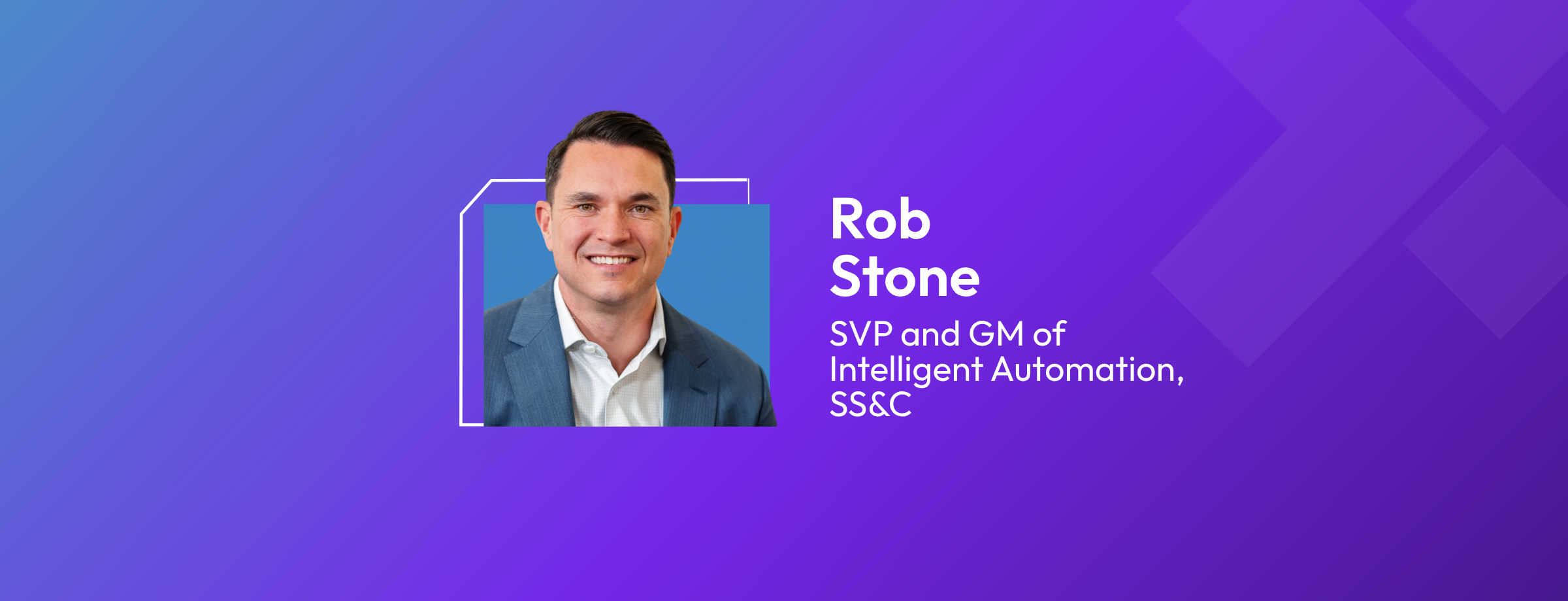
Rob Stone has spent the last year and a half running a $550 million AI and automation business at SS&C Technologies, and his experience points in the opposite direction. Governance wasn't what slowed them down. It was what let them go fast.
SS&C is a unique company. They're both a vendor of AI-enabled solutions and a large-scale consumer of the same types of products, running fund administration, mutual fund transfer agency, and healthcare processing at massive scale. That dual position means Rob sees AI deployment both as a builder and as an operator living with the consequences.
In this episode of Keep Moving Forward, Rob shares why AI governance is the fastest path to production, how SS&C built a governance framework and then gave it away, and his take on what it actually takes to move from pilots to production at scale.
Governance Is a Form of Leadership
The AI governance conversation usually starts in the wrong place. Organizations frame it as a question of risk tolerance, when the real question is what happens if you do nothing.
"Every organization is dealing with unsanctioned AI use in their organization," Rob says. "It creates just a really risky situation because you have employees authorize unsanctioned AI tools into their corporate IT infrastructure, and all of a sudden there's a hack, or there's an attack."
Good governance gives organizations permission to move forward. "We think governance is a form of leadership,” he says. “Because if you can mitigate those risks, you can give yourself and your organization confidence that you can deploy this really powerful technology and go faster. Versus always having that nagging feeling that keeps you up at night, that there's something that's gonna go wrong because there's a blind spot."
Why SS&C Built a Framework and Then Gave It Away
When SS&C started deploying AI internally, Rob looked for a governance framework to track why an agent was built, which model was chosen, and which regulatory constraints applied. Nothing fit. "We foresaw the need for strong governance, a strong governance framework, and we actually went and looked for one and didn't really find that anyone had published anything," he says. "So we decided to build one and provide it open source."
Making the AI Governance Ledger public was a strategic move. "Where we wanted to compete was not on the AGL itself, but building an orchestration layer," Rob says. That layer is Work HQ, SS&C's recently launched orchestration platform. The ledger established a foundation. Work HQ is where SS&C actually competes.
The customer zero practice runs alongside it. SS&C deploys everything internally before it goes to market. "When we built Work HQ, we were very intentional about deploying it internally at SS&C because we knew there was so much value in the real-time observability that we would get in terms of how our colleagues were going to use it." Customers gain confidence not just that the product has been tested, but that it has been tested by the people who built it, at scale, on live data.
Where AI Belongs in Production Right Now
Rob draws a clear line between AI agents and agentic AI. An AI agent has a discrete outcome: one job, one task, powered by a large language model.
Examples from SS&C's portfolio include credit agreement processing, invoice processing, and imaging referrals in healthcare. Agentic AI is different. "It's not a task, it's more of a coordinated effort of multiple agents working together, interacting with systems, interacting with data, working to achieve a desired business outcome." That coordination requires orchestration, a control plane, and the confidence that governance provides.
Knowing where to start on that spectrum matters. Not all processing carries the same risk. Marketing content sits at the lower end. "If you use AI in that process and the AI makes a mistake, like it creates an image with six fingers when they were supposed to have five, that doesn't rise to the level of creating regulatory risk for that mistake." Mutual fund net asset value calculation sits at the other end entirely.
The organizations moving fastest are the ones that know the difference. Start where the risk is manageable, and build the control environment that earns them the right to go further. That’s the counterintuitive truth Rob keeps coming back to: the organizations moving fastest aren't the ones who skipped governance. They're the ones who did it from the start. Control isn't the enemy of speed. It's the on-ramp.
Transcript
Rob Stone:
Every organization is dealing with sort of unsanctioned AI use in their organization. It creates just a really risky situation because you have, you know, employees authorize unsanctioned AI tools into their corporate IT infrastructure and, you know, all of a sudden there's a hack or there's an attack.
From a governance perspective, like we think governance is a form of leadership, right? Because if you can mitigate those risks, you can give yourself and your organization confidence that you can deploy this really powerful technology and go faster.
Gemma Versace:
Hey everyone, and welcome to Keep Moving Forward, I'm your host, Gemma Versace, Chief Client Officer at X-Team.
Most organizations right now are somewhere on the same spectrum. AI is spreading inside their walls, often faster than anyone sanctioned it. And the instinct, especially in regulated industries, is to pump the brakes. But what if that instinct is backwards? What if governance, done right, is actually what lets you go faster?
Today's guest is Rob Stone, SVP and General Manager of Intelligent Automation and Analytics at SS&C. They’re a leading provider of software-enabled services and technology to the financial services and healthcare industries. Rob came up through sales, not engineering, and SS&C runs its own AI internally before selling it, which gives him a perspective most vendors simply don't have.
In this episode, we get into why governance is a form of leadership, the difference between AI agents and agentic AI, and where regulatory risk actually lives right now.
So if you're leading a team that's trying to move faster with AI but keeps running into risk and compliance conversations, this one is worth your time.
Let's get started.
Welcome Rob. Thanks so much for joining us here today.
Rob Stone:
Yeah. Thanks Gemma. Thanks guys.
Gemma Versace:
Yes. Excellent. Very much looking forward to the conversation. We'll get straight into it with some questions. So you went from junior hedge fund salesman to running a $550 million AI and automation business, and you're not an engineer. How does that commercial lens change the way you approach deploying AI?
Rob Stone:
Well, there were a few years between junior hedge fund salesman and running the business. So that was good 17 years ago. But no, I think it did, it does have an impact on kind of how I run the business, how we think about deploying AI. You know, I started my career out of college as a salesperson in the fast-paced hedge fund world, so kind of thrown into the fire right away. And I think, you know, it was a lot of reps, right? A lot of reps over the course of 15 years in sales, learning how people buy, why they buy and what they buy. So, you know, kind of bringing that to developing and deploying, you know, product, you know, certainly has had an impact.
You know, at the same time, I got a chance to be really broad. Coming from the sales perspective, you had to get really broad because you had to be able to talk about a lot of different things. But in order to be a really good salesperson, you have to be able to go deep. So that's what forced me to, you know, to learn a lot and to get immersed in sort of, you know, complex processing in financial services.
You know, over time, I became an expert in my own right. And then, you know, as I took over the automation business at SS&C a year and a half ago, and we embarked upon, you know, a strategic pivot to agentic AI. I think, you know, living in the world of end-to-end processing for investment managers shaped sort of how we embarked upon designing a product that we understood. You know, the world that we participate in would need. So yeah, it's been a fun, you know, 17, 18 years and yeah, I remember the days of a junior hedge fund salesman well and fondly.
Gemma Versace:
Oh, I love that. And as you said, you know, having that lived experience of being in the seat of what ultimately some of your customers are, I think that's just such a crucial insight that you're able to bring to the table every day, and no doubt helping you as you mentioned, you know, get deep and make sure that you're getting all of the right insight and making it a lot more meaningful for your customers as well.
You open sourced your AI governance ledger, which could have been a competitive advantage that you kept for yourself. Why give that away?
Rob Stone:
We're a unique company, right, in that we're both a vendor of AI enabled solutions, but also a large scale consumer of the same types of products. So we get to look at it from both perspectives. Again, we think that's pretty unique. And so the AI governance ledger was really born out of, you know, thinking about deploying AI internally at SS&C and what that was gonna mean.
So, as AI and agentic AI and AI agents proliferated around SS&C. You know, we foresaw the need for strong governance, a strong governance framework, and we actually went and looked for one and didn't really find that anyone had published anything. So we decided to build one and provided it open source. Because, you know, we want to be of value to our customers and for us to be able to look at it from the perspective of SS&C, which is a large scale fund administrator, a large scale mutual fund transfer agent, a large scale healthcare processor. You know, we knew that we were gonna have to have, you know, a framework that allowed for us to understand why an AI agent was built and deployed.
What model was chosen for what task, what other models were considered, what constraints might you be operating under from a client or regulatory perspective. And you know, where we wanted to compete was not on the AGL itself, but building an orchestration layer, which is what Work HQ is, which is the product that SS&C has launched recently.
We figure the competitive advantage is building an orchestration platform that does allow for that portability, right? Because ultimately that's what, you know, we think a lot of the vendors in the space now are trying to do is lock you in. But from an SS&C perspective, we don't wanna be locked in. We don't wanna be locked into a model. We don't want to be locked into one, you know, agent framework. We don't want to be locked into one orchestration set of components. So as we were building Work HQ and deploying, you know, or sort of publishing the AGL, we thought about portability from our own perspective and for what our clients were, you know, going to find valuable as well.
Gemma Versace:
Yeah, what they needed and found valuable. And I think one of the points that you touched on there is that, you know, you guys internally use obviously AI a lot yourselves, and SS&C calls itself customer zero. You run your own AI internally before you sell it. What did you learn from that that you couldn't have learned from, you know, any other way?
Rob Stone:
I think it's a lot of little things constantly all the time rather than one big aha moment. You know, SS&C's whole philosophy is we wanna be two things. A technology provider and an outsourcing provider that uses its own technology, and that goes back, you know, dozens if not decades, dozens of years if not decades, right? That's a core philosophy of SS&C. So, Geneva is our portfolio management and accounting tool that we sell into market. It's used by 75 of the top 100 hedge funds worldwide. It also powers our fund administration business, which, you know, administers $4 trillion on behalf of our customers.
So you know, when we built Work HQ, we were very intentional about deploying it internally at SS&C because we knew there was so much value in the real time observability that we would get in terms of how our colleagues were going to use it. So, you know, that customer zero concept, it's great, you know, for a couple of reasons. One, because it forces us to build a product that is useful to SS&C. And, you know, therefore should be useful for our customers as well. And we think it's valuable too because our customers gain confidence that this will work for them because SS&C is using it themselves as well.
Gemma Versace:
Absolutely, and what an amazing opportunity to be able to create your own reference stories and case studies to be able to take to market. As you said, that you know, is also leaving your clients safe in the knowledge that it's been tested before, but not only tested before, but tested before by the people who created and made it. So the pressure testing is definitely something that they can have, you know, a lot of confidence in.
Pivoting back to the AGL. A lot of leaders hear governance and hear slow down. You say it's the opposite, which is fantastic. What should someone stuck in pilot mode actually build first to get to production faster? What's some advice that you'd have for our listeners on that?
Rob Stone:
There's risk in AI. I think that's undeniable, right? But there's also a lot of sprawl, right? So all of a sudden it's everywhere because it's a personal productivity tool that's sort of unmatched in its capability. And you know, that naturally finds its way into people's professional lives, right? As they try to, you know, be better at their jobs, get leverage out of technology and then, you know, try to increase that leverage through, you know, kind of the use of, you know, more important information. But the problem with, you know, the more important information is it also tends to be the most sensitive, right?
So, every organization is dealing with sort of unsanctioned AI use in their organization. And so it creates just a really risky situation because you have, you know, situations or scenarios where, you know, employees authorize unsanctioned AI tools into their corporate IT infrastructure. And you know, all of a sudden there's a hack or there's an attack, you know, and then there's a Bitcoin ransom, right? And you just didn't expect it, but because there's so much sprawl, it's naturally gonna find its way into your organization.
So, from a governance perspective, like we think governance is a form of leadership, right? Because if you can mitigate those risks, you can give yourself and your organization confidence that you can deploy this really powerful technology and go faster. Right. Versus always having that nagging feeling that keeps you up at night, that there's something that's gonna go wrong because there's a blind spot.
So we started with governance. I mean, we are in the most sensitive processing environments, right? With financial services and healthcare being the two major industries that SS&C serves. Like it's just a, it's an interesting story how we got here because we bought Blue Prism, which is an RPA leader. A pioneer in robotic process automation. SS&C acquired it a few years ago and one of the first things we did was deploy it far and wide to gain leverage out of it ourselves. And today we've got 4,000 individual robots that are supporting our workforce, you know, in our kind of day-to-day operational tasks.
But it was right around the time that ChatGPT came out and generative AI and LLMs were, you know, becoming available. And our automation specialists that were automating within SS&C saw the power of combining RPA with LLMs, but our IT and security organizations sort of looked at that and said, there's too much risk, right? We deal with really sensitive client information, HIPAA information, GDPR information, you know, trade files, position files, so on and so forth. We need to be able to lock this down. And so we actually built a governance platform that's now commercially available, you know, to secure the inputs and the outputs and the access to large language models to make sure that our organization wasn't put at undue risk.
So that actually, you know, really sped up the evolution of our automation program into, you know, robots to AI agents. And all of a sudden we had, you know, 10, 20, 50 AI agent use cases in and around SS&C that we actually packaged up within the intelligent automation business and started going to market with.
But then you start looking at the landscape and you've got, you know, people and robots and AI agents all doing work, doing tasks, and that's what led us to, you know, the recognition that we needed to be able to orchestrate all of that work getting done. And that's what the last year or so has been in terms of building towards Work HQ, which we just released, which is, you know, an orchestrator that sits on top of your systems, your data, your people, and your automation technologies, including AI to really allow you to transform.
But it started with governance. So, you know, organizations are on their own journeys, right? Some are further ahead than others. Some are in pilot mode, some have AI agents deployed. But we do think that, you know, when you start with governance, it lets you go faster.
Gemma Versace:
Yeah, absolutely. I think that's really great advice for people listening as well, to really make sure that you get the governance locked down before taking that next step to make sure that everything runs a lot smoother and that it's very clear, you're giving clarity to the business from the very beginning.
You just spoke a little bit about AI agents and agentic AI and have previously drawn a sharp line between them. So between AI agents and agentic AI, what's the difference in practice? And where do you see people getting it wrong?
Rob Stone:
You know, we do differentiate. It's still a nascent category. So I think there's, you know, room for different definitions still. But the way we kind of differentiate between AI agents and agentic AI is, you know, an AI agent for us is just an outcome. It's a discrete outcome. It's one job that's done with, you know, a large language model doing the reasoning, right. Typically, you know, replacing or enhancing work that, you know, people would have done previously. But it's very discrete.
And we deliver these outcomes to our customers. So examples would be, you know, things like credit agreement processing, invoice processing. In healthcare we've got several use cases or outcomes or AI agents that handle things like imaging referrals for healthcare organizations, so MRIs, X-rays, et cetera. You know, reading the imaging and the notes associated with the imaging to determine appropriateness for a radiology referral. Which has been a really powerful one for our customers.
But agentic AI is different. It's not a task, it's more of a coordinated effort of multiple agents working together, interacting with systems, interacting with data, you know, kind of working to achieve a desired business outcome. So that's kind of how we differentiate. And then ultimately, you know, when we think about the world moving towards, you know, pilots to AI agents or discrete outcomes to more agentic AI, that's when orchestration becomes really key, right? Because you can't run a coordinated effort without some control plane.
You've got to feel like you have control, the ability to deploy the right tool at the right time for the right job. You need supervision, analytics, so on and so forth. So that's where a lot of the work we think is going. You know, the firms that are forward thinking or are further ahead in sort of the agentic AI space are really looking at, you know, sort of global transformation. And you know, they're all recognizing, as are a lot of the big technology and automation vendors in the space, that orchestration's gotta be a really big key to deploying AI at transformational scale.
Gemma Versace:
Yeah. Amazing. Thank you so much for explaining that and walking us through, I guess, what your specific thoughts are on that and some great advice and insight for those listening as well. You mentioned a little bit earlier around the financial services industry, but also a lot of the industries where your clients are from being quite heavily regulated, but particularly in the financial services.
And an AI mistake isn't just embarrassing. It has the potential to become a regulatory event. Where can AI be trusted in production right now and where can't it, in your opinion and what you are seeing?
Rob Stone:
Yeah, no, it's a great question. You know, I think there's more risk for regulatory action right now in the EU than the rest of the world just due to the enactment of the EU AI Act. So there's certainly real regulatory risk as it relates to, you know, ensuring compliance with, you know, why did you put an agent in place, to do what, were the outcomes consistent with expectations, so on and so forth. So there's a lot of scrutiny going on in the EU and it's important to comply with for sure.
And then just generally, when it comes to regulated industries, when it comes to financial services, like it's just about, there's a risk spectrum in all processing. Not all processing is created equal. There's higher risk processes and lower risk processes. And if you take things like marketing material, for instance, might be a lower risk process that might be somewhere that a firm wants to start with agentic AI, right? Because it's content creation, it involves multiple steps. It involves different media, you know, various systems, a lot of checkpoints. And you do want to, you know, ultimately create an outcome that is, you know, sort of discrete in nature as well, which might be a glossy one-pager or, you know, a website or something.
But, you know, if you use AI in that process and the AI makes a mistake, like it creates an image with a person that has, you know, six fingers when they were supposed to have five, that doesn't rise to the level of creating regulatory risk for that mistake. But you know, when you start moving up that risk spectrum and you're looking at, you know, things that could cause regulatory filings to be late or not filed or inaccurate, right? And then you've got regulators that come knocking on your door. You know, those are things that, you know, you do wanna be a little bit more circumspect about deploying AI. Like mutual fund net asset value calculation processing. Like you can't have systemic mispricing of those mutual funds. And you're gonna run into trouble if, you know, you've got that happening.
But that might happen anyway, right? Like, mistakes are made, whether it's people or AI. And so I think it becomes more about the control environment that you put in place. So it kind of comes back to the governance aspect. And there's, you know, governance, you can come from different angles on governance, right? You've got governance of keeping, you know, records of models that are used for tasks. So you've got regulatory defensibility for when, you know, an audit is to happen. You've got governance on, you know, protection against prompt injection, right, which is a threat, and hallucination, which could impact downstream processing. So governing the inputs and the outputs of the large language model itself.
You know, the governance around, you know, in production agents, right, from an evaluation of those outputs is huge. And then, you know, governance is as old as the day is long, which just in terms of four eye processes, six eye processes, thresholds and materiality, sort of tests and maker checker processes, internal audit, you know, they like those types of governance processes apply to AI the same way they apply to people now. It's just, you know, you gotta have a technology infrastructure in place to manage, you know, technology assets like AI.
Gemma Versace:
Perfect. Thank you so much. I'm learning a lot as well as I'm listening to you through this. So no doubt our listeners are taking notes very rapidly as well. When I was doing some research on you coming on, it was so amazing to hear that your father founded SS&C 40 years ago. You've spent your whole career there. In an industry obsessed with disruption, what does that teach you about building something that lasts? Obviously being able to see what your father has created and now you continuing there. What has that taught you about building something that's built to last?
Rob Stone:
Yeah, my father, he built SS&C in the basement of the house that I grew up in, north of Hartford, Connecticut. And yeah, I've been here myself, you know, almost 20 years. And you know, even prior to being that junior hedge fund salesman, I kind of worked in various capacities for the company and around the company.
So I've learned a lot from him. Right? I mean, he's still running the show. He is still chairman and chief executive officer and has no plans to retire anytime soon. But you know, for me, a lot of the lessons that I've learned in terms of like, you know, ensuring continuity and the right to continue to exist is that healthy paranoia. You know, you kind of have to be looking around, have your head on a swivel. And that's what's great about America. It's a competitive environment. It's built to be competitive. Right. And so there's competitive threats everywhere. Right. And especially with the, you know, in the age of AI, you know, you've got an ability to reimagine how things get done all over the place, including how we do things.
So, one of the things we try to do is, you know, not cherish anything, right? I mean, I think it can sound cold, but you can't really fall in love with the way you do something. You always have to be thinking about how can I do this better? Right? And you have to surface ideas from all over the place. So just creating an environment of, you know, sort of passion for the craft, is part of it, right? Surrounding yourself with people that, you know, strive to improve is key.
And, you know, we don't take for granted that we've been doing what we've been doing for 40 years, but we've evolved every step of the way. I've got stories and, you know, Bill, my father, has more stories than me about, you know, pivots and strategy changes and decisions that were made in order to remain competitive, right, for our clients. In an industry that is fast moving because that's the industry we're in, which is technology.
So, you know, we've got a long way to go, right. We think we're really well positioned. Again, you know, SS&C plug, right? We're unique. We're the only provider in the technology space and financial services that is also a big asset servicer. We're the only big asset servicer in the financial services space that's also a commercial technology provider. So the combination of those two things reinforces each one in a way that is hard to replicate. Right? The technology gets better because we use it at large scale, the services are better because we own the source code of the technology that we use to provide those services.
And now because we've got this native automation capability, where we're building and deploying agentic workflow orchestration in the AI space, using it ourselves, it keeps getting better and better every day for our third party customers, right? That's a unique position that we think gives us an opportunity to, you know, to continue to compete and continue to win, hopefully.
Gemma Versace:
I just absolutely love that answer. And, you know, being around for 40 years, everybody should take note that it really is the pivot, the evolving, the transforming and as you said, kind of not cherishing anything, even though it does sound cold, but it is also the recipe for success to be able to keep moving forward and really just never give up and evolve to what clients and market are telling you. You know, that's how you can remain relevant. And as you said, if people aren't looking at you as competition, then you're no longer relevant. So the fact that you guys have still got your head on a swivel shows that you're doing absolutely something right.
We finish all of our podcast guests with one question. What keeps you moving forward? What gets you out of bed in the morning? Rob, what makes you keep moving forward every single day, you know, not only from a professional perspective, but also personally as well?
Rob Stone:
I love competing. It's a burning fire of competition that lives inside me and, you know, I just love getting up in the morning and every day, you know, kind of attacking, you know, the set of opportunities that are in front of us. I value highly the team that I get to work with every day. It's a privilege, right? You know, there's so many talented people that bring their best every day. That inspires me. Right. And you know, kind of that flywheel of feeding off of each other, the pace at which we're able to operate right now, and I think we will continue to be able to operate with, is just something that is so energizing.
So, we love to win. We intend to win. And you know, we wanna show up for our clients and each other every day.
Gemma Versace:
Absolutely fantastic. And it seems like, you know, not only have you got the right blueprint for staying around for 40 years, another thing that seems that SS&C deeply have is a really good winning growth mindset culture, which, you know, is also something that no doubt has helped fuel your business success over the last 40 years as well. So thank you so much for joining us today, Rob. It's been great to have a chat with you.
Rob Stone:
Yeah. Thanks Gemma. Thanks so much.
Gemma Versace:
Governance and speed feel like opposites. Rob makes a pretty strong case that they aren't.
When you can see every AI agent you've deployed, why it was built, what model it's using, what constraints it's operating under, you stop second-guessing. The nagging feeling that something's going to go wrong in a blind spot goes away. And when that goes away, you move.
He also makes an interesting point about unsanctioned AI use. Every organization has it. Employees bring personal tools into professional environments because those tools are genuinely useful. The smarter response isn't restriction. It's building an environment where sanctioned AI earns more trust than whatever someone found on their own. That's a different kind of leadership challenge.
Join us next time for more conversations with technology leaders who inspire us to grow, lead, and innovate. You can find us on Apple Podcasts, Spotify, or YouTube. If you enjoyed this episode, please share it with your network. We'll see you next time.