
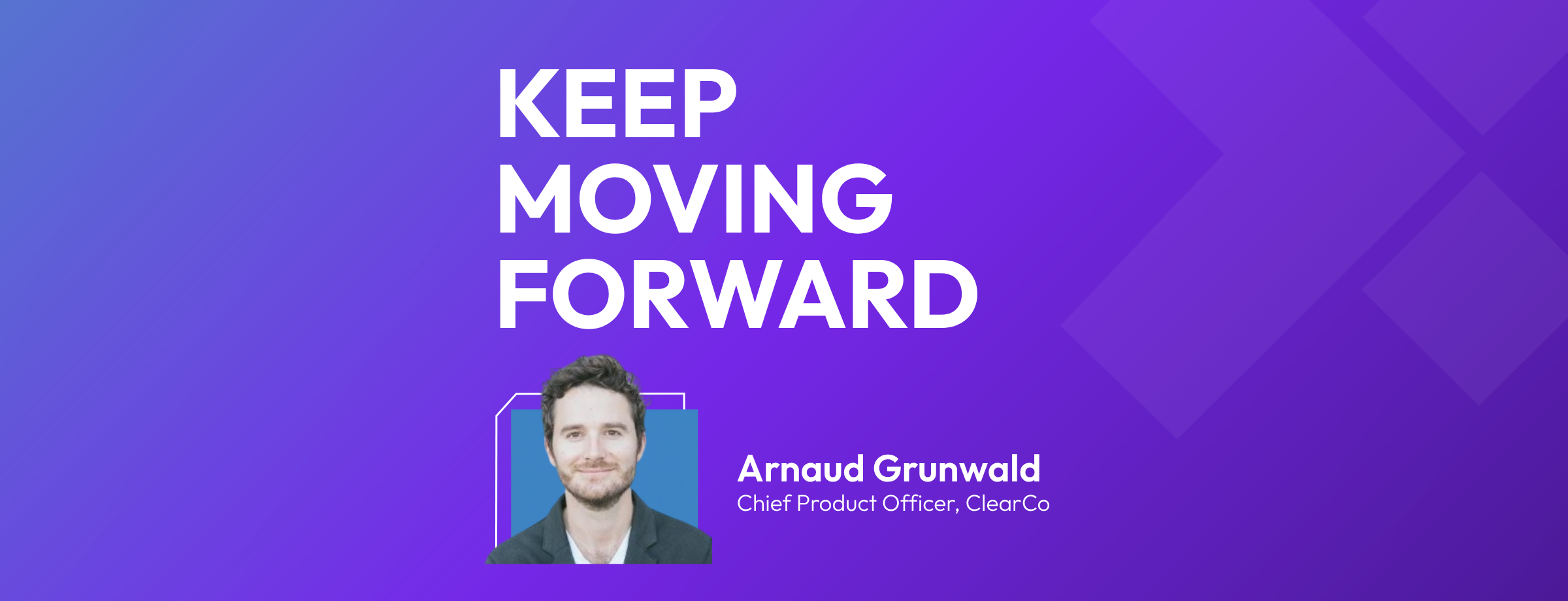
Most organizations collect more feedback than they know what to do with. Surveys, pulse checks, one-on-ones, performance reviews — the data exists. What rarely follows is evidence that any of it changed anything. Arnaud Grunwald has spent the better part of a decade working on that gap, and he has a clear view of why it's still so hard to close.
Arnaud is chief product officer at ClearCo, a talent platform covering the full employee lifecycle — from sourcing and hiring through performance, learning, and compensation — for more than 3,000 mid-market companies. He came to the role through Betterworks, where he led product for four years after selling his employee listening startup Hyphen to them. The through line across those chapters is the same problem: building systems that make feedback useful, not just frequent.
In this episode of Keep Moving Forward, Arnaud joins host Gemma Versace to talk about why the philosophy behind the annual performance review no longer holds up, what real AI adoption looks like when it reaches every team in the business, and what the next era of performance management is actually going to demand.
When Listening Isn't Enough
Arnaud founded Hyphen on a simple observation: employees had things to say that never made it into the official channels. His solution — anonymous, mobile-first conversation between peers — worked well in some organizations. But most didn't want a real-time signal. They wanted a rhythm.
"There was a moment where I felt I was seeing some friction between the employee base and what I was hearing at the coffee machine and what I was hearing in the boardroom, so to say," he says. That tension was the seed of Hyphen. But over time, Arnaud learned that the challenge wasn't surfacing feedback — it was acting on it. Most organizations already had more signal than they could use.
The gap, he argues, lives at two handoff points: between HR leadership and the data, and between HR and the managers who have to do something with it. Without a feedback initiative making it onto the business agenda, the exercise produces insights that go nowhere. "Whether it is as an OKR or as a goal, or more informally, it needs to be followed through," he says. The organizations that close the gap are the ones where HR and business leadership move together. That coordination is rare. It's also decisive.
3 Levels of AI — and the One Most Companies Miss
Arnaud has a test for real AI adoption: imagine yourself on a bike pushing hard on the pedals. If you're truly accelerating, you feel it. "If you truly push on the pedals, then you feel that wind and it's exhilarating," he says. If you're not feeling the wind, you haven't pushed far enough.
Most organizations, he argues, are coasting. They're using AI to write emails and summarize meetings and calling it transformation. Arnaud is working on three distinct layers: in-product AI, where agentic capabilities are doing things the platform simply couldn't do before; AI engineering, where development velocity is measurably faster; and AI applied to business operations across every team.
That third layer is the one most technology organizations skip. "It's too easy, as a software company, to focus only on AI in the product and AI engineering," he says. "What about AI for revenue operations? What about AI for the implementation team? What about AI for the marketing team? And I'm trying to lift all boats." The test isn't whether your product has AI features. It's whether you can feel the wind.
The Feedback Model That No Longer Makes Sense
Arnaud doesn't think the performance review is going away. What he does think is that the philosophy behind it — periodic, manager-driven, scheduled — can't survive the AI era.
His reasoning is direct: "It is prehistoric indeed to give people feedback, official feedback once a year. It is historical, at least, and probably Middle Ages-ish to give people feedback once a quarter." He doesn't mean this as provocation. It's a description of where most organizations still sit relative to what's already technically possible.
The example he uses to make the point is a recruiter who hangs up after a call with an uneasy feeling. In the current model, that feeling either reaches a manager who happened to be listening, or it doesn't. In the model Arnaud is building, an AI agent has already flagged the pattern and generated a personalized learning module before the recruiter picks up the phone again. "It doesn't make sense to expect the managers to give you feedback formally every once in a while when AI can give you feedback every day," he says.
That shift doesn't make managers obsolete. It moves them away from catching what AI can already see and toward the decisions only they can make. The question isn't how to make performance reviews better. It's whether the whole model still makes sense.
Transcript
Arnaud Grunwald:
It is prehistoric indeed to give people feedback, official feedback once a year. It is historical, at least, and probably Middle Ages-ish to give people feedback once a quarter. It doesn't make sense to expect the managers to give you feedback formally every once in a while when AI can give you feedback every day.
Gemma Versace:
Hey everyone, and welcome to Keep Moving Forward, the podcast from X-Team for tech professionals who are passionate about growth, leadership, and innovation. I'm your host, Gemma Versace, Chief Client Officer at X-Team. In every episode, we sit down with leaders who are redefining how technology teams work, grow, and lead. People who understand that performance begins with connection.
Most organizations today are drowning in feedback signals. Surveys, pulse checks, one-on-ones, performance reviews. The data is everywhere. What's far harder to find is evidence that any of it changed anything.
Today's guest is Arnaud Grunwald, Chief Product Officer at ClearCo, formerly known as ClearCompany. His career has taken him from the pharmaceutical industry to founding Hyphen, an employee listening platform, to leading product at Betterworks. Now he’s at ClearCo, where the platform spans the full talent lifecycle from sourcing and hiring through to performance, learning, and compensation.
In this conversation, we get into why the gap between listening and acting is still so hard to close, what it actually takes to build alignment across a leadership team, and why Arnaud believes the annual performance review is already prehistoric. He also makes the case that the real opportunity in AI right now is not just in the product. It's in how every team in the business actually works.
Let's get started.
Welcome to Keep Moving Forward, and thanks so much for joining us today.
Arnaud Grunwald:
Thank you for having me.
Gemma Versace:
Excellent. And we like to ask all of our guests how you got to be where you are today. If you could just tell me a little bit about yourself.
Arnaud Grunwald:
I'm a French guy in California. I came 20 plus years ago to study and never left. And originally I'm an engineer, turned consultant, turned sort of jealous about my friends being in tech. So ended up in tech a few years later, and in HR technology.
I first founded a company called Hyphen. I was the founder and CEO, and that adventure lasted for four, five years before I sold it to Betterworks, a performance management company, where I stayed four years as a Chief Product Officer. And I'm now the Chief Product Officer at ClearCo, formerly known as ClearCompany. We just rebranded.
ClearCompany spans the gamut from pre-hire to retire, if you will, from a talent perspective. So we source candidates, we evaluate candidates, we run background checks, we do their onboarding, and then they become employees. They have goals, feedback, performance reviews, they learn new things and they get promoted and get compensation increases. So all that happens in our system.
Gemma Versace:
Amazing. Amazing. I like how you put a positive spin on it saying From Hire to Retire rather than hire to fire, but it covers. It does seem as if the platform and the business that you have is a fabulous value add to a lot of organizations out there.
Your career, as you mentioned, has taken you from pharma and analytics to building the SaaS business, as you just mentioned, with founding Hyphen, and then leading product at Betterworks and ClearCompany. What's the through line across all those chapters and what has consistently, you know, pulled you towards the problems that you've chosen to solve?
Arnaud Grunwald:
Yeah, I would say the through line is innovation and getting people together around innovation. Prior to being an entrepreneur, I was an intrapreneur. I like to say that at my last company before I was an entrepreneur, I was at the company called Model N and I created a new division. I created a new business unit based on an idea that I brought forth. I went to talk to the CEO and he, fortunately, it gave me a small team and we got to do great things together.
Outside of the professional realm, I'm also an organizer. I like to organize events, trips, and really gather people. So that's what makes me happy. I guess a little bit of an extrovert, for that matter. In terms of the threads, topic wise, pharma, you know, just happened to me. It's one of these things when you are a generalist kind of engineer and you go to a career fair and you meet interesting people, and really the pharma world fascinated me because of all the facets there are, right? The medical side, the science side, but also the business side, the marketing side. You can spend several lives in the pharma world and not have the same job, of course. So that was fascinating.
I was first a consultant, then I worked in the industry. I was at a little company called Novartis, which is now the biggest pharmaceutical company in the world. And then I worked on the software side as sort of a jumping board between pharma and the tech world, for that company called Model N, which is a company that does software for the pharmaceutical industry. So pharma sort of happened to me.
And then after three jobs in the pharmaceutical space, I was wondering, should I do something else? Right? And I believe in the concept of mini, mini careers, where to keep you engaged, to keep you excited, you need to change jobs and you need to change topics. So there was a time at the end of my time at Model N where I was really brainstorming a lot of the things that I like to do. And it could have been a lot of other things, but I landed on this concept of building teams. At Model N I had the opportunity of building a team of close to 30 people, a global team, and to recruit them and to engage them and to train them and to performance manage them. And so that got me in touch with the world of HR technology, which was not my world.
But then I thought, why not? Why not use these skills that I have developed as a professional and try to share it with the world. So Hyphen was based on the concept of employee listening and employee engagement, and we tried to challenge the status quo, right? People are surveyed out, employees are surveyed out, and it's, can we find a new way for people to speak up and to analyze this input in a way that is more real time, that is more useful for managers to take actions and engage their employees. So that got me into HR Tech and I then got the virus. And I think now I'm in for the long haul because I really love this space. I love working with people, right? HR people are really special to sell to, to work with, to optimize the results of their engagements.
And then the progression in HR technology is sort of opportunistic, right? When you create a company, one of the goals is to exit. And so I had the opportunity to exit and take a different role, but for a bigger scope. And the transition between Betterworks and ClearCo, it's kind of the same thing. Same role, but a bigger scope. I think as a product management person and as a product leader, it gets more fun when the toy box is bigger. And so here I have a huge box of toys to play with, to organize, to build. I'm taking the metaphor because I'm playing with my son a lot these days, to build beautiful temples and cities and roads that,
Gemma Versace:
Amazing.
Arnaud Grunwald:
That are really exciting to make, and hopefully exciting to our customers too.
Gemma Versace:
Yeah. Fantastic. And so no more mini career changes for you. The HR Tech has now stolen your heart, and as you said, there's quite a lot for you to be able to achieve and deliver. With all the wonderful roadmap that you guys no doubt have in place, with a lot of the wonderful engagement and ideas and opportunities that no doubt are flowing through from not only the employees using your system but also the HR teams that are getting a lot of meaningful data and information and feedback through the systems as well. So that's absolutely fantastic.
The Hyphen story, as you kind of gave us a little bit more insight into just then, it really started with, you know, a very human moment. You wanted a better way to hear what people were really thinking. And the system basically told you to wait. What did that moment reveal to you about how companies listen, and why did it feel important enough to build a company around it?
Arnaud Grunwald:
It's an interesting story and it goes full circle.
Gemma Versace:
Amazing.
Arnaud Grunwald:
I've been working for amazing managers and amazing CEOs, but amazing CEOs don't always listen to employees. They can have their intuition and that can go against employee feedback. And so there was a moment where I felt I was seeing some friction between the employee base and what I was hearing at the coffee machine and what I was hearing in the boardroom, so to say.
So I imagined a system where employees could connect on their mobile phones in an anonymous or semi-anonymous way, yet secure, yet safe for the organization, and have sort of back and forth conversations with their peers to surface these topics that nobody talks about, or to be able to counterbalance the most common opinions in the organization. So that worked really well in some organizations, especially those that didn't have any way for employees to surface feedback.
Gemma Versace:
Mm-hmm.
Arnaud Grunwald:
What we learned after a couple of years is that it's really exciting for employees to voice out their concerns and their ideas. It's less exciting for HR, because you don't want a crisis to be surging up every day, and you don't want to have to respond to employee feedback every day in real time, right? That would be ideal, but you have to be reasonable. And so that's why the quarterly survey works well for HR because they can sort of focus on other things, and God knows that they have tons of things to do, putting in place trainings and benefits administration and payroll. I mean, there's so many things that HR needs to do in a focused way without being distracted.
And then once a quarter, okay, let's get into listening mode. Let's collect the input from employees and let's analyze and get into action planning for a few days, delegate to managers, and then we can move back on to other things. And so we learned that was the better way for organizations to do employee listening. So probably 10 or 20% of our customers were still doing the bottoms up, mobile anonymous, sort of water cooler conversations. But 80% of our customers ended up going closer to something traditional yet more frequent, more like pulse surveys. These were the days of the pulse surveys and Josh Bersin's famous "feedback is the new killer app" article. And that's when we started sort of hockey sticking and growing to a point where we started being an acquisition target for other companies.
Gemma Versace:
Yeah. Fantastic. Thank you so much for sharing the origin of your story there, and you touched on it a little bit in your answer there. But also in doing some research for the discussion today, there's been a lot of reading about how you talk about the gap between feedback and action, and a lot of leaders do listen, but employees don't feel any, you know, changes from that.
Where does that cycle usually break down and what do the best organizations do differently to make sure that the employees can see that their voice is getting heard? Because the leaders aren't just regurgitating it to them, they're actually actioning a particular initiative or changing process to show that they've really listened and they're happy to action that feedback?
Arnaud Grunwald:
I think it starts at HR leadership level and it ends at company leadership level. HR leadership makes sure that employee listening and employee feedback is on the agenda, is on the schedule. You know, even if it's not quarterly, it can be bi-annually, or even annually. It needs to be there as a program that is being resourced and funded. And also HR senior management has a lot of responsibility in making sure that once the survey is done, once the listening exercise is done, enough time is being buffered for translating these insights into manager actions.
So that's HR leadership taking the listening into insights and then into an action plan. And that's where it transitions onto company leadership or business leadership, where these actions, you know, HR can only push managers so far. Now it's really managers. Managers that need to say, okay, you learned something about your team. It is affecting productivity, it is affecting effectiveness, it is affecting their level of preparedness when it comes to projects and so on and so forth.
Yeah, so management, your n plus one, your n plus two need to be aware of that. And it needs to be put on the business agenda. So whether it is as an OKR or as a goal, or more informally, it needs to be followed through. Otherwise, if you talk about it and you're like, oh yeah, that's interesting, yeah, maybe we should... you fill the blanks. And if it doesn't get talked about in the next one-on-one, in the quarterly review, how did we do? And in the performance ratings eventually of that manager, then the exercise has not had the impact that you wish it had. So it's challenging because coordinating HR leadership and business leadership is no small feat.
Gemma Versace:
A lot of teams are buried in meetings and, you know, you mentioned one-on-ones that happen quite frequently with leaders and their employees, but they don't feel aligned even though there is that regular cadence and frequency in one-on-ones. The employees and leaders don't often always leave those meetings feeling very aligned. For a leader trying to make those conversations more useful, what are a few signs that their current rhythm is helping performance versus just creating more overhead? What are some tactical ideas or tactics that you could share with the listeners in how to overcome that and make sure that there is that alignment during those conversations?
Arnaud Grunwald:
Yeah. Something that I've learned over the past few months is that it doesn't matter if meetings feel like overhead. You need to have these meetings and you probably need to have more meetings. You know, everybody says you need less meetings. I find that if you want that alignment that is crucial for business execution, you may need more meetings.
And you need a military style organization to the business. So we here are adhering to the philosophy and methodology of Patrick Lencioni. There are many books that he's written. You start with a rallying cry for the organization so that everybody's aligned. And then you have defining objectives under the rallying cry that sort of help achieve that rallying cry. And then every defining objective is supported by strategic initiatives that will be owned by different people in the organization. And everything is measured and everything is tracked on a weekly basis.
That's from a strategy perspective, and then from an execution perspective, you should probably have quarterly reviews and monthly updates. So kind of everybody should have quarterly priorities and monthly commitments and weekly check-ins and even daily check-ins maybe. I know that my team, and when I say my team, it is the leadership team, me and my peers, not me and my downline. We have a daily check-in, all the executives, 8:15 AM sharp. We have a daily check-in and we know what everybody's priorities, but also roadblocks are.
So both from a top down, strategic planning perspective, but also from an execution daily, weekly, monthly, quarterly perspective, we know exactly what's going on in the organization. We know what the roadblocks are. We know what the dependencies and collaborations are. And I've come to be a fervent believer in this methodology, whether it is Patrick Lencioni's or someone else's. There are other methodologies out there that I'm hearing about, enterprise OS, the OKR methodology to a certain extent. But it's very powerful, very powerful.
Gemma Versace:
Fantastic. And let's skip ahead to the question on AI and innovation, because I think even just expanding a little bit on how you utilize that, in a more granular answer, would be amazing for listeners as well. Because there's AI in product development and across your engineering teams, but then as you've rightly just pointed out too, there's AI to make you more efficient and quicker and faster and more value adding in those meetings. So I love that. And there's a lot of AI theater in enterprise software right now.
When you say, or when we say real world AI, what separates something genuinely useful from something that demos well, but never becomes part of how people actually work? So it might look pretty sexy when you're watching it, but it doesn't actually move the needle on productivity or anything meaningful. What separates the really useful real world AI versus the stuff that can look shiny and wonderful, but not terribly meaningful?
Arnaud Grunwald:
Yeah, I was having a conversation with a friend and colleague and we were talking about, are we using AI enough? And the conversation was, well, let's look at the dashboard, right? We're using tokens. We're using models. We're using tools. And there was something that didn't click, right?
I said, are you feeling the wind in your face from the acceleration? If you're not feeling the wind, if you're not feeling that breeze, that gust of wind in your face, then it means that you haven't accelerated. Right? It's like, imagine yourself on a bike, right? If you truly push on the pedals, then you feel that wind and it's exhilarating and you feel like, okay, now I am at a maximum speed. So real world AI, I think, needs to bring you that wind of acceleration in the face. You need to, it's something that you feel, but you can also measure it.
So for instance, there are three levels of AI that I work on with my team or with different teams. There's the in-product AI, so of course we do recruiting, we do talent management, so there's a lot of AI that can be done. AI sourcing, AI screening, AI interviewing, AI onboarding, you name it. One of the things that we are working on right now is agents, so we are going to release in just a few weeks our agentic platform and agents in ClearCo. How do I know that it's useful? Well, I will know it because agents will do things that we are not able to do today in ClearCo, in the ClearCompany software that our customers have been clamoring for in the past.
We are a software company and in the traditional engineering kind of way, you have a backlog. There's a ton of things that you cannot do because it takes too much time or it makes your software too complicated. And so when we think about agents, we think about them as, it needs to be magic, it needs to be, oh, suddenly it opens the gates to all these things that we never thought we would be able to do in the system. So that's one, in the product.
The second way we're using AI is AI engineering, right? To develop code faster. So that's something that is self-evident when you see the number of lines of code and the velocity of the roadmap. And the third thing where we're using a lot of AI, and it's one where I'm really passionate about these days, it's AI applied to business operations, business execution on a daily basis. It's too easy, as a software company, to focus only on AI in the product and AI engineering. What about AI for revenue operations? What about AI for the implementation team? What about AI for the marketing team? And I'm trying to lift all boats, right?
And make sure that everybody's well versed in AI and that they are ambitious. What I found with AI these days is that people don't know how much AI can do. So I've talked to some people who are really excited and saying, I'm using AI to the max. Right? I'm using ChatGPT to write emails and summarize meetings. And like, this is great. Did you know that AI can get you there? Right? Let's talk about the most ambitious thing that you can do. And nowadays the most ambitious thing that you can do might be just a couple of English sentences away. And AI figures it out. So I'm trying to empower everybody in the organization that way and that's probably the project that gets me the most excited these days.
Gemma Versace:
For those leaders that might be founders themselves or that are wanting to get some advice on operating at scale, you've gone from founder mode to leading product in larger organizations with really established teams and processes, as well as clear expectations. What did you have to unlearn to be effective in those environments? And how did you keep a sense of ownership alive as the companies that you were founding and working for were growing and were getting bigger?
Arnaud Grunwald:
Yeah, I mean, as you're the founder and the innovator, you do a lot of things yourself. You're wearing a lot of hats, so naturally you have to learn how to delegate. You have to learn how to be patient, because not everything has to happen that same day. You have to empower people and teach them how to fish, right, as opposed to handing them out the food. So these are natural, natural transitions.
That being said, as a leader, and I think I'm being comforted in that idea with AI and the new developments in AI, as a leader I've always been a little more hands-on, I think, than the average. Hopefully not a micromanager, but someone who cares about the details. So in a sort of trust but verify kind of way. But also empower and lead by example kind of way, right? So that people can understand what's expected from them, what kind of level you wish they were at. And it's easier that way to operate the transition between founder mode and scale, because you are still doing things, you're still feeding your appetite of innovating yourself, of trying out ideas, but you're doing it not for the sake of yourself and your little two person in the garage startup, you're doing it for the sake of showing a larger team how it's done and communicating your expectations.
And then also sometimes giving some extra help. Right? I think there are projects sometimes that need extra help and you have two types of leaders. You have the leaders who will look around and say, who can help? And the leaders who say, I will help. Right? In a sort of servant leadership model. So that's one where I like to recognize myself.
And to go full circle with the comment that I made about AI, there is now a trend, especially in the CPO world, about the IC CPO. So you might be a CPO, but you are back to an individual contributor, because suddenly you have all these tools. And you're not developing tools for your customers, right? This is the world of the engineering team. But you can develop tools for your team, for the company, as the CPO. You are the number one or number two technologist in the organization. So people look up to you to see how AI is going to be adopted, and therefore it's actually rejuvenating to be back to IC level, to be building stuff and releasing tools and products internally. And yet continue being a leader, but also being an individual contributor. Yeah.
Gemma Versace:
Last question. You've described the current era of HR Tech as embedding, you know, these processes into the flow of work rather than interrupting it. When you look ahead, what do you think the next era will demand from leaders and product teams and the companies that are trying to keep talent and key talent engaged? Where's it all going, do you think?
Arnaud Grunwald:
Warning, it's gonna be a scary one. When I was talking about the flow of work, and when all the industry analysts and innovators were talking about flow of work, that is HR tech prehistory now, or at least history. It's old news, right? Everything is of course in the flow of work, with Slack, Microsoft Teams integrations, mobile access, and APIs and now CPOs and things like that.
I think the next frontier that people need to be aware of and preparing for is that AI is going to replace everything, and not in a bad way. There will still be managers, there will still be employees, there will still be work to be done. But in HR technology, the tools that we have today are not matching the AI era, right?
I take for example, well, this is gonna be a controversial one, because people have tried to do away with performance reviews and they keep coming back. Right. But I strongly believe that, at least as it pertains to the philosophy of performance reviews and providing feedback that is useful for people to get to the next level, it is prehistoric indeed to give people feedback, official feedback once a year. It is historical, at least, and probably middle Ages-ish to give people feedback once a quarter, right, at a time where AI knows what the company goals are, what your manager goals are, what your own goals are, how you have progressed, how you're progressing in real time, what conversations are you having with all your team members, with all your stakeholders, it's being recorded in Granola, in Obsidian, in all these tools.
At a time when you have integrations of all these tools, if you are a salesperson, you have all your Salesforce that's connected with all your pipeline generation tools and your email and your pricing sheets and your competitive intelligence information, et cetera. There it doesn't make sense to expect the managers to give you feedback formally every once in a while when AI can give you feedback every day. Right. In a super helpful way.
Because suddenly, guess what? AI is also connected with your learning management system or with your coaching system, with sort of virtual coaches. So if you do something, I like this example because it's one that we will be able to do in ClearCo very soon. Let's say you are a recruiter and you hang up the phone. You just had an interview with a great prospect, but you have an uneasy feeling. You didn't do a good job at presenting the company, at selling the company vision, mission, values.
Well, there is an AI agent, the recruiter agent, that has been listening to the interview and that's seeing this in real time and that can communicate with the learning agent and say, well, it's three times in a row now that Arnaud is botching the mission, vision, and values of the company. Can you craft an eight slide refresher for him to take? And can you also add an assessment quiz? And that's produced in 30 seconds.
And so that's the flow of work. The flow of work doesn't need to be a tool. It doesn't need to be Slack or Microsoft Teams. The flow of work is the instantaneity of the feedback where AI tells you, hey Arnaud, good job on your interview, we noticed you could do a slightly better job at presenting the company. Here's a personalized piece of learning, it will take you five minutes and then you'll take an assessment and you'll be done with it. And next time you'll ace it. Have a great day. And suddenly you have feedback in real time.
And you don't need to wait for the recruiting manager to listen to a call to realize that you can improve, to ask the training team, hey, what can we do about Arnaud? He really needs to get better at presenting the company. All these things can be replaced by AI in a way that is not scary, in a way that is really helpful for everyone. And meanwhile, managers can take on more strategic responsibilities instead of the tactical daily ones.
Gemma Versace:
And so tailored. Just quickly, we do ask all of our podcast guests, you know, what gets you out of bed in the morning? What keeps you moving forward? You've spoken a lot about the wide ranging tasks that you were charged with across your business at the moment. What is it that really gets you out of bed in the morning to say, all right, yes, I'm ready to keep moving forward today?
Arnaud Grunwald:
That's a good question. Sometimes the question is, what puts me to bed? Because you wanna keep building these tools. AI is really addictive and so I have to fight it and be like, I need to go to bed now. So what keeps me out of bed, generally speaking, I mean, it's a question that can be answered in many different ways.
You know, I could talk about the company and I really believe in the mission of connecting, like building a really truly unified talent system. I don't think it exists and I think building a unified talent system is the kind of thing that will enable the examples that I just mentioned, where learning, compensation, feedback, recruiting, onboarding is all in the same database analyzed by the same agents, et cetera. So that sort of magic wand-ification of HR and of the workplace gets me excited.
And then on the personal basis, what keeps me excited, frankly speaking, it is the competitive aspect of the market. You know, it's everybody's rushing to win and to be the best software. And we're trying to be the best, the best suited for a certain ideal customer profile. We have 3,000 customers in the mid-market, 500 to 5,000 employees. I'm super focused on how can I develop the best software so that I'll be the competition, to be honest.
And it comes back to my comment about feeling the wind in your face. I think that when you sell, when you implement, when you're successful, when you have happy customers, you sort of feel that breeze in your face of, okay, I'm moving, I'm moving forward, moving fast and winning.
Gemma Versace:
I love that and I think it's definite that you guys are winning, and ClearCompany is winning, having you part of their leadership team as well. That was such a wonderful, wonderful conversation. Thank you so much for joining us today.
Arnaud Grunwald:
Thank you, Gemma.
Gemma Versace:
The example Arnaud shared about the recruiter and the AI agent is a good one. Not because it's a clever product demo, but because of what it assumes. It assumes that feedback is only useful if it arrives when you can still do something about it.
We have built entire systems around the idea that performance feedback is a periodic event. You collect it, you analyze it, you act on it. Quarterly, if you're disciplined. Annually, if you're not. And the whole time, the gap between what happened and when someone hears about it keeps growing.
What Arnaud is describing is a different assumption entirely. That the most useful feedback is immediate, specific, and connected to what you're already doing. Not a report about last quarter. A nudge about this morning.
The leaders who take that seriously are going to stop asking how to make performance reviews better. They're going to start asking whether the whole model still makes sense.
Join us next time for more conversations with technology leaders who inspire us to grow, lead, and innovate. You can find us on Apple Podcasts, Spotify, or YouTube Music. If you enjoyed this episode, please share it with your network.
We'll see you next time.