
The moment an LLM could solve your favorite LeetCode question in under three seconds, the AI coding interview was born.
For decades, technical hiring leaned on a convenient proxy: If a software engineer could balance a binary tree or invert a matrix on a whiteboard, we assumed they could ship production software.
That proxy collapsed the moment automated assistants commoditized syntax and solved code problems on demand. According to Karat’s 2025–2026 AI Workforce Transformation Report, 71% of engineering leaders say AI has made technical talent harder to assess — yet nearly two-thirds still attempt to forbid the very tools candidates use anyway.
Banning what developers rely on daily doesn’t protect the hiring bar; it forces teams into an artificial compliance exercise that yields zero actionable signal.
What Is an AI Coding Interview?
An AI coding interview is an observed, collaborative technical assessment where a candidate actively uses an AI assistant (such as GitHub Copilot, Claude, or ChatGPT) to write code, refactor legacy logic, or debug software while an interviewer assesses their problem-solving workflow, verification habits, and architectural choices in real time.
Rather than testing rote memory or typing speed, this interview format evaluates how effectively an engineer collaborates with modern development tools across various programming languages to solve realistic code problems:
- Problem Framing: How accurately the software engineer defines constraints, data contracts, and architectural context before prompting.
- Tool Direction: Whether the engineer steers the model with domain context or passively accepts generated drafts.
- Code Interrogation & Verification: How rigorously they audit what tools like ChatGPT or Copilot AI generate for edge cases, performance regressions, and security flaws.
- Technical Communication: How clearly they justify trade-offs, discuss alternative implementations, and explain their decisions to a peer.
Why the Traditional Technical Interview Doesn’t Work Anymore
Great software engineering was never about typing syntax. It has always been about architectural judgment, edge-case resilience and real-world delivery. Welcoming AI-assisted coding into the evaluation doesn't lower the bar; it moves the hiring process closer to where value is actually created.
Verification Replaces Code Generation
When any model can draft a standard function in seconds, asking candidates to produce raw syntax from scratch is no longer a meaningful differentiator. The real constraint in production is code review, and that requires knowing whether that code is secure, scalable, and resilient against edge cases.
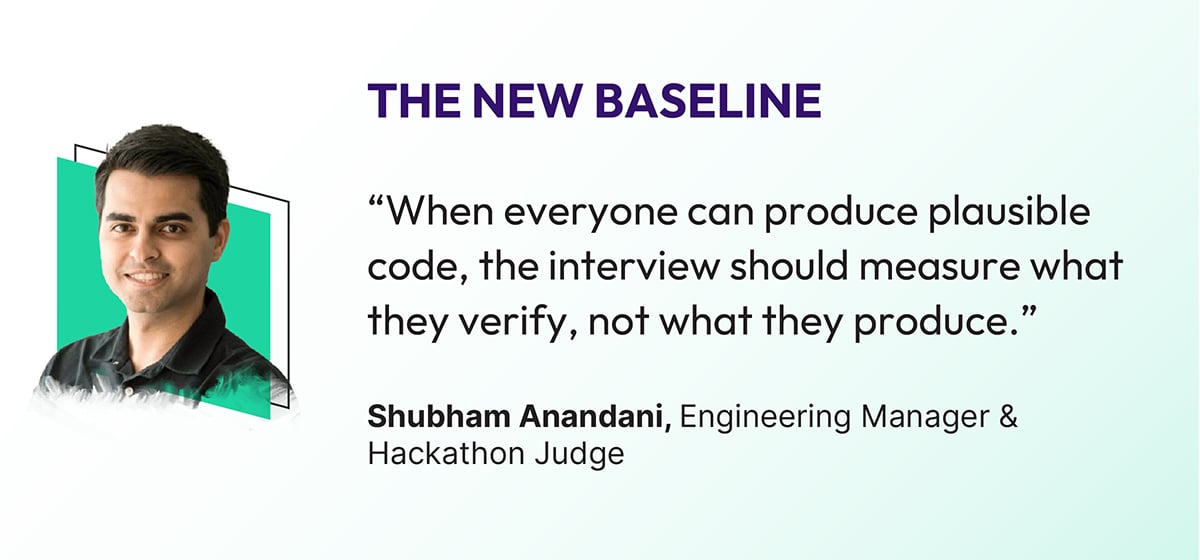
“When everyone can produce plausible code, the interview should measure what they verify, not what they produce,” says Shubham Anandani, an engineering manager who hires engineers and managers and has judged more than 10 hackathons connected to frontier labs. Anandani’s baseline rule for the modern technical round is simple: “Treat AI output as a hypothesis, not a result.”
Multi-File Architecture Replaces Toy Puzzles
Single-file algorithmic puzzles collapse instantly under frontier AI models. To produce meaningful signal, progressive tech leaders now mirror the environment developers actually work in: multi-file codebases, interconnected modules, third-party libraries, and imperfect documentation.
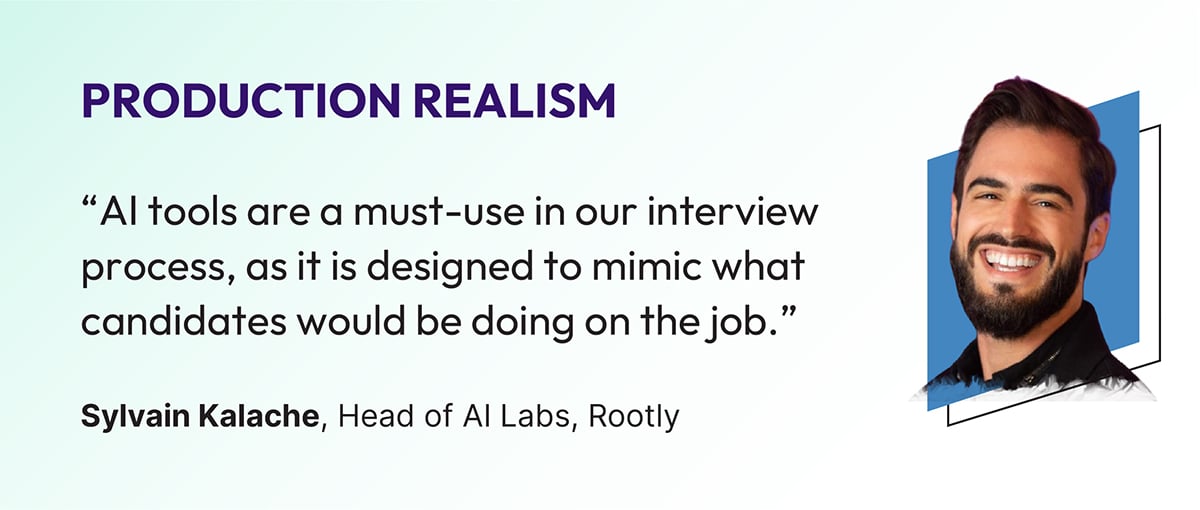
At Rootly, an incident response platform where engineers operate under live operational pressure, pretending developers don't use AI was never an option. “AI tools are a must-use in our interview process, as it is designed to mimic what candidates would be doing on the job,” says Sylvain Kalache, who heads Rootly AI Labs. The exercise shifts from testing textbook recall to observing how an engineer navigates system design and real-world system architecture.
The Live Interview Becomes a Collaborative Pairing Session
Banning modern tools creates an adversarial dynamic where interviewers act like suspicious proctors monitoring screens for contraband. It brings the same shadow AI friction companies already battle internally right into the hiring funnel.
Welcoming an AI interview tool turns the round into a collaborative conversation. Interviewers no longer spend 45 minutes watching someone struggle with language-specific syntax or missing semicolons. Instead, they observe how a candidate reasons through architectural trade-offs out loud, navigates ambiguity, and validates machine-generated proposals alongside a peer.
How to Conduct an AI-Assisted Coding Interview
Evaluating an engineer with an assistant requires shifting the rubric from "Did the code run?" to "How did they reach this solution?"
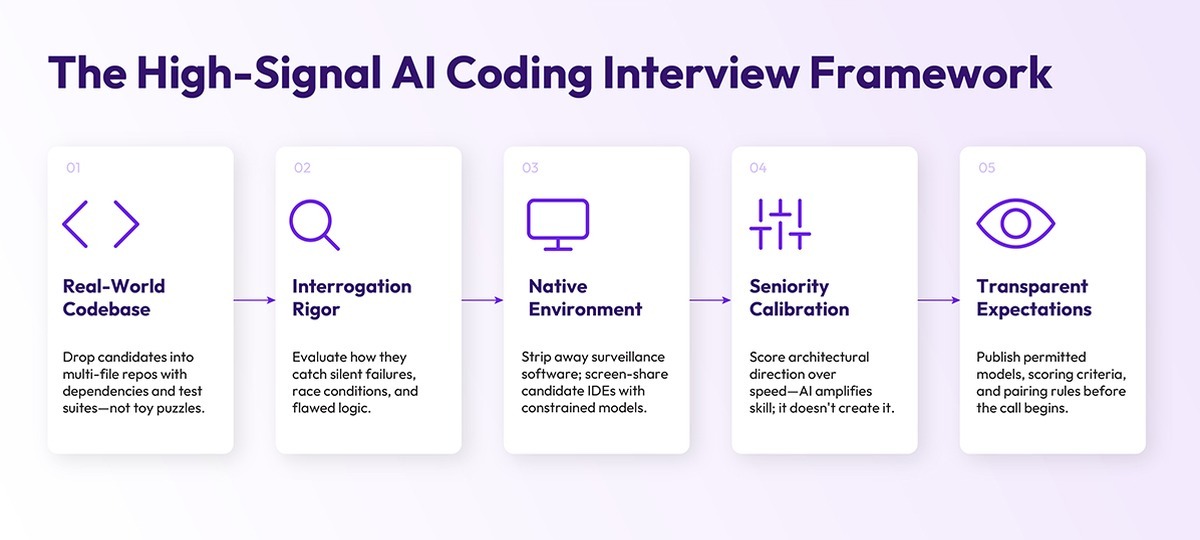
1. Anchor on Real-World Codebases
Don’t use isolated technical questions that a model can solve in a single prompt. Drop candidates into an authentic repository with existing architectural conventions, dependencies, and automated test suites.
Build the exercise around realistic engineering scenarios:
- Trace a multi-service bug: Have them locate and resolve an issue spanning multiple files.
- Implement a feature against existing APIs: Ask them to extend functionality while maintaining existing data contracts.
- Refactor for performance: Introduce a performance constraint and observe how they profile and optimize the code.
Roman Milyushkevich, CEO of HasData, tests this dynamic by having candidates work inside an unfamiliar codebase with an active bug, then adjusting requirements once they are already inside the logic. During one live evaluation, an internal assistant suggested a patch that cleared a visible error but introduced a subtle race condition.
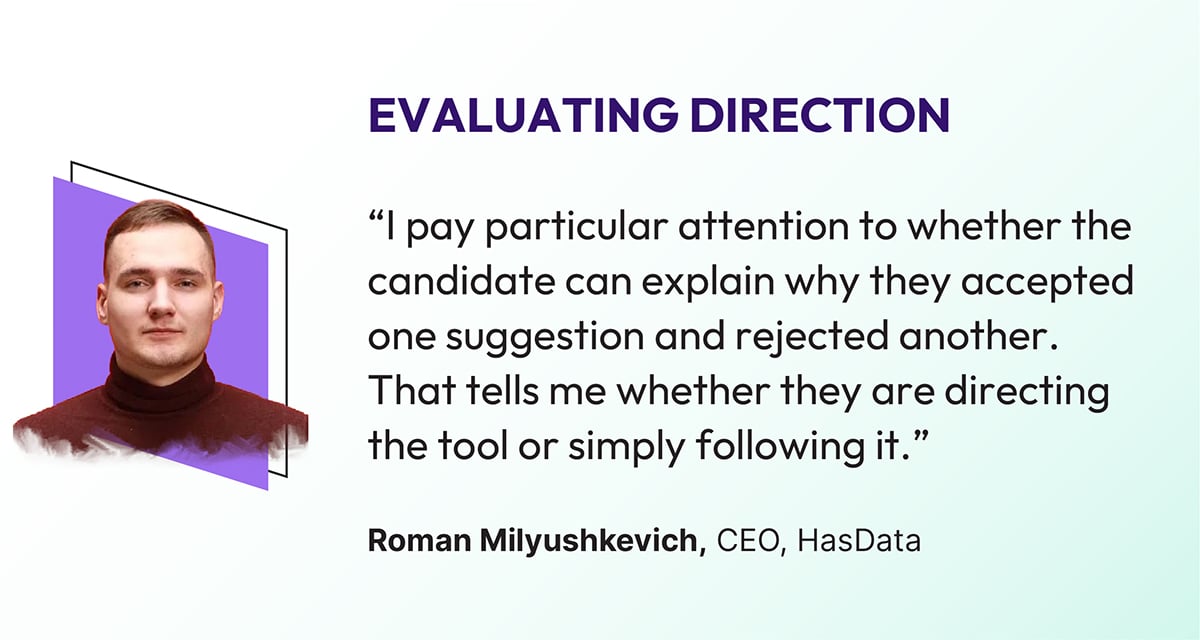
Rather than accepting the code because the error cleared, the candidate paused, asked what would happen when two requests executed simultaneously, and wrote a test for it before merging the change. “I pay particular attention to whether the candidate can explain why they accepted one suggestion and rejected another,” says Milyushkevich. “That tells me whether they are directing the tool or simply following it.”
2. Evaluate Code Review and Interrogation Rigor
The highest signal comes from observing how a candidate reacts when the AI makes a mistake or suggests a suboptimal pattern.
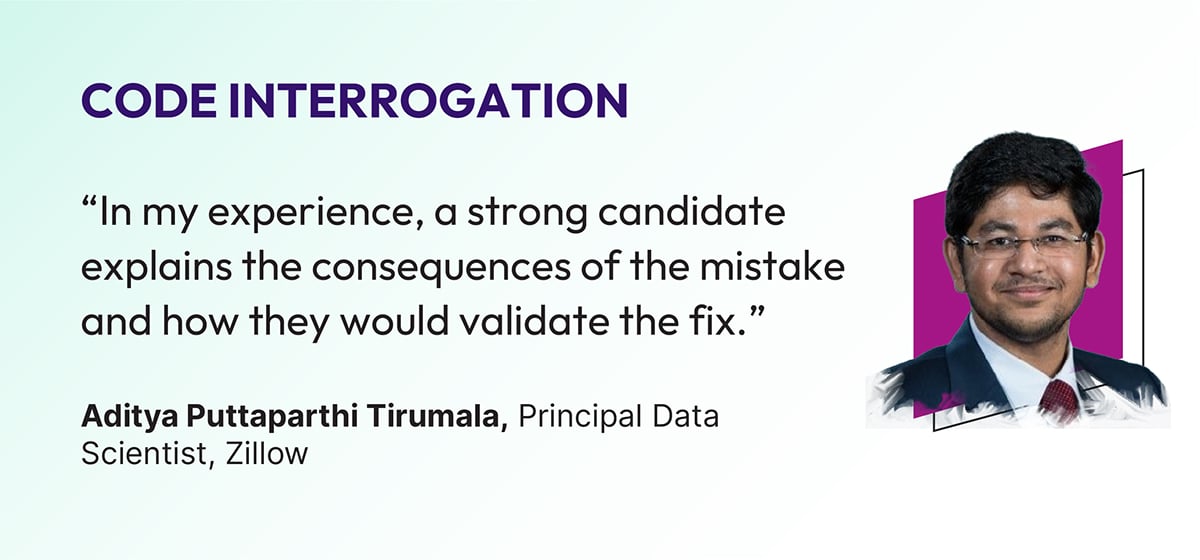
Aditya Puttaparthi Tirumala, a principal data scientist at Zillow who leads a team of eight, evaluates candidates on how they handle AI-generated SQL and Python containing realistic oversights, such as a join that duplicates records or logic that depends on missing business context.
“In my experience, a strong candidate explains the consequences of the mistake and how they would validate the fix,” Tirumala says.
3. Keep the Technical Environment Native and Uncluttered
You don't need invasive proctoring software to run a high-signal session. Many high-performing teams have candidates work directly in their native development setup over a shared screen.
James Lloyd, senior AI strategist at Tenex, has candidates work in their own editor with their screen shared throughout. “The one rule is that they set it to the weakest model it offers, with no auto-routing up to a bigger one. That way I see how they work when the tool isn’t doing all the thinking for them,” Lloyd explains. Constraining the model forces the candidate to supply the domain judgment and architecture that a larger model might otherwise gloss over.
4. Calibrate Expectations Across Seniority
The impact of AI isn't uniform across career stages, and high-performing engineering loops account for that reality.
Ranjith Raghunath, CEO of CX Data Labs, runs technical assessments to gauge how candidates operate both with and without AI. In his experience, the tool acts as a multiplier of whatever baseline understanding is already present. Senior engineers with strong mental models use assistants to execute complex architecture at speed. Less experienced engineers, by contrast, can easily be led down blind alleys by plausible-sounding suggestions.
Evaluating AI fluency means looking for the foundational domain expertise required to keep the assistant on course.
5. Establish Transparent Rules Upfront
Elite candidates hold back when policies are ambiguous. Transparent vetting starts before the interview begins; writing a clear AI developer job description grounds the evaluation criteria in day-to-day delivery rather than arbitrary tests. State clearly before the session that AI tools are permitted, specify the allowed models or extensions, and explain how the session will be scored.
Lloyd tells candidates upfront that their prompt framing and review choices carry just as much weight as the final commit. Removing ambiguity eliminates candidate hesitation, ensuring you see how they actually work under normal production conditions.
Scaling Beyond the Syntax Trap
The conversation around AI in technical hiring is moving past compliance. When any model can draft boilerplate code in seconds, typing speed ceases to be a competitive differentiator.
Teams that build their evaluation around real-world problem-solving won't just hire faster; they will assemble engineers who make modern tooling worth the investment.
Ready to build high-performing engineering squads that deliver production-ready software? Talk to X-Team.
SHARE:


