
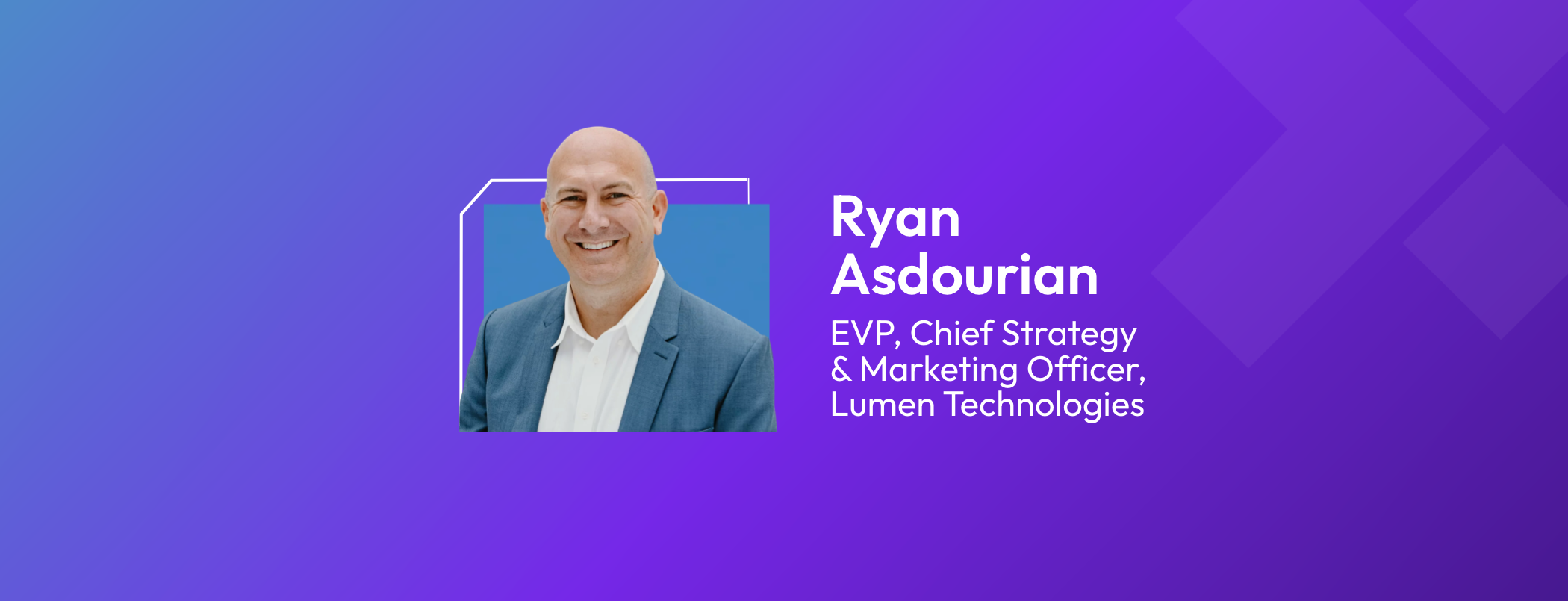
You can’t optimize a stadium full of fans the way you tune an algorithm. Ryan Asdourian learned that lesson inside a Seattle Seahawks mascot costume, getting a stadium full of people screaming and smiling while he built a career at Microsoft.
Now the chief strategy and marketing officer at Lumen, he brings that same energy to AI leadership: autonomous agents can speed up daily execution, but they can’t replace judgment, empathy or trust.
Ryan joins this episode of Keep Moving Forward to talk about how Lumen moves fast on AI and still keeps people in charge of the decisions that are hard to turn back from.
AI Agents Get Optimized; People Still Need Feedback
With an agent, you can be blunt. “You say, this was good. This was not so good. This is what I want.” Ryan knows that people require a different conversation. “There’s a lot more empathy. There’s a lot more soft skills that goes into that feedback process,” and the result is “much more powerful because we’re shaping with that human wisdom.”
The need for a distinction between how you give feedback to your top salesperson or your customer service agent is becoming increasingly important as agents take on more of our menial work. “We build cultures, we build teams, we build outcomes with people where agents can help drive that faster,” he says.
You can’t do any of that effectively if you’re still trying to prompt your human team members the same way as you do Claude.
Moving Fast on AI Without Breaking the Business
Lumen moves fast, driven by a senior leadership team that believes AI can fundamentally transform their business. Even so, Ryan sets clear boundaries to prevent losing control. Teams should move quickly, he says, just not so fast that they lose the human element or send a process “in a direction that is hard to reverse.” As he puts it, “How do we make sure we don’t go so fast that we break too many things?”
AI slop is one of the most egregious offenses you can commit in today’s world of democratized mediocrity. If you ask Gen Z, it’s what happens when you let boomers play with image generation software without any graphic design background (or taste). If you ask Ryan, it’s what you get when AI replaces human judgment at the wrong moment.
Lumen’s answer to the question of how to move quickly without slopping it up or mishandling customer data is AI governance that leaves ample room for experimentation. One golden rule that keeps confidential documents out of ungoverned systems.
Beyond that, people are expected and encouraged to try new things. Anyone who wants to adopt a new tool can bring it to an internal AI governance board, which reviews login security and data controls. If it needs to be regulated, only the most necessary restrictions are set to ensure client data is safe and “code red” remains only a fortunately-forgotten flavor of Mountain Dew.
For CTOs fighting shadow AI, this approach gives engineers a sanctioned path for the experimenting they’re already doing. And it affords managers a much lower likelihood that their engineers are secretly running Copilot on a separate laptop to speed up their commits.
Allowing people to make mistakes in a derisked environment is how Lumen keeps moving forward. Fast.
AI Leadership for Engineers Starts With How Customers Find the Product
Asked what engineering leaders should steal from his playbook, Ryan points to understanding both engineering processes and “the commercial motions, the business,” and how they fit together. “We can’t have products that are ‘build it and they will come,’” he says.
AI changed how products get built, and it also changed how buyers find them. “Just like our development processes have changed, customer ingestion has changed.” A buyer might first meet a product through a salesperson, a marketplace, a website or a generative AI system that pulls the information together. Buyers now absorb far more information before talking to sales.
The kind of context that helps companies show up well can only come from thoughtful, human-driven decisions. Engineers build it by staying close to a product and the people who buy it, and consequently that context also leaves whenever burned-out staff disengage or rotate off the team.
That’s why Ryan keeps a close eye on team fatigue. The morning he recorded this episode, he sat down with one of his teams to talk openly about burnout. The conversation kept coming back to “Who’s burned out? Who’s feeling overwhelmed?” An AI transformation like Lumen’s “requires rethinking everything you’re doing,” he says, and his job is to meet people somewhere between the anxiety and the excitement of it.
That’s the same job he had in the stadium in the bird suit. What keeps him moving forward, he says, is “people, and it’s the connection.” Lumen can run as many agents as it wants, but reading the room and getting people ready for change will be a human leader’s job long into the foreseeable future.
Transcript
Ryan Asdourian:
The technology, it's been such an incredible pace. I mean, it's changing every month, every week. Sometimes it feels like there are new features out, but some of the stuff doesn't change, like driving the business in a really important way. You have to make sure people can understand what stays the same.
Gemma Versace:
Hey everyone, and welcome to Keep Moving Forward, the podcast for tech professionals who are passionate about growth, leadership, and innovation. I am your host, Gemma Versace, Chief Client Officer at X-Team. Plenty of executives get their start as engineers. Far fewer can say they have also fired up a stadium full of NFL fans from inside a mascot costume.
Today's guest has done both. Ryan Asdourian is the EVP and Chief Strategy and Marketing Officer at Lumen. He started as an intern at Microsoft and grew up there as a test engineer before finding his passion on the business side in marketing and strategy. Along the way, he was a mascot at the University of Florida and then for the Seattle Seahawks, a story that has come full circle now that the Seahawks play at Lumen Field. He was even there for the Seahawks' first Super Bowl. As a Jets fan, I'm really trying hard not to be too jealous.
Ryan explains why he treats AI as a leadership question before a technology question, and why you can spend a lot of money on tokens just to move bad processes faster. He talks about why optimizing an agent and giving feedback to a person are two different jobs. We also get into AI slop and the pages-long answers nobody has time to read. Plus, how Lumen pairs conviction from the top with a governance board that keeps experimentation safe. And yes, we find out what a stadium full of screaming fans has in common with running a marketing team.
Let's get started.
Hi Ryan, and welcome to Keep Moving Forward.
Ryan Asdourian:
Hi. Thanks for having me, Gemma.
Gemma Versace:
Excellent. So, well, let's just start off with, tell us a little bit about yourself, Ryan.
Ryan Asdourian:
Sure. Well, thanks for having me. I work at Lumen. I am our Chief Strategy and Marketing Officer. I've been in a variety of careers from engineering to marketing to different business functions over the past 20, 25 years almost.
And excited to spend some time today just talking about some of the history, some of the things that we're thinking about, and what's current in the world today.
Gemma Versace:
That sounds like a plan, and let's jump straight into it. So you started as a test engineer at Microsoft and moonlighted as the Seahawks mascot, which we definitely need to learn a little bit more about. What from those years still shows up in how you lead today?
Ryan Asdourian:
Yeah, well, yeah, you found some of the, you know, some of the secret items on my resume and some of the not so secret ones. But I really started my career, I actually started as an intern at Microsoft and, so to speak, grew up there. But that engineering piece was core to who I was, you know, when I was growing up through my career.
I never lost that, but then I found myself really finding a passion on the business side. And I found myself moving into a marketing world, moving into strategy of how we think about the world and how businesses move forward. And the fun part on that, you know, it's hidden there on my LinkedIn, but I started a career on mascotting. I did that at the University of Florida, and then over into the Seahawks world, which has come full circle now as we have Lumen Field.
And really the thing that's special about that is the thing that's special about business. It's all about people. And whether you are getting a stadium excited and getting everyone screaming and smiling, or you are doing the same thing in the business world, it's really about the connection that you have with people, how you find joy in what you do. But it's really about that connection that you find. And I've had the opportunity to do that in a variety of ways, and it's shaped who I am as a leader.
Gemma Versace:
That's fantastic. And it would've been absolutely amazing had you still held the Seahawks mascot role last year when they had the big Super Bowl win. That would've been pretty spectacular.
But I love what you talked about there around, you know, really wanting to be able to harness what brings you joy as work. And I think that that's a dream for everybody, isn't it?
Ryan Asdourian:
Hey, don't worry. I was actually there for the first Super Bowl the Seahawks won.
Gemma Versace:
Ah, fantastic.
Ryan Asdourian:
Like, every one of 'em is special. But, you know, it's quite the moment to be part of a world championship team.
Gemma Versace:
Oh, I can imagine. And as a Jets fan, I'm only hoping that one day in the very near future it comes our way, because we are relatively new with our family, moved here about five years ago, and we lived in Jersey right near Florham Park, which is the Jets training facility. And our 8-year-old and 12-year-old boys, every Sunday when we're watching the Jets game, they just stare at my husband and say, "Why aren't we Giants fans?" So, love it. Yes, I can only imagine the thrill.
You've talked about the math problem that every CMO faces, things like, you know, more demand with the same headcount. What did that look like at Lumen?
Ryan Asdourian:
Well, you know, when you look at any sort of math problem that a CMO faces, it's always about what is the return on marketing investment? How do you think about that in the right ways? And there's one piece that says, how do we produce more assets more quickly? But it's not just about producing them quickly, it's about quality. So there's always this battle of quality and speed.
And then what you really want to get into is how do you ensure that our customers are getting a clear, concise message about what it is that we are bringing to the world, how we are going to help them, how are we gonna get to the actual customer outcomes that our customers care about the most?
So, it starts with math, but it really ends with kind of that core strategy and core content so that we make sure the technology that we're providing is ensuring that customers are getting what they want from a company like Lumen.
Gemma Versace:
You talked just then about the criticality of the different systems and platforms that you are providing to your teams to utilize. With AI being so prevalent across our daily lives now, with work and personal, plenty of teams, you know, are dropping AI on top of an old process. What did you do instead?
Ryan Asdourian:
Well, first of all, we're all learning as we go into how do you apply AI to your teams, to your company? And for me, it's really a leadership question before it's a technology question, because you can spend a lot of money on tokens and processes, and you can move bad processes faster.
But the point is, how does AI actually help us? How do our teams use the technology to move forward what we can serve for a customer? What is our strategy? How do we move in a creative direction faster? And how do you take repetitive pieces of the puzzle out so that it is AI powered, but really human led?
Human wisdom is the thing that is really magic across our team, and building the relationship between people and AI is the thing we're all trying to get right. As CMOs, as business leaders, we're all trying to understand how do we use this in the right way versus the wrong way. That's part of the magic that we're trying to figure out about our processes, and not just make old processes go faster.
Gemma Versace:
Yeah, really insightful answer there. And I think what is also we are seeing a lot is there's also that kind of leadership requirement as well, and management requirement, that people are now not only needing to invest in managing and leading humans and individuals as part of their team, but with so many different agents becoming kind of the daily norm now, how are people also starting to be able to ensure that they're spending the right time and effort in providing that right level of feedback to agents as well, to ensure that they're continuing to enhance and optimize?
Where's the line between, you know, what agents do and what your people own? How have you gone about kind of working out what that separation looks like?
Ryan Asdourian:
Yeah, well, you brought up an interesting point on feedback towards people and agents. And let me be super clear, the conversations that I have with employees and our team, that's a very different feedback mechanism. That's human, that's a connection.
I'd say when you optimize an agent, that can be very direct. You say, you know, this was good, this was not so good, this is what I want. And when you're working with people, there's a lot more empathy. There's a lot more soft skills that goes into that feedback process, and the output of that is much more powerful, because we're shaping with that human wisdom and we're understanding how do we actually work together.
I know that there are tools and systems that are making agents work together in a more collaborative way. It is really about how you think about humans and agents together. And so, the feedback, the line between what agents do and what people do, I think it's on all of us to understand that we build cultures, we build teams, we build outcomes with people where agents can help drive that faster.
There's more of a science to that, and I think more about the art of how do you build high-performing teams, and how do you really find the way that our people will thrive in this new world that we're all adjusting to.
Gemma Versace:
Absolutely. And I think we're all seeing too on a daily basis, just with the proliferation of AI coming through our businesses and just society in general, there's those early adopters that really take it up and they're using it for absolutely everything. There's the people that look to optimize and enhance. And then there's the kind of the stragglers that are still working out exactly how they can engage and get the best of themselves utilizing AI as well.
So it's really important that there are those, you know, varying support levers across the business, depending on who you're needing to support as well.
Ryan Asdourian:
And you actually see that in some of the companies telling the stories around, you know, "I have this many agents running." We actually are very proud of how many agents we have across Lumen. We've been very AI forward.
At the same time, we're being thoughtful on how do you mix and match all of those. How do you make sure you move quickly, but you don't move so quickly that you, A, lose the human element, B, lose control of what you are doing and what your narrative is, and, C, like, making sure the process doesn't go in a direction that is hard to reverse?
So these are big decisions that every company has to think about. You know, how do we be fast and agile? But how do we make sure we don't go so fast that we break too many things?
Gemma Versace:
Absolutely. And also not break the bank with the amount of tokens that people are using as well. It seems like that's becoming the next kind of big-ticket item to try and solve with some of the larger businesses out there as well.
You are known for explaining really complicated things in plain language. How do you do that when technology is changing at such a rapid rate?
Ryan Asdourian:
Yeah, well, look, the technology, it's been such an incredible pace. I mean, it's changing every month, every week. Sometimes it feels like there are new features out, but some of the stuff doesn't change, like driving the business in a really important way. You have to make sure people can understand what stays the same.
And one of the ways that you do that is you ask a couple simple questions, especially when you're looking at your customers that you are serving. Who are you talking to? What are they trying to accomplish? And how are they going to make some of these decisions in a partnership of using the technology we provide, the way that they think about their solutions?
If you put yourself in the seat of the customer, whether you use AI tools for everything you do or to assist in the tasks that you're driving, those questions stay the same. The customer has always been the center of what our businesses are driving towards. And I pull sometimes on, you know, I'd say both the engineering background and the business side of what I've been part of, to bring those together and say what's at the core for what we're delivering as a customer outcome.
Gemma Versace:
It's a really good way to look at it and then kind of build out from there as well, making sure that whatever is getting delivered is going to add that all-important value and create that stickiness with your clients and customers.
Where has an AI rollout gone wrong for you, and what did you do about it? Can you share an example?
Ryan Asdourian:
Well, where has AI rollout gone right and gone wrong, I think, is in the eye of the beholder. You know, one of the things that we believe at Lumen is that we should give people the tools to be successful. And so we've made sure that we give people the tools that can help them use AI in the right way. And part of that is understanding what are the guardrails around that.
We use a number of technology tools at Lumen, but one of the ones we use is Microsoft Copilot, and it gives us some of those guardrails built in as we build that out. One of the things we have to make sure, you mentioned, you know, how people are using tokens and understanding that. I would reframe when it's gone wrong to how do our employees use it in the right way?
One version of that is what I think many people are referring to as AI slop, where you have, you know, a question that's posed, and then suddenly the answer is, you know, pages long. And you're like, wait, wait, wait. Now I need more time just to read this. And then you have, you know, people taking those answers and putting them back into the AI system and back and forth, back and forth.
It's one of those places where you can feel it not going quite the way we intended for it, because it's not using what we talked about before, which is human wisdom. And making sure we inject that at every step of the process is, I think, one of those things that helps us make AI go right. But you can see it where AI could quickly go wrong, and we're guilty of that, just as I think many other companies are, of you try to use it for speed, but you find people are actually not injecting the human wisdom at all of the right places.
Gemma Versace:
Yeah. Agree. And it's kind of getting to the point sometimes where, you know, you do get that big 20-page document, and it's like, as you said, do you want me to respond appropriately, or would you let my AI respond to your AI?
Ryan Asdourian:
Can't all the agents talk to each other like that? That's not the answer for the business.
Gemma Versace:
Yeah, completely agree. Quick question for you, if you don't mind me asking. Obviously, there's different strategies around what tooling and what platforms and what AI strategy each business has. At Lumen, was it a case of mandating from the top down? Or did you give some kind of a bit of a license for your engineering team to bring in their own tooling and then be able to kind of make decisions based on what feedback you were getting from the engineering team? Or was it a case of being very meticulous at the beginning and systematically kind of mandating what AI tooling would be adopted across Lumen?
Ryan Asdourian:
Yeah, it's a great question, and I think it's one that every organization has to be thoughtful about an answer for their own situation. For us, this started as a core belief from the top, in our entire senior leadership team, that AI can fundamentally transform a business.
When we think about Lumen as an example of a company that has been a telco that is transforming into critical technology infrastructure, that's a big change. When you have a big change, for all the companies that have that out there, you also need to make sure you've got a change that can meet the moment. And so we felt, and we feel, that these AI tools can help us move in different ways, have more agility, have more context for how we serve our customers. And that's where technology infrastructure becomes this invisible layer that is so powerful when you think about enterprise networking needs. Their needs are changing. Our solutions that we're delivering are changing.
And so you've really had support from the top, and then you need the tools to go and meet the moment that I was describing for our company. In that, you have this special space where, like, one of the rules was don't put confidential documents in systems that are not governed. And, you know, we want all of the systems to be governed, but we know that people experiment, people learn, people explore. And so you have to have the right controls and AI governance there.
And then you'll have to also make sure people understand that we want to be forward-leaning. So there's been an AI governance board where, if you're looking at certain technology and you think that is something that we need, you bring that to the group and they can evaluate it. They can make sure you've got the right type of login. They can make sure you've got the right sort of data governance. So that is finding the magic of agility.
And we talked earlier about how fast this technology is changing. We wanna make sure people are empowered. But it starts with a belief at the top of our company that in order to make the change from a telco to a technology infrastructure company, we have to empower our people. We have to have the discipline, and we have to give people the tools to make that pivot.
Gemma Versace:
Yeah, I think that's a great answer, and also a bit of a kind of template for those people listening in how to do it right as well, with the right buy-in, but also making sure that you're tempering that and giving the opportunity for people to bring in new tooling, but also with that right governance and checkpoint, that all-important governance that is in place as well.
For engineering leaders listening, what's the one thing from your playbook that they should steal?
Ryan Asdourian:
Well, look, the one thing from my playbook that I think makes us powerful leaders is understanding both the engineering processes and the commercial motions, the business. How those things go together is how we make real progress, and making sure you've got the time to understand the flow.
We can't have products that are "build it and they will come." We have to have products that are rooted in customer truth, and we have to have products that can scale how they get delivered to our customers. So, you know, that's the thing for me.
When we move from the engineering processes of how software development happens, and we can iterate so much faster, we have to understand, where does a salesperson go and have a conversation with a customer? How does the customer receive that? Is it through a marketplace? Is it through a salesperson? Is it through a website? Is it through, you know, a gen AI system where they're going to get that information? How does that get ingested?
Suddenly, you have to think about new ways for everything that we create to show up in the ways customers will digest. And just like our development processes have changed, customer ingestion has changed, and that's where marketing optimization really changes. As we move through, getting that information to our customers and making sure that we're giving them everything that they need, because they're changing just as fast as we are.
Gemma Versace:
I think people listening will be busily writing a lot of what you've just said down, because I think there are a lot of businesses out there that come up with some amazing technology. But the one thing that is clearly evident, and very powerful, as you've said, that Lumen and yourself and your team are very committed to, is keeping the customer at core for absolutely every decision along the way. And I think that that's just phenomenal advice for everybody.
Last question. We ask every guest, what keeps you moving forward? What gets you out of bed in the morning, Ryan?
Ryan Asdourian:
Look, if I bring this back towards the very first question you asked me about, that other piece of my resume where I had the opportunity to go and inspire fans and stadiums at my college, with the Seahawks, it really brought me to the thing that keeps moving me forward. It's people, and it's the connection, and it's being able to inspire. I get energy from being in the room with the people that make it happen.
And just this morning, I'll share, you know, very personally, I sat with one of my teams, and we talked about burnout, and we talked about how hard it is. And we have the debate, kind of, of what we're talking about too, is how do we use AI to move faster and all that. But it came back to who's burned out, who's feeling overwhelmed? How do we make an impact?
And the question that I posed to the room was, how do we meet our people in a place that challenges being overwhelmed with the anxiety that they feel versus the excitement that they have for doing the things that we get to do? Being part of a transformation is incredibly hard. It requires rethinking everything you're doing. It requires fire drills. It requires real change inside an organization.
And so what keeps me moving forward is figuring out, yes, of course, like, how do we do that change? But the thing behind that is, how do we empower our people to be ready for that change? 'Cause that's where we will change our company. It's where we'll change what we do for our customers. It's where we change the world. That's what gets me out of bed every single morning and gets me excited about the position that I have.
Gemma Versace:
Oh, I love that. And your team is super lucky to be working with somebody like you that is able to bring that perspective together as well, and know what buttons to push to keep people motivated, or when to pull back on, when to, you know, kind of charge forward.
So that's, thank you so much, Ryan. And I definitely, as soon as I'm finishing this podcast, I will be trying to look at some video footage of you in the Seahawks mascot, because I'm very excited to be able to see that live. But yeah, thank you so much, Ryan. That was great.
Ryan Asdourian:
Thank you so much. I really appreciate you having me. And look, it's these conversations that help us all think about how do we move forward in an ever-changing world.
Gemma Versace:
Absolutely. Absolutely. Thank you so much.
If you think about it, a mascot and a CMO have the same job. You get people excited, and you build a real connection while you do it. Ryan has done both, and the lesson carries over.
His thinking on AI comes from the same place. AI can make a team faster, and it can make a bad process faster just as easily. Speed on its own says nothing about whether or not you are headed somewhere useful. Human wisdom makes that difference, and it has to show up at the right points along the way. Leave it out and you end up with agents writing 20 pages for other agents to summarize while nobody in the loop reads a word.
There's a distinction from this conversation I'll be borrowing. You optimize an agent, but you give feedback to a person. One can be blunt and direct, while the other takes empathy, and that's how teams get built. Leading the company through that kind of change is hard on people. The leaders who get through it will meet their people somewhere between the anxiety and the excitement, and they get them ready for what comes next.
Every tech leader rolling out AI right now could use a little more mascot energy. Join us next time for more conversations with technology leaders who inspire us to grow, lead, and innovate. You can find us on Apple Podcasts, Spotify, or YouTube. If you enjoyed this episode, please share it with your network.
Until next time.