Your AI implementation strategy is only as good as the talent you have to execute it.
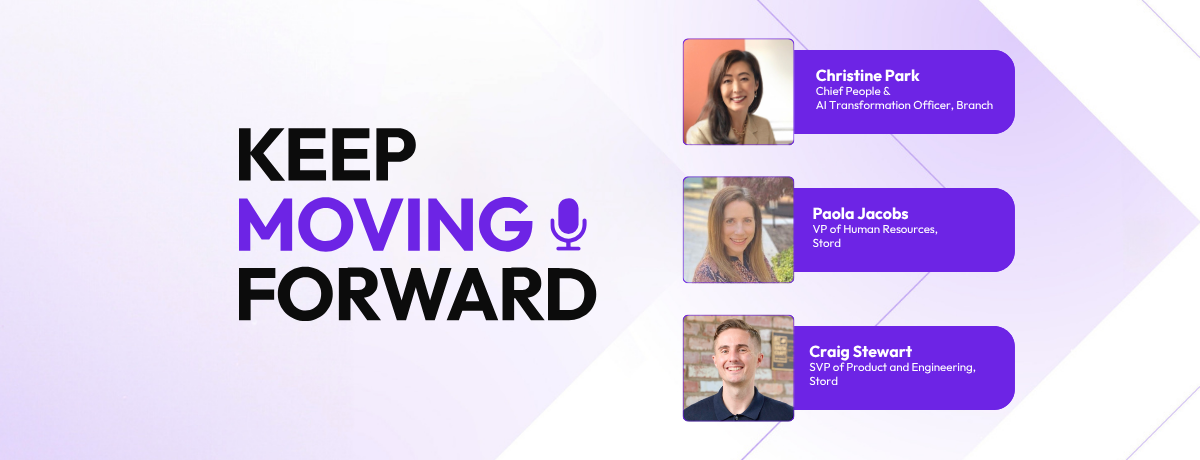
This episode of Keep Moving Forward is adapted from a live webinar hosted in partnership with SmartBrief featuring Craig Stewart, senior vice president of product and engineering at Stord, Paola Jacobs, vice president of human resources at Stord, and Christine Park, chief people and AI transformation officer at Branch.
We talk about why executives report far more confidence in their organization's AI talent than the people doing the day-to-day work actually feel, what AI talent really means once you get past the headlines about scarcity and costs, and how three different leaders are closing that fluency gap from their own perspectives. We also cover why organizations using embedded AI teams, rather than internal staff alone or short-term contractors, are seeing meaningfully stronger outcomes.
Your People (Probably) Aren't the Problem
Executives keep asking whether they have enough AI talent, but the confidence gap in our research tracks less with hiring budgets than with distance from the actual work. Strategy gets built with a clean plan at the top. Execution happens in the mess underneath it. "People who are planning strategy with AI are doing it with ambition," Christine said. "But the lower you go, where the work actually gets done, they're getting the work done through ambiguity. So of course that gap gets greater."
"AI talent" means something different depending on where you're standing in that mess. Executives tend to picture the small, expensive pool of engineers building frontier models at places like Anthropic or OpenAI. Almost nobody in a typical organization needs to be in that pool. What they need is a much larger group of people who can use these tools well inside their existing jobs. "AI talent more broadly is actually a skill and training issue," Craig said, which puts the gap on the training side of the org chart rather than the recruiting side.
HR often finds out about AI decisions after they're made elsewhere. "We're often downstream of the decisions, which means we're playing catch up instead of shaping the actual strategy," Paola said. That position in the process accounts for a lot of the gap on its own.
Developing AI Fluency Isn't a Training Event
These three leaders didn't run a program. Each built a system, and started using it before it was finished.
At Stord, that meant building AI fluency into the hiring bar itself. Candidates go through a pair coding interview, solving a real problem with whatever AI tool they're already comfortable with. It tests whether someone can think alongside the tool rather than just operate it. Craig carried the same standard inside the company through a dedicated AI enablement function. "You have to make AI tools successful to people," he said. "There can be a really high barrier to entry, but at the same time, you also have to build guardrails around them."
Paola's team rebuilt Stord's career ladder to include AI competency at every level, but the framework mattered less than what came before it, the fear people carried into using the tool at all. "A lot of people hear AI and their first instinct is worry," she said. Her fix was simpler than a rollout plan. "Just start," she said.
Christine's team at Branch sequenced the rollout on purpose, access before adoption, adoption before results. "We started with access… and then we do adoption and usage," she said. "We're looking at results last because there needs to be a level of psychological safety that we give people." Ask people to prove ROI before they've had room to get comfortable, and the numbers measure hesitation instead of capability.
Why Mixed Model Teams Outperform
The embedded-team advantage in our research has less to do with speed than with what doesn't have to be rebuilt every time a project starts.
Christine's team brought in an embedded partner instead of backfilling an open role, and worked alongside them rather than handing the project off. "They're really helping us not just accelerate things, but really teaching us," she said. "And it's not like we separate it, it's really together." Paola described the same mechanism from the other side. "Embedded teams work because they build that institutional knowledge and create those proof points, and it makes AI feel tangible," she said.
Speed without guardrails is borrowed time, and it comes due eventually, in a compliance failure or a tool nobody trusts anymore. "The two main things to remember with AI are safety and cost," Craig said. "Balance the excitement with those factors."
That balance is the actual strategy. An AI implementation strategy is only as strong as the people trusted to run it, and trust is built through access, training, and guardrails, not assumed from a dashboard.
Transcript
Paola Jacobs:
This data doesn't surprise me. Honestly, I think it's a reflection of how HR has historically been brought into technology conversations. We're often downstream of the decisions, which means we're playing catch up instead of shaping the actual strategy.
Gemma Versace:
Hey everyone, and welcome to Keep Moving Forward, the podcast from X-Team for tech professionals who are passionate about growth, leadership, and innovation. I'm your host, Gemma Versace, Chief Client Officer at X-Team.
This episode is adapted from a live webinar I joined alongside three other leaders, moderated by Mackenzie Putici of SmartBrief, and built around X-Team's own AI Talent Readiness report. We surveyed over 300 technology, HR, and business leaders and landed on a finding that changed how we read everything else in the study. AI readiness isn't primarily a talent scarcity problem. It's an organizational design problem, and the real gap sits between the people setting AI strategy and the people actually executing it.
Joining that conversation were Craig Stewart, SVP of Product and Engineering at Stord, Paola Jacobs, Vice President of Human Resources at Stord, and Christine Park, Chief People and AI Transformation Officer at Branch.
We talk about why executives report far more confidence in their organization's AI talent than the people doing the day-to-day work actually feel… what AI talent really means once you get past the headlines about scarcity and cost… and how three different leaders are closing that fluency gap from their own perspectives. We also get into why organizations using embedded AI teams, rather than internal staff alone or short-term contractors, are seeing meaningfully stronger outcomes.
Let's get started.
Essentially, we wanted to conduct a study that, because we were speaking to our clients, and we kept on hearing the same thing, that AI is their top priority.
The budget is there, the budget's been approved, the ambition, the motivation is there. But unfortunately the execution keeps stalling. And so the explanation as to why the execution kept stalling was due to talent scarcity when speaking with our clients. And that talent is incredibly hard to find.
AI talent in particular is too expensive, you know, they're hard to keep. And we wanted to test that assumption, because frankly we weren't sure that it was really the right diagnosis. And so in February this year, we fielded a survey across 325, 324, sorry, US based, technology, HR, and business leaders.
And we really wanted people with direct or adjacent involvement in the organization's AI work. We also wanted to really deliberately spread the sample across seniority levels and different functions. And so about a quarter were owners or executives. Roughly a quarter sat within senior management, and a quarter in middle management.
And just under 30% were individual contributors or practitioners that, you know, were responsible for delivering the day-to-day AI work. And so on the function side, we had IT and infrastructure, HR, engineering data and AI teams, really a cross section of people who set AI strategy as well as the people who actually are responsible for executing on it.
And you know, what we expected to find was definitely a gap between confidence and reality. But what we did not expect was the size of it. And you just touched on it as part of your leading Mackenzie that. You know, when we asked respondents how confident they were in their organization's ability to source AI capable talent executives came in at a really whopping 92%.
As you mentioned as well, the individual contributors and practitioners actually doing the work, they came in a lot less at 29%. So that is a really significant 63-point spread from executives to those actually completing the work. And an important point out also is that it is the single widest gap across the whole entire study that was conducted and the people setting the AI strategy and the people executing it.
Are really not looking at the same organization, is what we also found when looking into the data that was shared, that finding really reframed everything else that we looked at as well. Because if the gap were about talent scarcity, you know, you'd really expect to show up consistently regardless of level.
Whereas everyone, you know, would feel the same squeeze. We would definitely feel that, you know, whether or not your executives or you're the ones doing the work, that there should still be that same feeling of, and that same pressure and that same concern. But instead what we did find was that confidence rises really sharply the further you get away from the actual work.
And so executives see the strategy, and practitioners more. We're seeing the tooling gaps, you know, the training that never happened. The measurement that hadn't been particularly defined or, or no clarity given. And when leadership's view is one that shapes how readiness, you know, gets assessed, the operational picture disappears, unfortunately.
So at the first sign anything is wrong is usually a stalled project or a hire that didn't land. So for us, and kind of just to kind of wrap up the sentiment post reviewing the study for us, the central argument of this report is really that AI readiness is not necessarily a talent scarcity problem.
It is more of an organizational design problem.
Mackenzie Putici:
Perfect, Gemma, thanks for setting the stage. And I think that sums it up beautifully. So, and another thing we noticed that was quite interesting from reading the study is you found a sizable gap between HR and the other kind of set of IT and AI leaders.
So when it comes to confidence in their organizations ability to source AI capable talent, about 78% of data and AI team leaders reported confidence. Great. 65% of IT leaders, 60% of engineering leaders, but only 31%, amongst HR leaders. So the folks charged with workforce planning have the least amount of visibility into AI, sorry, into how AI capacity is built.
So, Paola, I wanna jump in with you as an HR professional. What do you think is going on here? Why is HR ranking so low?
Paola Jacobs:
Yeah, so this data doesn't surprise me. Honestly, I think it's a reflection of how HR has historically been brought into technology conversations. We're often downstream of the decisions, which means we're playing catch up instead of shaping the actual strategy.
At Steward, we made a deliberate choice to treat AI and HR the same way we're approaching it across the rest of the business, trust but verify. We're not ripping out our existing processes and replacing them with AI, we're using it as a multiplier in talent acquisition specifically. That's meant layering AI into sourcing and screening, places where it can compress the time it takes to get to a first interview without actually sacrificing the human judgment that matters most later in the process.
And we stay open to new tools as they emerge because this is not a set it and forget it initiative. It's definitely iterative.
Mackenzie Putici:
Perfect. Craig, what do you think when you hear all of this, what's your personal response?
Craig Stewart:
Yeah, I mean, it's not surprising, but honestly, I think it comes back to partly what Paola said, like looking at AI holistically and making sure that you include the people organization.
But honestly, the biggest thing here is that definition of what is AI talent. So, Gemma mentioned at the start, like, a lot of people think AI talent is hard to find and it's very expensive. I think there's a differentiation because there's two groups of AI talent. There's AI talent, like engineers that, you know, work at Anthropic or OpenAI that are building.
Unbelievable tools that are driving a huge change in the world. And that whole industry in itself is extremely competitive, extremely high paid, and, you know, challenging to really poach talent from. But then there's this fundamental question of like, more broadly what is AI talent? And AI talent more broadly is actually a skill and training issue.
So rather than looking at it as, you know, we need people that are on the bleeding edge, which in some cases you do, you really need to think about how do you screen for and also train for people that know how to leverage AI. And I think, you know, in a lot of cases, you'll probably have executives going to their HR team saying, we need people with AI talent, but they're not being specific.
What does that mean? What tools do they need to have experience with? And also how do they know to use these tools? 'Cause a lot of AI tooling kind of abstracts away decision making. So actually a really important part of trying to determine if you have the right AI talent is understanding how do they leverage the tools not to abstract their job away, but to actually compound or multiply their impact on the business by taking away the simple tasks.
So it's not surprising, I think it's difficult to get past, unless you have these proper conversations between the business and HR and have a very clear definition of what AI is, what you're wanting to do with it, and what talent you need to make that happen.
Mackenzie Putici:
That's a good point, Craig. And I feel like often in the past we've had certifications or things for a lot of technology where, okay, I can prove, I can code, I can prove I can do this.
I've gone through this program. AI is so new, we don't necessarily have that in terms of competency around. I'm using this answer engine or this, you know, agentic AI tool. So it'll be interesting to see how that rolls out. And Christine, I'd love to also get your perspective here on this.
Christine Park:
Yes, Craig, I can't agree.
I'm violently agree. I think we need to start with the definition of AI talent, right? And I'm a CPO, Chief People Officer, but I also oversee our company's AI transformation. And AI is so new, there are no talent. It's about really developing that capability and fluency within the organization. So I really believe, you know, AI, when you look at it as a tool, AI is a tool and it raises the floor.
But true transformation, change management, upskilling. And increasing the capability and the way we redo our work raises the ceiling of the company. Right. And I think looking at AI as just a tool alone, I think that's where we kind of get into it. And Craig actually, you know, yes, there's AI people who are building like Anthropic and you know, different things.
That's not what we're talking about. We're talking about people who actually have AI tool experience building things. How do they make AI, how do they leverage the tools to make their workflow more efficient? Whether it's creating velocity or productivity. And I think that is not even a matter of getting certificate through Anthropic.
I know this tool, I think it's, if you only look at that. It's a very small pool of AI. I mean, it's almost ridiculous to say we need people with AI experience. It's so new. We're like experiencing this together right now. So I think organizations, and I'm not surprised about HR being this low because I think leaders come to HR and say, we need AI talent.
Right? And what does that mean? Like, what does it really mean? So, and I love the study that you guys done because. With the higher level, you go with the data and it's the level of fluency. And people who are planning plans with ambition, who set strategy with AI is doing it with ambition. So of course they're very high, but the lower, the more you go down, where the work gets done is they're getting the work done through ambiguity.
So of course that gap gets greater. And I think that's the problem that a lot of companies face of having this ambitious strategy. And the plane never takes off, right? Because the work gets done at the work level, and there's a lot of ambiguity about this.
Craig Stewart:
Yeah, perfect.
I would also say Mackenzie, you know, I was just looking again at this chart and what dawned on me is essentially matches an adoption curve if you think about early adopters versus laggards.
So data and AI teams have been around actually for much longer than, you know, ChatGPT for example. Data teams have been using, honestly, heuristic algorithms, machine learning for a very long time. And that essentially has been now re-categorized as AI, although most people think of AI as like.
Generative large language models. So it's not surprising that they have really high confidence 'cause they've already defined what AI is to them. Then if you think about it, they've been using AI for threat detection, penetration, checks and things like that for quite a long time as well. Finally down to engineering where engineering, they've been working with, you know, AI assistance for coding for some time.
But fuller agent development is actually more of a new development. And then finally you come down to HR and HR are responsible not just for hiring these technical functions, but also knowledge workers as well. And this is kind of the last layer of the business that's been penetrated by AI. Which is why you can see this descending level of confidence as you go through each of the departments.
So it makes perfect sense.
Paola Jacobs:
Yeah. And one thing to add to that, Craig, is that. Just like engineers, and data scientists, it's native to them to be in that space. I think when you think about HR beyond hiring, you know, we're the ones that are leading the charge on compliance and risk assessment and handling everything to be compliant with the law.
And so I do think that there is a little bit of that fear of adoption because we maybe worry about what does AI do to that? Is AI going to help us be compliant? And I know we're gonna talk about this a little bit later, but, I think that that is absolutely why you see this gap here as well, because traditionally, new technology is something that is embraced inherently by the engineering team and the data scientists because they've been used to that, you know, forever.
Mackenzie Putici:
Perfect. Thank you. Gemma, anything to add? I know we had you at the onset, but I wanna make sure we don't leave you out of this one.
Gemma Versace:
Yeah, no, I think from my perspective, what we see is, we see it obviously from X-Team being a staff org partner to our clients. We see this, this is like everybody I think has said already, this isn't necessarily a big surprise for us.
Because I think one of the other, just the points that we have seen as well is the confidence sitting with, you know, data and AI as well as IT, and engineering being higher is because they are just fundamentally more. In the know as to what the tooling is because there's a general interest and there is already a, an awareness and familiarity with it as well.
So when you come to HR, it's not, I think you touched on this Paola, it's not something that you guys are sitting in every single day. So I think that's also what drives the level of confidence as you go into different functions that are using AI more, that are around AI talent more, and that aware and are aware of being able to identify what good looks like in this space.
I think that's what also drives the increasing confidence, across the engineering IT and also data and AI functions within a business as well.
Christine Park:
I mean, Gemma, I'll give you an example. I got access to Claude Code and Craig don't like judge me, but they, I have to go into the terminal to do these coding.
And I said, what is this? I mean, visually, I'm not used to working in a terminal, right? And my brain just really popped. And, but when you look at it, Paola, like, when do HR go into terminal and look at it? It is so foreign. But when you look at an engineer and they go into the terminal and they're using this Claude Code, it's, there's a familiarity.
And it was, I mean, I'm just, it's a funny things and I went, what? Like I had the hard time getting used to the terminal initially. So I think that a lot of those things, there's just more familiarity with the data. And when you look at AI and you're leveraging what.
Business we're gonna solve, right. But the data becomes critical. So I think there's a natural kind of, I'm, this is, I think, a natural split. I think we're gonna be closing that in. HR eventually will play a very huge role because like I said, it's not just about the tool, but it's how we, the future work and how we take the workforce through this transformation.
Paola Jacobs:
And how exciting that the HR team can now learn to code using AI.
Christine Park:
Right. Well, I aged a little bit, but I got it. I got a little there,
Paola Jacobs:
Quote right in quotes code. I know. It's not a simple,
Mackenzie Putici:
Just vibe coding over there.
Christine Park:
Got it. I've never seen a terminal. Okay.
Mackenzie Putici:
No, I actually echo that sentiment. I feel like once I see that sort of black screen with all the — wouldn't blame
Christine Park:
Uh-huh.
Mackenzie Putici:
Yeah. My brain's like, I don't like that so much. I don't
Christine Park:
Like it.
Mackenzie Putici:
So speaking of sort of the shift, the training where this is going, another big finding was around this, around skills. So leaders name skills as a top barrier, but they're not necessarily addressing it or don't know how.
So 51% of leaders who identify skills gaps as their top constraint seem to have no structured training program in place to address it. They all say they're going to use in-house teams, but they're not investing in them. So I wanna open this up to the panel. When it comes to upskilling and re-skilling, how are you all approaching this?
Craig Stewart:
Yeah,
Mackenzie Putici:
Maybe Craig can kick it off with you.
Craig Stewart:
Yeah, I'll take this. I think it goes back to kind of what we mentioned earlier about thinking about what AI talent is and you know, I think, even just what Christine and Paola just talked about, about the accessibility of AI is really important.
So, the way we are approaching it at Stord, for example, kinda twofold. So if you think about bringing new talent in now, we've incorporated AI tests into our recruitment process, especially for product and engineering. And like I said earlier, a really important part of that test is making sure that someone is leveraging AI to amplify themselves not to just abstract away their job.
So for example, if you're applying to be a product manager at Stord, the process you're going to go through is obviously some traditional interviews, but then you're actually going to go through, one for lack of a better description, is like a pair coding interview where we're going to give you a very practical, real.
Stord example, problem to solve. And we're going to ask you to walk through that problem using the AI tools that you're comfortable with. So we don't mandate a specific tool, we just say, hey, use AI. And our ask is for them to use it to work through the problem so that we can see how they think, how they apply their product brain to the problem.
Then ultimately also whether they trust what the AI tool is saying or whether they use it to challenge assumptions, which is very good at, and then actually we translate that into, hey, okay, now you've done that. Let's produce a quick wireframe mock, and see what you think of that mock. Does it meet your expectations?
Would you be comfortable handing that to a team? And the really cool thing about that is it does three things. One, it checks their current literacy level because we're not mandating tools, they have to bring their own tools. Two, it actually exposes their skills, their tradecraft, through the process because it's almost accelerating what they, we would normally do.
So you can see the results in a faster time. And three, it gets them into this mindset of, okay. Can I produce something with AI that I could then hand off to the team to work with, which shows that they can move faster. So we do that for the recruitment side. And then for the internal side, we looked at it as a continuous education program.
So we actually have a product manager who's dedicated to internal AI enablement and the clear mandate that that team has. Actually they have a few mandates, but the main one that I would call out when it comes to training, is exactly what Christine mentioned about Claude Code and the terminal.
You have to make AI tools successful to people. They can't be, there can be like a really high barrier to entry, but at the same time, you also have to build guardrails around them. 'Cause you can't have people, you know, vibe coding and potentially exposing company data, or, you know, doing a write activity, on a database and wiping out a ton of information.
So. It's really important that you invest in the training, but also the guardrails and think about how am I going to make this accessible? Especially because AI as an industry, AI is tool, AI platforms, like Claude, for example, are evolving so quickly that unless you're staying up to date, and unless you're reading it, unless you're playing with it every day, you could look away for a couple of weeks and come back and be like, oh, wow, I actually have lost traction on what I'm capable of doing.
And you really need to just keep that going. You know, you need to keep the messaging going. You need to have a continuous program going, otherwise, your whole business won't keep up. Obviously though, there are people that get really excited about AI and are always keeping up by themselves.
But the reality is the vast majority of people probably are doing that. So you need to keep that drumbeat going yourself as a leader within your business.
Christine Park:
I can share. What we're doing is we have a team of one, the transformation AI trust team of, I have one strategic PMO. So it's not a big function.
We're facilitating it, not owning it. So we do the transformation office and we do it with, and the executive is me and the CEO and our CTO that actually governs it. So we do a very global governance. So we kind of, she's the one that, we have a global governance with local execution. We believe in democratizing the actual usage and hands-on because the more you democratize that, I think the faster the learning curve will happen because it's not a classroom training.
You actually have to do it. And so we have a global team. And again, it's a one executive PMO in my transformation. It sounds big, but it's nothing. And we do global, we put the guardrails and she creates the framework. So we, our decision is everyone has equal access. So we started with access, right?
And so we gave everybody Claude desktop, right? And then we do look at tiers, and of course, engineers, Craig, we don't, we give them Claude Code and things like that. So we start with access. So we have this governance tool where it's access, and then we do adoption and usage. And we're looking at results last because there needs to be a level of psychological safety that we give people.
That they could have access and learning. So we created a five level of AI fluency model and we created an enablement tool that self-serve, they could test. It's kind of funny because we did it kind of comically so that they could get the fear, the anxiety, and the psycho like out and psychologically safe, and they test their fluency and depending on their fluency, we provided training.
We provided a different type of training so people could do that on their own so they don't feel vulnerable. Because right now I do believe there's a lot of vulnerability sense of that. So everybody's talking. That's why when you look at executive, they're like, oh yeah, we're AI native. No you are not.
You know, like they're, there's this over kind of emphasis on this. So we created that training, because we can't, to Paola, you, what you said was you can't hire AI talent all the time. This is brand new. So it's about how do we raise the floor, how do we create capabilities so we do the fluency.
So we are doing our enablement. In basically on the fluency. And then we created a format where each of the function, we embed AI champions enablement in each function. Does that make sense? Mm-hmm. So rather than a centralized function, so we work, we create the fluency training and stuff like that, but we democratize it and we meet on a regular base with all of our AI champions, and they do that.
So we do access, we do adoption, and then we have each of the AI champions in their focus groups create one use case. We just ask, we do microdosing, you guys, it's like, give us one use case. Build it. And we are in the HR department because HRs are a little bit, you know, they're not used to it, to your point, you know, and we do, every Friday we do hackathon.
They build one process, one thing, on hackathon, and we just do that and that's where we get the hands-on practice. So we have a model that we created that we're executing against.
Mackenzie Putici:
Excellent. Paola, I'd be curious to know sort of how you're approaching this skills challenge as well.
Paola Jacobs:
Yeah, so a lot of what Craig and Christine have already said is what we're doing at Stord, a lot of the same things, Christine, that you're talking about.
And I think that AI fluency is so important that keeps coming up. So we've really tried to just bake it into how we develop people in general. One thing that we did is we redesigned our career leveling framework to now include an AI competency layer at every level. So there's different expectations around AI fluency depending on where you are in your role and level in your career.
Not just the job function. So it's not, AI is just for the tech team. It's AI is for everyone. It is embedded in how you perform at Stord. And we definitely expect everybody to use the AI tools that we've invested in, right? So we've given them full access to tools and explained how you use it, how maybe you should not use it.
And I think the biggest unlock, honestly, is going back to addressing the fear. A lot of people hear AI and their first indent is worry. On one hand it's. I don't know how to use AI. And on the other hand, it's, if I use AI, is my job gonna be vulnerable? Am I not gonna be able to hire more people under me because I'm now admitting that I'm using AI and look at all the great things I'm doing?
So for us, we're really just trying to remove that fear on the how do I use it? I like to tell people, just start, if you don't know how to use AI, ask AI. How should I use you? Like literally, you can just ask Claude, what is the best way for me to get started using Claude? And it'll tell you. And that's what I think is great for AI is that you know, anybody, it's approachable to anybody if you just start.
So that's what I tell my team is just start. And just having that culture shift I think is really important. Letting people try it out. You know, there's no such thing as failing in Claude. You go in there and you can ask things and. Maybe you don't like what it's gonna respond with, and then you just ask it a different way.
And I think it's just a really easy thing to try once you try. So we have a monthly people team meeting, and I've started having an AI time at the end of the meeting, where it's just a few minutes where people can come and give examples of how they've used AI in the last month.
Just really helping others see, oh, I could probably do that in my role, because this is how this person is leveraging it. And so that's been really good. I think it's important that everybody in the organization, no matter where they are, they see everyone else using it from the leaders all the way down.
And celebrating those examples of how they're doing it, I think is important.
Mackenzie Putici:
Excellent. Paola, I think that's really wise in terms of, like you said, kind of showing, sharing, reducing the... Craig, I think you're gonna add something there.
Craig Stewart:
Yeah, I would say so. What Christine outlined is really similar to what Paola and I are doing at Stord, which is awesome.
And I think it's exactly the right approach. Like you, if you are starting this journey fresh, you can't start by going to a full mandate. You do have to start with availability and kind of bring people along with you. The analogy here is, you know, you have to think of this as a change management challenge, 'cause it as a fundamental change.
So, you know, one of the key elements of change management is making sure that you have stakeholder buy-in. And then that brings you to that fundamental question. 'Cause both Christine, Paola mentioned about like, that fear and people wanting to adopt the tool. This is kind of like the old school digital transformation when all the businesses moved from paper to digital processes.
Which, believe it or not, I did actually experience part of that because I've been working for quite a long time in that transformation. You know, everyone back then was very nervous. 'Cause it's like, well if my job is, you know, filing and I'm filing all day long, what's gonna happen to me when there aren't any files anymore?
Mackenzie Putici:
Um,
Craig Stewart:
It's the same thought process which people justifiably think about for AI. They think, well, if my job is working this Excel spread. What happens if that's not a thing anymore because AI does it for me, and a large part of the AI transformation, the skills gap, getting people to adopt AI and go on that adoption curve is actually making it really clear to them like, hey, this isn't about removing you as a person.
It's about, again, to that point I made earlier, trying to unlock your specific skills and have you focus on higher value work. So you know, rather than you spending three hours producing a spreadsheet and then one hour analyzing it, what if the spreadsheet could be produced in five minutes and then you would actually have.
Two to three hours to spend really deeply analyzing that spreadsheet and identifying, hey, this is what's impacting the P&L. This is an opportunity for the company to be more efficient and coming up with more intelligent insights that actually drives the business forward and also is more fun for you in your role.
And that, ironically, can apply to engineers as well. You know, engineers are often seen as like early adopters of these things, but the reality is some engineers also think that the AI could, you know, come for their jobs. So I think that message is really important that we all continue to say that.
Of course there'll be efficiency gains, but those efficiency gains can just flatten the kind of curve on high growth businesses. They can help businesses be more efficient with their people, have their people do more interesting work and drive more value. Not necessarily like, hey, I'm going to, you know, replace a whole department with AI.
Mackenzie Putici:
Excellent.
Christine Park:
You know.
I think with people's nervousness about this AI, and AI means different things to different people. Actually, I've noticed that some people think AI is just Claude. Well, there's more to AI than Claude. There's a difference between going into your Claude desktop and asking questions and being a thought partner and writing emails versus actually creating deterministic.
Agents to do your workflow, and then also probabilistic agents that could contextually do your workflow with context. There's different kind of things. And what we're doing on top of this AI skill, and I don't know if this is relevant to you guys, is I believe we are doing a lot of business understanding courses, like what are we trying to solve as a business?
What are we doing? How do we make money? Because when people don't understand and they're just doing spreadsheets and they don't have the data. And technology flow, like how does the data flow and what's the data governance? And then they don't have the business knowledge, the tool itself becomes very nascent.
You can only do it at a certain level. So along with the AI fluency, we are adding a lot of the business. So for our people team, Paola, we do a lot of business training and data and technology, and our data team comes and trains them on the data flow to that because that actually will create amplification once they get more learning.
So we are adding the business fluency, understanding, like what are we solving as a business in a broader sense, and then the data and technology stack and the data flow. So we are adding those two.
Mackenzie Putici:
Perfect. I want to pivot to one final topic here before we get into some audience Q&A. So Gemma, let's shine some light here on AI capacity models, and we've got this graphic up on the screen.
Can you break this down a little bit for us? What does the data say about their impact on value capture, outcomes tracking, as well as governance?
Gemma Versace:
Yeah, absolutely. And look, just from the outset, you know, this particular finding was a surprise to us. So when we first looked at how organizations are adding AI capacity, AI engineering capacity, we were a little disappointed.
You know, not many of them were using embedded longer term augmentation partners. And, you know, we're rather relying on internal teams or bringing in short term contractors to deliver on specific pieces of work. And so our first read was maybe that the market potentially hadn't caught up yet. But when we looked closer at the outcomes, the picture completely flipped for us.
And so the organizations that are using embedded teams are dramatically outperforming everyone else, nearly, you know, across every dimension of AI talent readiness. And I wanted to share some numbers from the report, which you've got up on the screen there, because they are really quite striking.
You know, organizations with embedded partner teams are achieving 85% strong value capture. They've got higher outcome tracking, higher structured training, and 47% embedded governance in workflows. And if you compare that to internal only teams, that is sitting at much lower rates, you know, on the same measures.
So that's not a small edge. It's a really structural advantage, really. And, you know, the deeper insight that we landed on is that this isn't primarily about faster delivery or short term velocity per se. It's about continuity and institutional knowledge that really compounds over time.
And so when the same senior engineers stay embedded with teams for months, or, you know, in some cases even years, where they truly become part of the code base, they've become part of the team culture, you know, the day-to-day decision making that's influencing the AI roadmap and strategy.
They're not just shipping projects and rotating out, you know, they're transferring really deep contextual knowledge. They help raise the bar on practical AI usage across the business that they're working with, and they really help embed. You know, they're really helping to embed governance directly into workflows and build measurement practices that are really sticking across, you know, the AI initiatives that the businesses are wanting to deliver on.
And so you've got, you know, short term contractors that can come in, or purely internal teams, and, you know, they can find themselves sometimes restarting the learning curve for every new project when they are bringing in a different set of people or new people coming in that potentially there's turnover.
So embedded talent really turns individual excellence into helping strong and lasting, you know, organizational capability really. And this is exactly why these organizations that are using embedded teams are ending up more mature overall and getting to that maturity level quicker. And they're not just executing on that AI work.
They're really systematically, in all honesty, helping to build the muscle that's helping to keep improving and scaling it, you know, the AI strategy and roadmap really long after the single initiative or whatever they've been brought in to deliver ends. But I'd be also keen to be able to get the thoughts obviously of the panel, who have a variety of different models and engagements in play, just to see kind of what they have found to be the right model to be able to really get that key stickiness, but also that ensuring that there's that institutional knowledge that is allowed to continue over time because of the consistency and continuity that you get through really long, longstanding and embedded teams.
Christine Park:
I use a hybrid model, Gemma. I agree with this because for our HR finance, we put it as a G&A team versus just HR. But we did bring in an embedded team, rather than, and it's about we decided not to when, rehire existing position. And with that, we funded an embedded team. And they're the one that's actually, they're somewhat engineer.
Not like an HR or finance, 'cause we do have a lot of very talented HR and finance people, but we have an embedded team that came in and they're working with us in creating the AI fluency. They're doing the workflow for us and they're kind of leading us. They're doing the work, like we're kind of watching, and eventually we'll be able to do that.
But the hybrid work really worked for us because we create the context, our organization culture, what drivers, and they really help us build this across all of our systems, you know, from kind of a TS to payroll to NetSuite, you know, just tying. And then they're doing a lot of the workflow and helping us develop like triggers and agents.
And so we're kind of there. We're at the, Craig, pro deterministic agents. Okay, very narrow. We, like HR people, hate taking, and finance people hate taking risks. So it's very narrow, deterministic workflows. But we are really enjoying, we brought this partner in. They're augmenting our workforce, and they're really helping us not just accelerate things, but really teaching us.
And it's not like we separate it, it's really together. So I actually agree with that.
Mackenzie Putici:
Paola, let's pull you in on this.
Paola Jacobs:
Yeah, so we also have an embedded team. And I think what Gemma was describing and what Christine is saying as well, it tracks completely with what we've seen.
So we actually have two different capabilities when you think about AI. It's internal. So how do we enable and empower our teams to use AI to make their work better, to make their work more efficient, to help with everything? Like what Craig was describing earlier, assessing data, but then also helping you create a framework to analyze it.
But then there's also of course all of the external facing AI, which at Stord is a huge part of our business. So of course, we're constantly trying to iterate on our product features to make things better, more visible for clients, and AI is a huge part of that. So that's been a huge focus for 2026.
But so I do think that what's been working for us is having that embedded team and what I mentioned earlier about creating the culture around it. So we've been very intentional from signaling from the very top that we believe in AI tools. We're providing those tools to everybody. We're providing the training, and we have things like, for example, a dedicated Slack channel, where anybody can go in and there's a workflow built in so that you can show either something that you've done or a question that you wanna ask.
We have a weekly AI newsletter. It usually has maybe a Loom video of somebody explaining what they did, which I think is really helpful because again, removing the fear of like, you can actually copy exactly what somebody's showing you and do the same thing yourself. And we also have in team meetings, we have people show examples of what they've done.
I think when someone sees a peer solving a real problem with, like, an AI agent for example, that's really motivating. More so than even just a formal training. So yeah, I think embedded teams work because they build that institutional knowledge and create those proof points and it makes AI feel tangible.
So yeah. Makes sense.
Mackenzie Putici:
I just wanna open it up to have sort of one final thought, key takeaway. Any closing comments from each of you? So, Paola, I'm gonna pass it to you first.
Paola Jacobs:
So I would say, just everything that I've been saying is that, don't wait for a perfect strategy to start.
You know, AI is an iterative tool. And we should leverage that, right? So just start, just start. Encourage people to start using it. Have them celebrate the wins. Let people be champions even if they're not the official champion. Just kind of start where you are and let the sky be the limit.
Mackenzie Putici:
Beautiful. Craig?
Craig Stewart:
Yeah, I think, on top of that, I would say you should also have some mechanism in mind for how you govern that. I agree with Paola, like you need to inspire people and say how you guys live it, but also from like a business standpoint, it's easy to get caught up in the excitement.
But remember the two kind of main considerations with AI, which is safety. So how do you protect your company data, and also, frankly, cost as well. How do you make sure that you're getting a good return on your investment. But absolutely agree with the change management approach and everything we've talked about.
But I just think you have to balance the excitement with those factors as well.
Christine Park:
I violently agree with you, Craig, and it's a balance, right? It's not, yes, or one or the other. I think it's a balance. You know, for me, I think, Paola, like Craig, you guys all talked about it. AI is a tool. So my recommendation is, but to me it's a little bit more than a tool.
I think it's gonna really dictate how we work. It's gonna transform like how humans work. And so I think what's important is a lot of people are using the AI to amplify what they're currently doing. My takeaway is this, try to reimagine that experience. Like for example, if we're onboarding a customer experience, the end result of what you want the customer to experience or employee to experience, and use AI as a tool.
To help you get there versus using AI to do faster and more of what we're currently doing. So I really encourage people, because it's very easy to get to, like, using AI, like just doing emails for you and the same, but maybe reimagine and kind of go with the end result you want and then go backward of how AI.
As a tool could help you get there versus, because I do, Paola, I think when you say sky's the limit, it's not going hog wild, but it allows us to reimagine things that we couldn't imagine that actually enhances the experience. And I am passionate about customer and employee experience because they are symbiotic, and that's where there's no business without customers and there's no customers without employees that acquire and serve them.
So I would encourage everyone to kind of use this opportunity. I know there's a lot of anxiety, but maybe reimagining a better experience for humans, both customer and employee. We're talking about business here and using AI to get to that versus the opposite.
Paola Jacobs:
Yeah, I like that. The amplify and reimagine, I think, is so, it's really a great way to look at it.
Mackenzie Putici:
And I think it ties the sort of technical side with the human side beautifully. So. All right, Gemma, I'm gonna pass it over to you to bring us home, so to speak,
Gemma Versace:
To bring us home. Yes. And just to, I guess, link it back really directly to the report is just, you know, if I can just share any 2 cents to finish today is, you know, organizational design and alignment is just so incredibly important when developing an AI readiness strategy.
And also too, just to double click on what Paola said as well, you just, you know, just start bouncing the ball and bringing in the right people into the tent with the right motivation, with the right interest, with the right guardrails and governance.
And, you know, again, to quote you, Paola, you know, the sky's really the limit for businesses who can get that really great design, organizational design and alignment, synergy as well.
Organizational design and alignment kept coming up no matter which angle we approached this from. The people setting AI strategy and the people executing it are often working from two different pictures of the same organization, and closing that gap takes intention, not just better tooling.
What stood out to me was watching these leaders build genuinely different answers to the same problem. Craig tests for how someone approaches an AI tool rather than whether they've already mastered a specific one. Christine built a five-level fluency model before asking anyone to prove results. Paola rebuilt her team's entire career ladder around AI competency, then made a point of telling people to just start rather than wait for the framework to feel finished. Each approach reflects a different read on where the friction actually lives, and all of them are working.
Pay attention to Paola's closing thought: don't wait for a perfect strategy before you start. Christine took that a step further. Use AI to reimagine what the end result could look like, not just to speed up what you're already doing. And Craig's addition: stay excited about what's possible, but don't lose sight of data safety and cost along the way.
Join us next time for more conversations with technology leaders who inspire us to grow, lead, and innovate. You can find us on Apple Podcasts, Spotify, or YouTube. If you enjoyed this episode, please share it with your network.
We'll see you next time.
SHARE: